
The Indian stock market is expected to witness considerable trading activity on August 31, 2026, when global institutional funds tracking MSCI indices will perform their portfolio rebalancing. This may lead to a significant passive buying and selling of stocks, especially when index weights change and funds will choose to change their investment into a new stock.
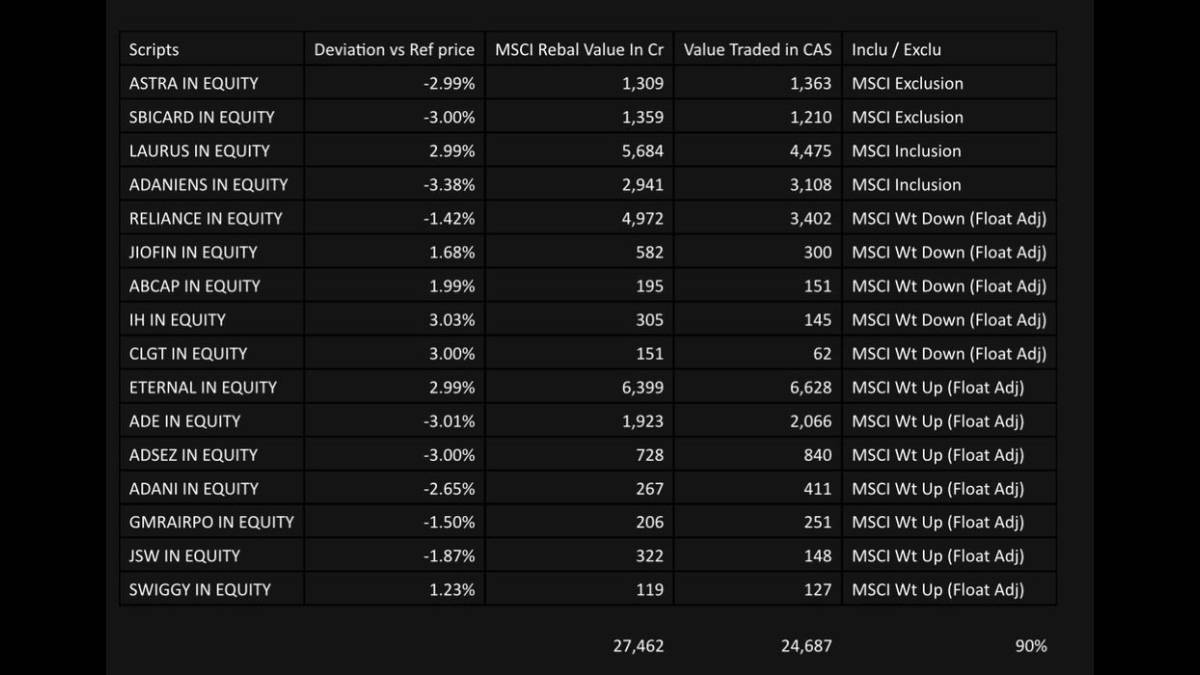
Based on the estimates being circulated ahead of the session, several Indian companies are expected to see large passive inflows and a smaller group of stocks may be targeted. These estimates are not guarantees of transactions and they give an indication of where institutional activity could be concentrated during the trading session.
Eternal shares are among the stocks most likely to attract the widest estimated inflow, with passive buying estimates of $674 million. After that comes Laurus Labs with an estimated inflow of $598 million on the list.
Lenskart is another stock expected to have a lot of institutional demand, with passive inflows of about $352 million. Adani Energy Solutions could get around $310 million and Groww has an estimated inflow of about $256 million.

These figures demonstrate the potential scale of institutional activity associated with the MSCI adjustment. And if their estimates are indeed true, the stocks could see a big increase in trading volume as funds tracking the relevant indices adjust their portfolios.
On the other side of the rebalancing, several companies will be subject to passive selling pressure. Reliance Industries has the biggest estimated outflow among the stocks listed, at around $523 million.
Reliance is followed by Balkrishna Industries, which has an estimated outflow of around $169 million. SBI Cards could see estimated selling at approximately $143 million and Astral at approximately $138 million.
We should distinguish between estimated passive flows and fundamental investment views. MSCI rebalancing transactions are mainly driven by changes in index composition, weightings, investability factors or other index-related adjustments. It is therefore not necessarily true that a stock with an estimated outflow is fundamentally weak, just as an estimated inflow does not necessarily reflect that the company's business outlook has improved.
The immediate effect on the market can still be significant because passive funds generally need to align their portfolios with the revised index structure. This can lead to intense buying or selling activity, particularly when large institutional positions have to be adjusted.
The trading volumes could then increase dramatically in the affected counters on the execution date. The effect may be most evident at the market close as passive funds will also act on their portfolios to match the new index weights.
For active investors, such sessions can present both opportunities and risks. Higher liquidity would enable large trades to be made, but high levels of trading volume can lead to extreme short-term volatility. Stocks with large estimated outflows might feel a bit of selling pressure in the short term, while stocks with big inflows may have more demand.
But investors should be wary of taking these moves as long-term trends. Once the index-related trades are completed, stock prices will again be driven by the fundamentals, profit forecasts, sector conditions, valuations, and general market sentiment.
The estimated flows also need to be treated as projections rather than confirmed amounts. Actual transactions can differ due to market prices, fund tracking strategies, execution methods, and other factors. The actual buying and selling observed during the session may therefore be higher or lower than the estimates.
For August 31, the key stocks on the inflow side are Eternal, Laurus Labs, Lenskart, Adani Energy Solutions, and Groww. Reliance Industries, Balkrishna Industries, SBI Cards, and Astral are among the names that could attract significant passive selling.
As the rebalancing proceeds, market participants will be watching trading volumes and closing-price movements closely as the rebalancing takes place. Any large volume jumps in the market volume and closing price movements in these counters could partly reflect index-related transactions rather than a sudden change in investor sentiment towards the businesses.
The session will also allow us to compare the estimated flows with actual market activity. Such a comparison can help investors appreciate how closely passive flow estimates correspond to the actual transactions that are ultimately done by institutional funds.
So, the MSCI rebalancing on August 31, 2026, could be especially important for several Indian stocks. And with potentially hundreds of millions of dollars in estimated passive flows, investors should expect more activity and potentially more volatility in the affected counters, especially around the closing period.
The rebalancing is mostly a mechanical portfolio-adjustment event and not a signal to buy or sell a specific stock. Investors should therefore take into account the estimated flows and company fundamentals as well as market conditions to judge the potential impact.






Comments
Please to leave a comment on this article.