
Some foreign investors are now cautious on the Indian stock market, with India as the least-wanted Asian stock market, according to a Bloomberg report cited in recent market commentary. Investors are also concerned about the price of Indian stocks and the relatively expensive valuation, limited exposure to the artificial intelligence investment boom in the sector and the pace of economic and corporate earnings growth.
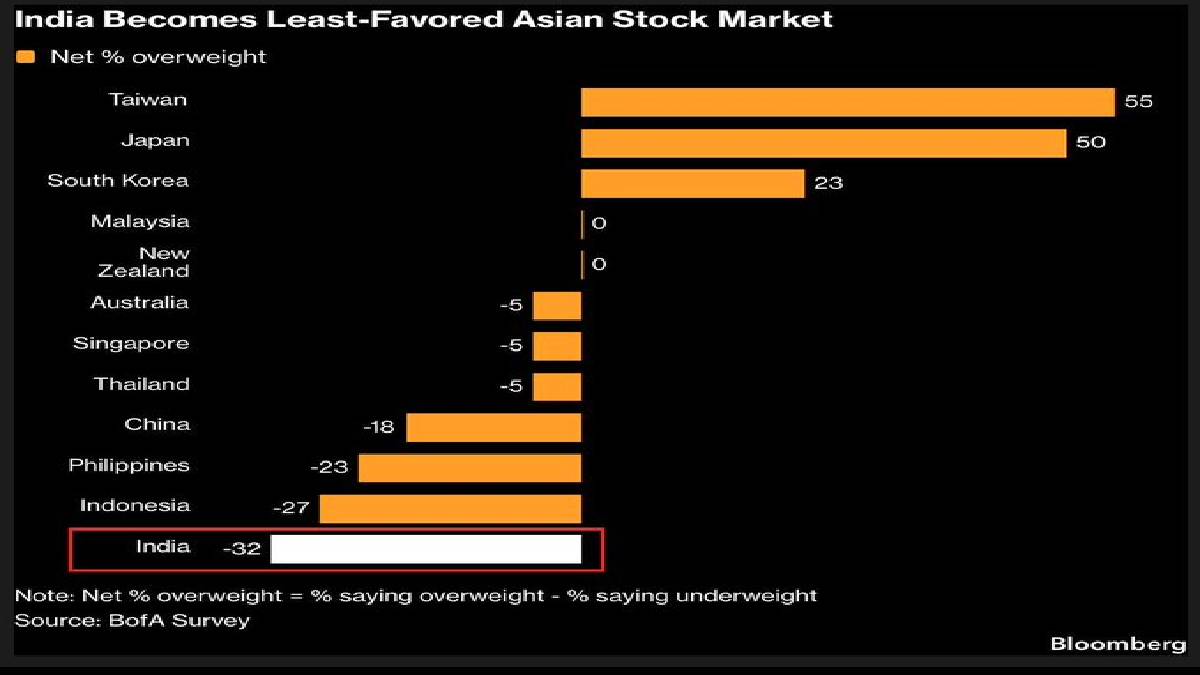
The sentiment shift is a contrast with the strong foreign investment that India had attracted during the past few years. According to the figures cited in the report, foreign inflows to Indian equities fell by more than 99% in 2024 from around ₹1.71 lakh crore ($20.6 billion) to just ₹427 crore ($50 million).
The trend turned out to be even worse. By 2025, foreign investors withdrew a record $18.9 billion from Indian stocks, the worst year for foreign equity withdrawals from India.
The latest figures illustrate how swiftly international investor sentiment on Indian shares has changed. For years, India was one of Asia’s most attractive long-term growth markets, and many were banking on sustained acceleration in the economy, increasing domestic consumption, infrastructure spending and growing formalisation of the economy.

However, the investment landscape has become more complicated.
One of the major concerns in the present market debate is valuation. Indian stocks are trading at relatively high multiples compared to other major emerging markets. When valuations become expensive, investors demand a higher earnings growth rate to justify prices.
If earnings were not in line with expectations, high valuations can become a vulnerability and international investors will opt to invest in stocks trading at lower valuations.
China has emerged as one of the leading alternatives. Chinese technology companies as well as other sectors have drawn renewed investor interest after years of pressure as valuations have seemed more attractive and the country has stepped up investment in artificial intelligence, advanced manufacturing and technology.
The global AI investment boom is another factor influencing capital allocation. Investors have poured enormous amounts of money into companies involved in artificial intelligence, semiconductor manufacturing, data centres and related infrastructure.
India has a growing technology sector but its stock market composition is different from that of the US and some other markets with large publicly traded AI and semiconductor companies. This means international investors looking for direct exposure to the AI investment cycle may find fewer large Indian-listed opportunities compared with markets such as the United States.
The issue is not that India does not have AI ambitions. The country is investing heavily in digital infrastructure, AI research, semiconductor manufacturing and technology startups. But to translate those investments to big listed company earnings and market opportunities will take time.
Growth concerns have also weighed on the cautious mood. Investors are very cognizant of corporate earnings, consumption, industrial activity, inflation, interest rates and government spending to where they can concentrate their money.
The reported foreign selling is in the face of India's vast economic potential. India is still one of the world’s fastest-growing major economies and its ever-expanding consumer market is attracted by multinational companies. Indian institutional investors and retail investors are also becoming crucial actors in the Indian stock market.
When foreign investors sell, this growing domestic investor base can provide some support. But if foreign outflows continue, the market liquidity, currency movements and overall investor sentiment can still be impacted.
The selloff apparently accelerated after the US-Iran conflict, as foreign outflows in 2026 were up markedly from the previous year. Geopolitical tension can affect global risk appetite, oil prices and emerging-market currencies and put pressure on markets that rely heavily on imported energy.
Higher oil prices can be particularly significant for India, as it imports a large percentage of its crude oil requirements. Higher energy costs can affect inflation, corporate margins, the current-account balance and the value of the rupee.
The combination of expensive valuations, geopolitical uncertainty, earnings uncertainty and the global movement to AI-related investments has made Indian equities very challenging.
But describing foreign investors as having completely “abandoned” India would be an oversimplification. Foreign institutional investors still hold substantial investments in Indian companies, and India remains an important destination for long-term global capital. The numbers reported here only illustrate the direction and scale of the recent foreign portfolio flows, not a declaration that international investors have entirely left the country.
Moreover, market preferences can change rapidly. A correction in Indian valuations, stronger earnings growth, stronger global conditions or opportunities in AI and technology could attract foreign capital back into Indian equities.
India’s structural advantages also remain significant. A big domestic consumer base, expanding digital economy, infrastructure development, manufacturing initiatives and a young workforce still underpin the country’s long-term growth story.
The latest foreign-flow data is also of great importance to investors as it signifies a sea change in the Asian market. China, Japan, South Korea, Taiwan and other markets are all competing for global capital and investors are becoming more selective about valuation and exposure to big-picture growth themes (AI, advanced technology).
The Indian market’s recent experience shows that strong economic growth alone does not guarantee uninterrupted foreign investment. Valuations, earnings, sector composition, global liquidity and geopolitical risks all play a role in determining where international capital flows.
As foreign investors are still worried about their exposure to Indian stocks, market participants will be watching corporate earnings, economic indicators, oil prices and global interest-rate expectations closely. If any of these factors change, the foreign investor exodus could continue to go on (or even reverse).
For now, the message from global markets is clear: India’s long-term growth story still has value for the long-term but international investors are demanding more attractive valuations and stronger catalysts before coming to return in force.






Comments
Please to leave a comment on this article.