
Uber is still noted for its huge scale of its global consumer platform, with nearly 208 million monthly active users (MAUs) on average—two times as many people on average as Lyft and DoorDash, and more than twice as many as Lyft and DoorDash combined with about 101 million monthly active users (MAUs) on average. Uber’s huge reach through mobility, delivery and other services are also highlighted, and its position as one of the largest consumer platforms in the gig economy, as well as being one of the largest consumer platforms in the gig economy.
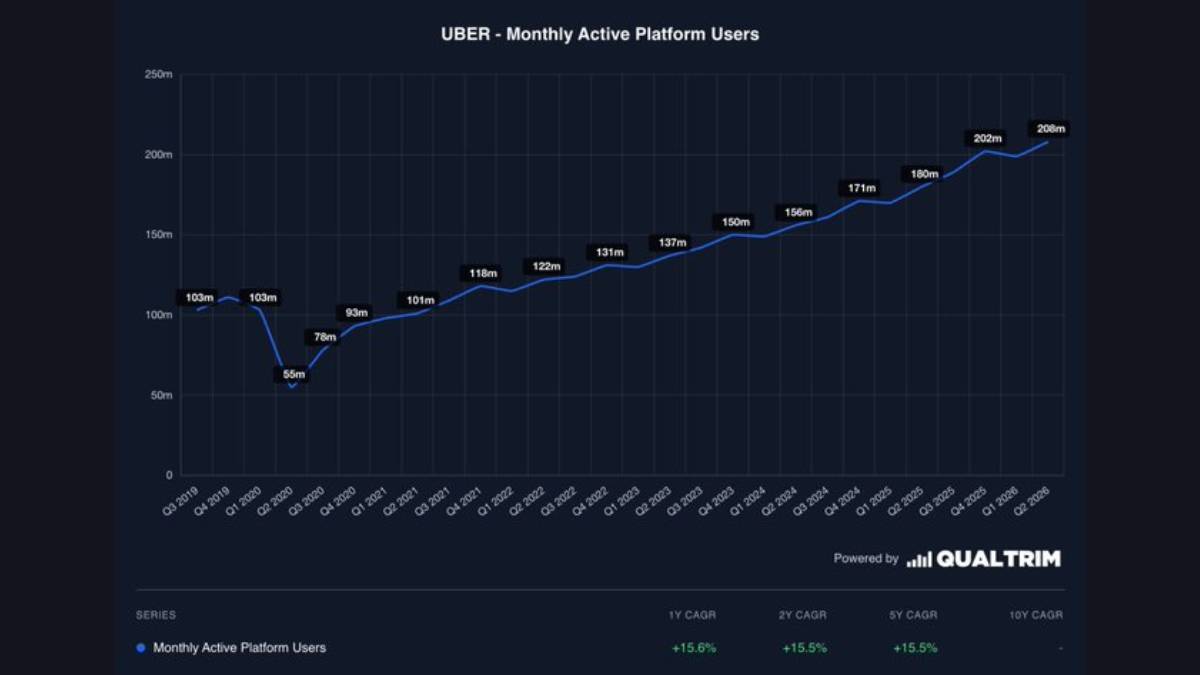
These numbers put Uber’s user base in perspective with the huge number of US competitors. Uber is estimated to have about 208 million monthly active users and Lyft and DoorDash together account for about 101 million MAUs. On that basis, Uber’s monthly active-user footprint is almost twice as much as the combined number of the other two platforms.
This scale is especially significant since the companies work in overlapping but different sectors of the consumer economy. Lyft is mainly focused on ride-hailing and DoorDash on restaurant/local commerce delivery. Uber, on the other hand, has built a more general ecosystem of ride-hailing, food delivery, grocery and retail delivery, freight and other services.
The fact that Uber can connect multiple use cases to one platform is an enormous benefit to customer engagement. A consumer can use Uber to request a ride, order food from Uber Eats or place any other local delivery. Uber can therefore generate more activity on the basis of the same customer relationship.
The MAU comparison is more than a simple number of app downloads or registered accounts. Monthly active users indicate how many people use a platform in a month, and this metric is useful to determine consumer reach and platform adoption.
Uber’s estimated 208 million MAUs show the company’s ability to retain engagement with a very large global customer base. The gap is more noticeable in comparison with Lyft and DoorDash, whose combined estimated 101 million MAUs are less than half the scale of Uber’s.
For investors who are interested in $UBER, $LYFT and $DASH, the comparison is useful to see where competitors are in the space. A larger active user base has advantages in terms of brand recognition and network effects, customer acquisition and cross-selling. But MAUs are not the only factor that determines profit or shareholder returns.
Uber’s platform strategy has been to build that scale for connecting different businesses. Mobility is still the core of the company, while Uber Eats has evolved from restaurant delivery to groceries, convenience and retail. And it has also spent money on ads and other business opportunities that can be made money from its huge consumer base to make money from that customer base.
DoorDash is also expanding into restaurant delivery as well as grocery and local-commerce. Lyft, however, is still very much in the transportation market and is trying to get better at ride-hailing.
The difference in business models is important for the user numbers. Uber's broader ecosystem means MAU has engagement across multiple services whereas competitors have more concentrated user activity.
Network effects are another advantage of scale. More customers will mean more drivers, couriers and merchants and supply will be more available and convenient for customers. If this dynamic is managed well, a platform will remain competitive.
But Uber’s huge user base might also provide it with much richer data and advertising opportunities. With consumers coming to the platform, the company has to gauge what they will buy and sell. Advertising is an increasingly important aspect of the business’s monetisation strategy.
At the same time, investors need not take the MAU comparison as evidence that Uber is the strongest investment among the three companies. Valuation, revenue growth, operating margins, free cash flow, regulatory risk and competitive intensity all matter in stock trading.
But this comparison does show the size of Uber’s consumer ecosystem. With around 208 million monthly active users versus about 101 million combined for Lyft and DoorDash, Uber has built a user base that is much larger than those two competitors on this metric.
They are also telling the story of how and why mobility and delivery industries have transcended one-purpose apps to more mature digital ecosystems. Organizations are increasingly competing not only for individual transactions but for the habit of consumer engagement.
For Uber, a big user base and growing the frequency and value of each customer’s activity could be one of its long term growth strategies. For Lyft and DoorDash, the challenge is to grow engagement and build up their ecosystems and compete with a platform with a much larger reported user base.
The takeaway is straightforward: Uber's estimated 208 million MAUs are more than double the roughly 101 million combined MAUs attributed to Lyft and DoorDash, highlighting the extraordinary scale of the Uber platform.





Comments
Please to leave a comment on this article.