
The Trade Desk (NASDAQ: TTD) is one of the worst performers among S&P 500 firms in 2026, with shares of the advertising-technology company down 62% year-to-date through September 4, it’s one of the biggest losers. A low point is the result of the company’s shrinking revenue growth, weaker-than-expected guidance, competitive pressure and an enormous restructuring of its workforce.
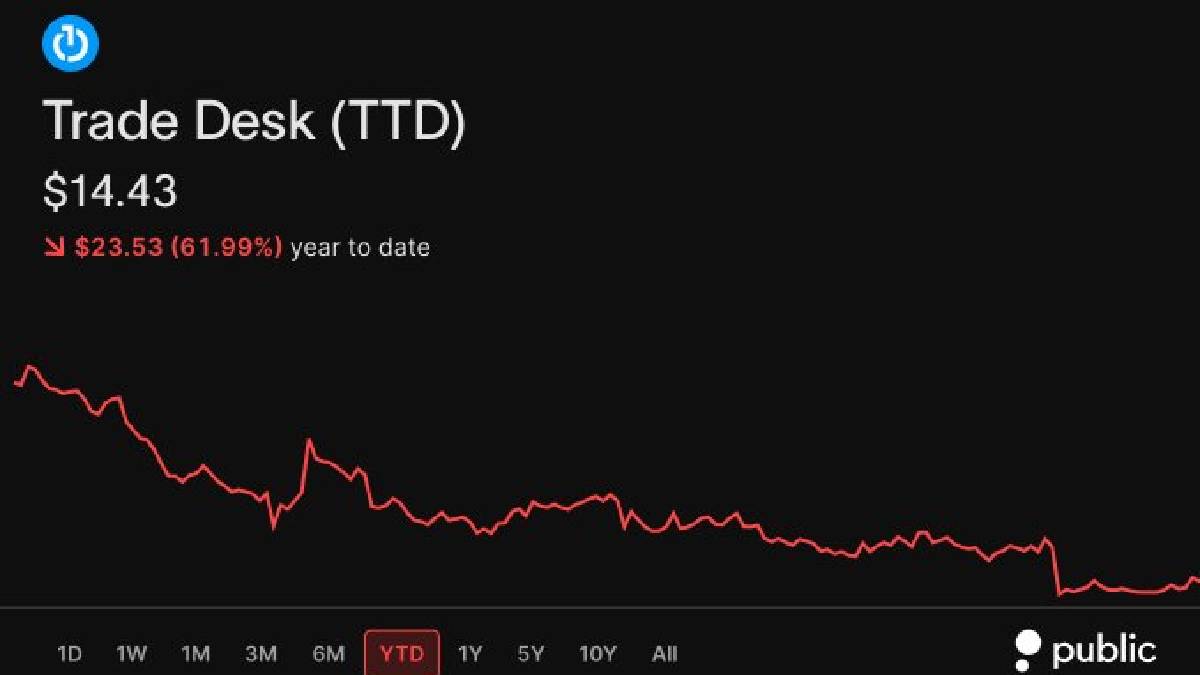
The latest blow came on September 4 when The Trade Desk shares closed at $14.43 and fell 4.37% in the day. The year-to-date decline was roughly 61.99% and its one-year decline was more than 72%. The shares are almost 90% below what they were at in December 2024.
The company's S&P 500 journey is also going to change. S&P Dow Jones Indices announced yesterday that The Trade Desk will be removed from the S&P 500 as part of the quarterly reshuffle. The change will happen before the market opens on September 21, 2026, and Everpure will be added to the index. The Trade Desk will go into the S&P SmallCap 600.
The index removal comes at a time when the company’s stock market fortunes have reversed.
The Trade Desk was one of the top-tier growth stories of digital advertising and benefited from the shift to programmatic advertising and the rise of connected television. Investors rewarded the company with a very high valuation because of expectation of sustained rapid growth.
That growth story has come under pressure in 2026.
The company’s second-quarter results were a major turning point. Revenue grew just 3 percent year-on-year to $715 million, well below Wall Street’s expectations of $752 million. Adjusted earnings per share came in at $0.34 and the company’s third-quarter revenue forecast between $650 million and $807 million was well short of most analyst estimates.
The slowdown has raised questions about whether The Trade Desk can ever recover the speed of growth that justified its premium valuation.
Competition is the other big threat to the company. The company is competing in an ever more competitive digital advertising space of huge amounts of consumer data and advertising infrastructure, in which huge technology platforms like Amazon are king.
The Trade Desk has also been in trouble with big advertising clients. In 2026, Publicis Groupe stopped recommending the platform due to an audit dispute when the two companies later announced they reached an agreement.
So now the company is heavily focused on expense reduction and execution.
CEO Jeff Green announced on Sept. 3 that roughly 15 percent of the company’s workforce would be laid off. As a result, the company’s headcount was already above 3,843 employees and the cuts might be up to 500 people. The restructuring will reduce the company’s workforce by creating smaller teams and increase organizational focus and agility.
The workforce reduction is just one more layer to the turnaround story. Management is making the company more efficient and growing in a much tougher environment.
The stock fell so dramatically but The Trade Desk’s financial position is not that of a company in need of immediate liquidity. It has close to $1.5 billion in cash and no debt, and management has financial flexibility in its restructuring of the business.
But for investors, that’s the key question for investors, too: If the company’s growth engine can be restarted, what if it is not able to run again?
The advertising market is huge and the transition to connected television, streaming and programmatic advertising is still creating long-term business opportunities. The Trade Desk also remains focused on the open internet in which it competes for advertising budgets outside of the closed ecosystems operated by companies like Google, Meta and Amazon.
But the market is demanding evidence that the company can execute.
The scale of the stock’s decline shows how dramatically investor expectations have changed. The Trade Desk has fallen 62 percent in 2026, after a drop of nearly 68 percent in 2025. The stock is now out of the S&P 500 for the second consecutive year.
The index removal could also lead to more trading pressure on the rebalance as index tracking funds adjust their holdings. But being removed from the S&P 500 does not change the company’s operation or revenue-generating capacity.
Instead, the problem is what business performance can do.
If The Trade Desk can stabilize revenue growth, improve its platform, rebuild relationships with advertising agencies and capitalize on connected-TV and other emerging advertising channels, the current valuation could eventually look more attractive to contrarian investors.
But on the other hand, continued growth deterioration would be the reason behind the market being cautious.
The Trade Desk’s steady decline from a high-growth market favorite to one of the biggest laggards in the S&P 500 is a reminder of the dangers of the high-growth technology stocks. When revenue growth slows drastically, a company can be hit by weak earnings expectations and a huge drop in its valuation multiple.
TTD is a turnaround story for now. Its exit from the S&P 500 on September 21 will mark one more chapter in that story, but it will all come down to whether management can drive more sustainable growth than the membership of the index.





Comments
Please to leave a comment on this article.