
India’s economy grew more than expected in the first quarter of FY27 at 7.8% real GDP but the impressive headline numbers have reignited a debate about whether the latest national accounts numbers are right or not.
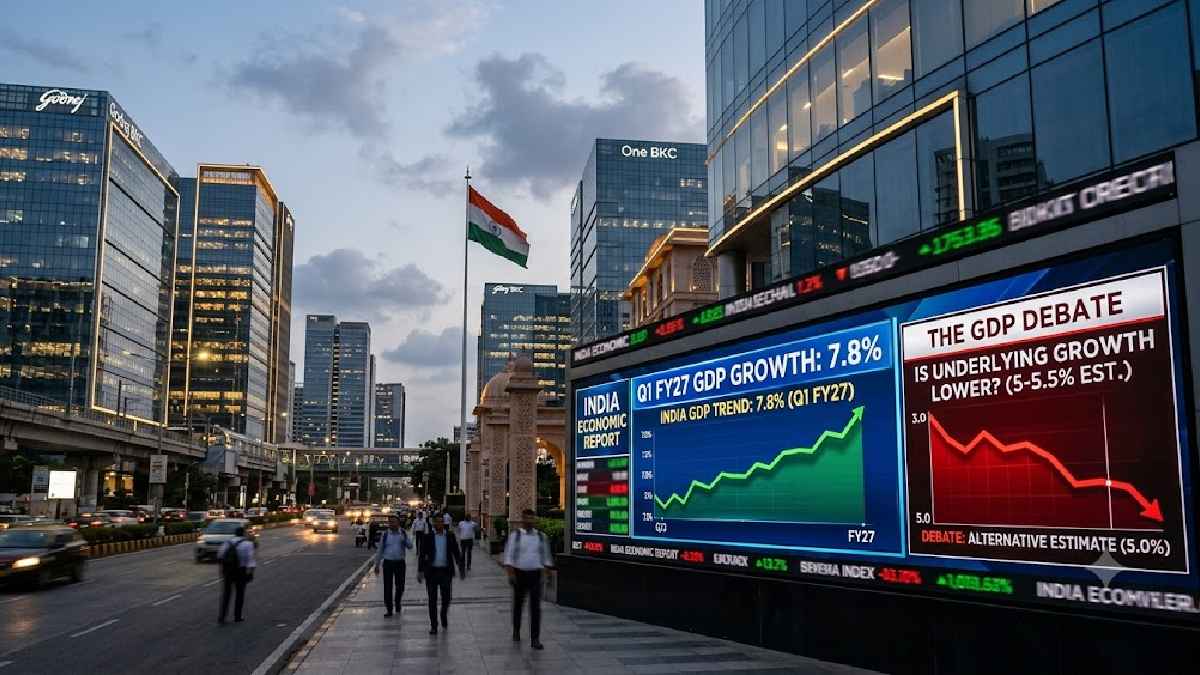
Some critics say that the actual pace of growth in the economy is likely to be closer to 5–5.5%, and questions are raised whether that is truly the case.
The April-June GDP number, released on August 31, was well beyond expectations.

The Reserve Bank of India had predicted Q1 growth at 7%, economists surveyed by Reuters had predicted around 7.1%.
The strong performance was due to investment, manufacturing, services, exports and domestic demand.
However, there was some controversy as to the comparison between the latest GDP series and the earlier 2011-12 base-year series.
Under the new 2022-23 base-year series, Q1 FY26 GDP at current prices was revised to approximately ₹80 lakh crore, and from ₹86.05 lakh crore under the old methodology.
A similar difference has been used by critics to argue that nominal growth would have been much lower if the older number had been kept.
But the Statistics Ministry has rejected such comparisons, saying the old and new series cannot be directly matched. GDP growth must be calculated using comparable estimates from the same series, the ministry said.
The government has also said it is concerned about the methodology used to calculate manufacturing output.
MoSPI said the negative manufacturing implicit deflator does not indicate that manufacturing prices actually fell. Instead, it added that its result reflects the separate deflation of output and intermediate consumption under the double-deflation approach.
There are also several other indicators that support the view that economic activity was still very strong in the quarter. Real Gross Value Added grew 8.2%, while manufacturing grew 9.2%.
Services for financial, real estate and professional activities had especially strong growth. Gross fixed capital formation rose sharply, indicating continued investment momentum.
At the same time, questions about the sustainability of such a high growth rate cannot be dismissed.
Economists are constantly monitoring household consumption, rural demand, inflation, exports, crude oil prices and global financial conditions. A moderation in these aspects might result in slower growth in the next quarters.
So the debate is less about whether India really grew 7.8% and more about how much of that growth is the economy’s momentum.
Some analysts may have lower estimates, after adjusting for methodological reasons, but the 5-5.5% number should not be presented as GDP growth rate.
For now, the official data shows a robust start to FY27. The next quarters, along with the national accounts’ future revisions, will help us see if the economy can sustain growth at the current pace or if underlying momentum eventually settles at a lower level.





Comments
Please to leave a comment on this article.