
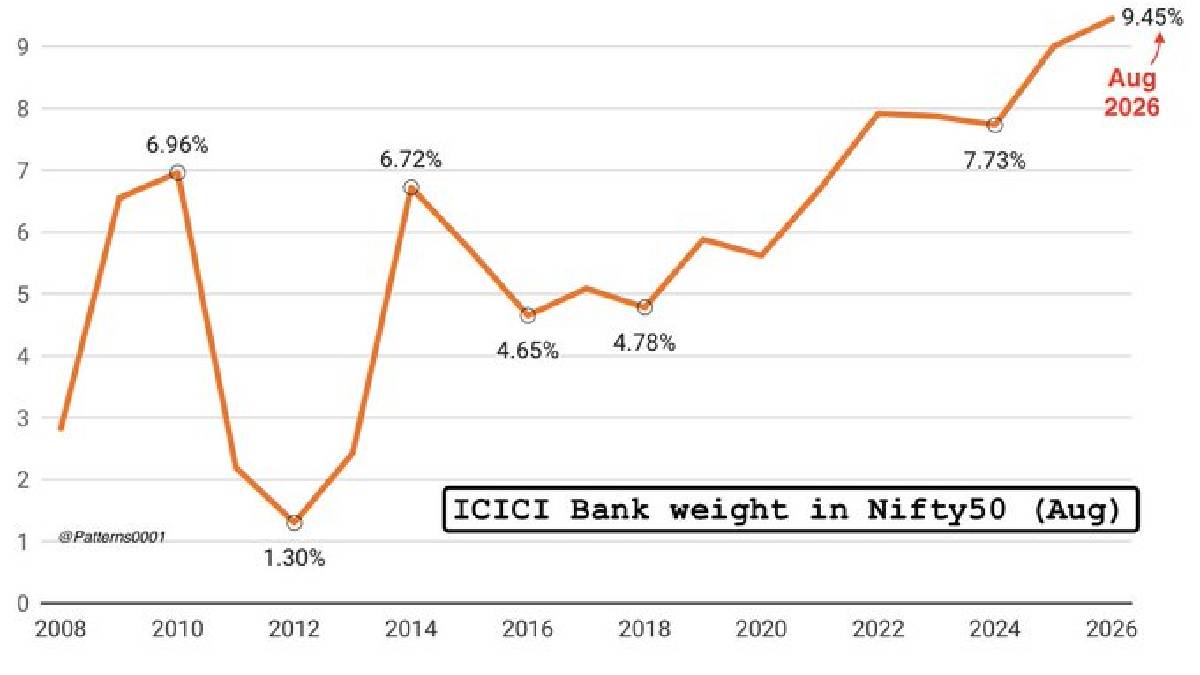
ICICI Bank’s weight in Nifty 50 is at its highest level since at least 2008, showing the bank’s growing influence on India’s benchmark equity index and a strong position among the country’s largest listed financial companies.
The development is significant because the Nifty 50 is calculated with a free-float market-capitalisation approach. So a company’s position on the index is not only determined by the total market value of shares, but also the value of shares that are available for public trading.
ICICI Bank has steadily strengthened its position in the benchmark as its free-float market capitalisation has grown. And recent market data suggests that ICICI Bank is one of the heaviest weights of the Nifty 50. In July 2026 ICICI Bank's weight in the Nifty 50 is estimated to be around 9.01%, making it the second-largest component.
The rise is even more remarkable when compared with ICICI Bank's historical position. In March 2016 NSE data showed ICICI Bank sitting at 4.96% of the Nifty 50 weight on the list. Its much higher representation today shows how its position on the list has changed over time.
For investors tracking index movements, a rising weight has an important implication: ICICI Bank's share-price movements can have a greater impact on the Nifty 50 than they did in the past. Passive funds, exchange-traded funds and other investment products that track the Nifty 50 thus have greater exposure to the bank as its index weight increases.
This is indicative of the importance of financial companies in India's benchmark index. Banks make up a large portion of Nifty 50 and ICICI Bank, HDFC Bank and other major banks are among the key constituents of the Nifty 50 index.
ICICI Bank’s rising weight does not necessarily mean the stock will continue to outperform the broader market. The weight of an index is primarily a function of relative free float market capitalisation and can change as share prices move, corporate actions occur or the composition of the index is periodically reviewed.
But the current position shows how ICICI Bank is one of the most influential companies in the Indian stock market. The bank is now very much part of the Nifty 50 and even affects the direction of the broader index.
Another important factor is the difference between total market capitalisation and free-float market capitalisation. A company can have a very large overall market value but still have a lower Nifty 50 weight if a substantial portion of its shares are not freely available for public trading. ICICI Bank’s relatively high public shareholding contributes to its strong representation in the index.
The comparison points to this as a significant achievement. ICICI Bank's Nifty 50 weight was less than 5% back in March 2016 and now it is 9% and it is having an impact on the benchmark.
For market participants, the change is worth watching because moves in heavyweight stocks can have an outsized impact on headline index performance. Strong gains or declines in ICICI Bank can therefore increasingly contribute to the Nifty 50's daily direction.
ICICI Bank having the highest Nifty 50 weight since at least 2008 is an important point for the lender and for India’s top-tier stock market. It also underscores the bank’s growing free float market value and solidifies its position as one of the country’s most influential listed financial stocks.





Comments
Please to leave a comment on this article.