
European bond markets are on a sharp sell-off as rising energy prices, renewed inflation concerns and expectations of tighter monetary policy push government borrowing costs higher across the region. The latest moves illustrate how quickly the geopolitical shock from the Iran conflict is spreading from energy markets into bonds, currencies and the broader European economy.
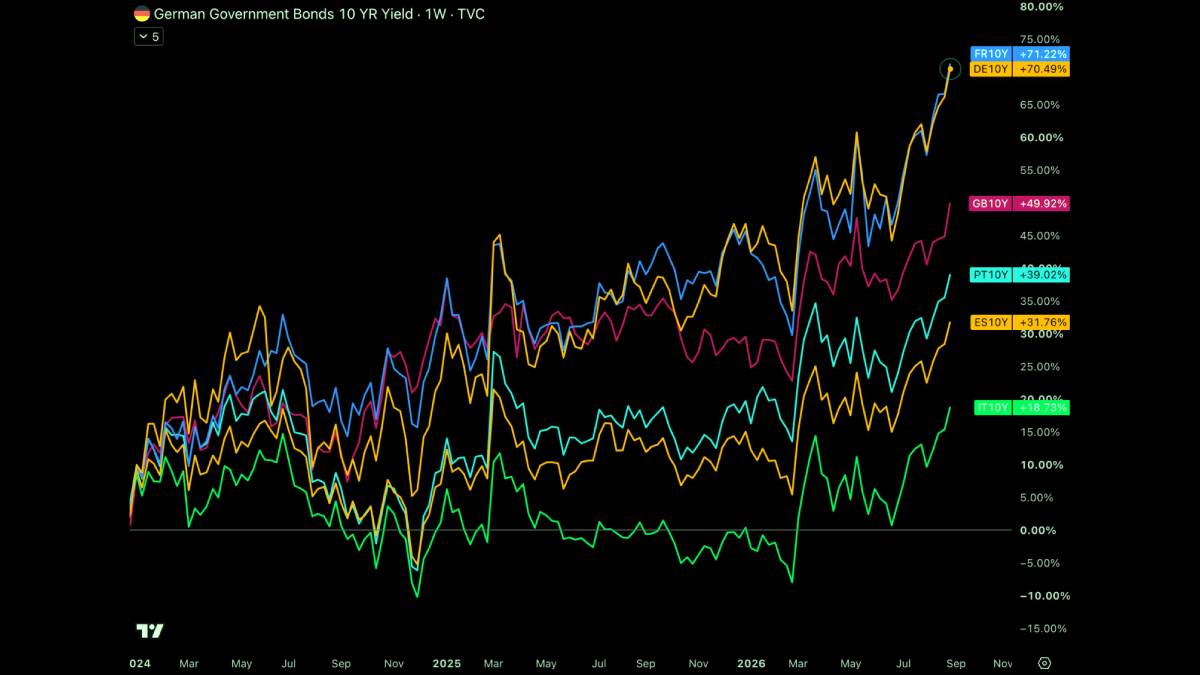
Germany's 10-year government bond yield has risen to around 3.4%, its highest level since 2011, according to recent market figures. Germany’s Bunds are the benchmark for eurozone borrowing costs.
France is under enormous pressure too. Its 10-year government bond yield has risen to 4.2%, levels not seen since the financial crisis era. French government debt had already been under pressure because of the country’s fiscal condition and political uncertainty so the rise in yields was a big deal for investors.
Italy’s 10-year yield has risen to around 4.25% and Spain's 10-year yield has also jumped significantly higher. Rising borrowing costs across southern Europe are closely watched because wider yield spreads can raise concerns about debt sustainability and financial conditions in the eurozone.
UK Bond Market Under Pressure
The UK is similarly moving up in its government bond market. The 10-year gilt yield has surpassed 5.2%, and levels last seen in the aftermath of the financial crisis. The 30-year gilt yield has risen to 5.9%, the highest since 1998.
The higher long-term yields mean governments incur higher costs when refinancing old debt or issuing new bonds. And those costs are likely to be passed on to the wider economy— to consumers and businesses with higher borrowing rates.
The UK is particularly sensitive to inflation because higher energy prices can cause household costs to rise rapidly and business expenses to increase very quickly. Investors are looking at both inflation expectations and the government’s fiscal position closely.
Oil is at the Center of the Shock
The current bond market turbulence is closely related to the Iran conflict and the resulting increase in energy prices.
Brent crude is above $90 a barrel and European natural gas prices are also surging as many investors fret about any potential disruption to energy supplies. Higher energy prices are making some worry that inflation will stay elevated for a long time.
For Europe, this presents a tough policy challenge. Higher oil and gas prices can push inflation higher at the same time that they weaken household purchasing power and increase costs for businesses.
That combination can make for a very difficult environment for central banks because raising interest rates may help contain inflation expectations but can also put additional pressure on economic growth.
Eurozone Inflation Rises to 3.3%
Eurozone inflation accelerated to 3.3% in August 2026, its highest level since September 2023. The energy shock of the conflict was largely responsible for this increase but core inflation has also been much less severe.
The latest inflation number has changed the interest-rate debate in financial markets. Investors are betting that the European Central Bank will raise interest rates again if higher energy prices start to feed into general inflation.
The market is pricing a very high probability for ECB tightening later this year. The exact path will depend on whether the energy shock is a temporary one or if it starts to create wider and longer-term price pressures.
What are the reasons for rising bond yields (see also the fact that bond yields are rising so rapidly)?
Bond yields represent the amount of money investors would like to lend to governments. When bond yields rise, bond prices typically fall and bondholders are punished.
For governments, higher yields mean higher refinancing costs. And for companies, higher government bond yields can increase corporate borrowing costs. Consumers can also feel it through mortgages, loans and other forms of credit.
The effect of this can be felt far beyond financial markets.
The latest global bond sell-off is driven by inflation risks, increased government borrowing needs, geopolitical uncertainty and interest rate increases, according to analysts. Government borrowing costs in several major economies have reached multi-decade highs in several countries and investors are assessing inflation and fiscal risks, Reuters reported.
Europe has a difficult balancing act to keep in mind.
Now the European economy is struggling with higher energy costs, higher inflation and higher borrowing costs.
If oil prices are still high for a long period, inflation could stay above the ECB's target for much longer than previously expected. That could force policymakers to keep monetary policy restrictive or even increase rates and may slow economic growth.
At the same time, European governments should continue financing large levels of public debt while dealing with increased spending pressures.
The question for investors is whether the current bond sell-off is the result of the geopolitical shock in the markets or just at the start of a period of structurally higher borrowing costs for the longer term.
As of now, the message from bond markets is clear: Europe’s inflation problem is once again a big concern for investors. Oil prices are at a decade high, eurozone inflation at 3.3 percent and government bond yields at multi-year highs, markets are preparing for the possibility that interest rates could remain high for a longer time.
If geopolitical tensions ease and energy prices pull back, some of the pressure could be removed. But if the Iran conflict continues to disrupt energy markets, European borrowing costs may be under enormous pressure—another major problem for governments, businesses, consumers and the ECB.





Comments
Please to leave a comment on this article.