
Bill Ackman’s bullish view on Microsoft is catching fire and investors are wondering if the tech giant can sustain a high-teens earnings growth rate through the end of the decade. Pershing Square has forecast that Microsoft can deliver earnings growth of about 19 percent annually over the next three to five years, and that would be a big deal for the company’s long-term earnings power.
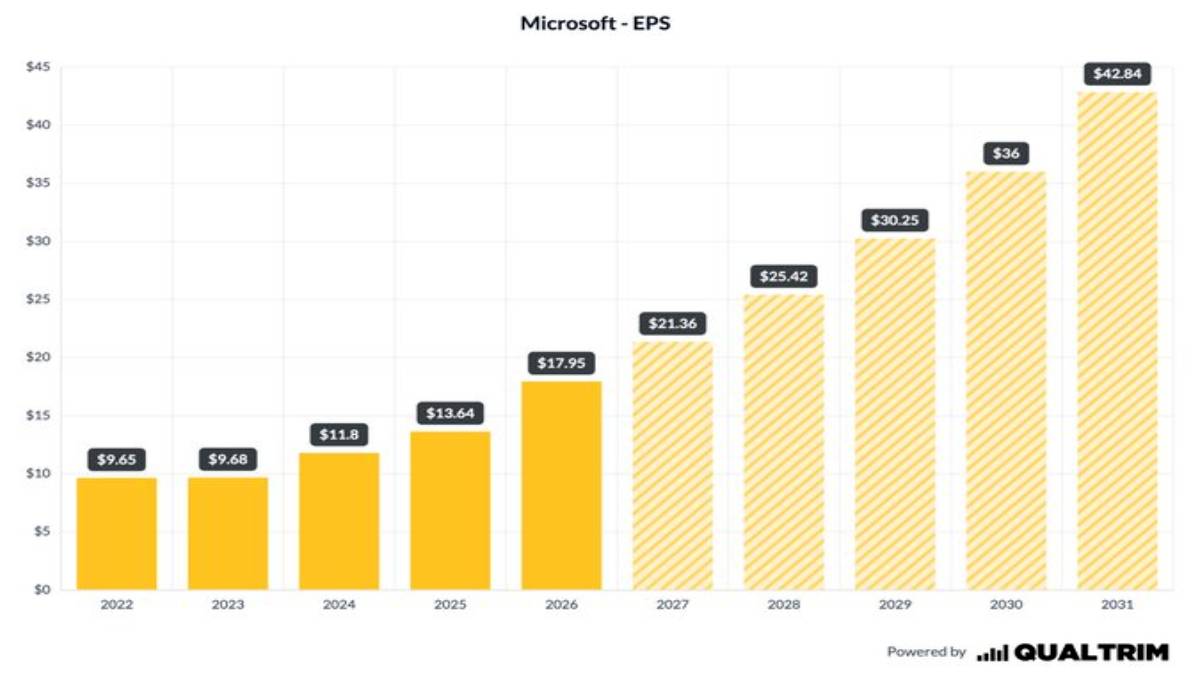
At 19% compound annual growth rate, earnings would increase much faster than a simple year-on-year calculation suggests because each year’s growth builds on the previous year’s growth. If Microsoft could maintain a 19% CAGR for five years, its earnings would become about 2.4 times the starting level.
That means earnings could more than double by around 2031 if the growth rate is sustained. But this is a mathematical illustration of the growth assumption rather than a guaranteed forecast from Microsoft itself.
Ackman’s Microsoft thesis is heavily underpinned by the company’s combination of cloud computing, artificial intelligence and enterprise software. Pershing Square built a substantial position in Microsoft in 2026, with Ackman claiming the market was undervaluing how long-term the company’s businesses would last. Ackman has also made Microsoft 365, Azure and OpenAI a key part of the investment case.
One of the central arguments is that Microsoft does not need to dominate the artificial intelligence model market to benefit from AI. Instead, its huge enterprise distribution network allows it to monetize AI through products already deeply embedded in businesses.
Microsoft 365 is particularly relevant to the thesis. The productivity ecosystem includes Word, Excel, PowerPoint, Teams and other enterprise applications used by hundreds of millions of people. Ackman has argued that the breadth of Microsoft’s integration into corporate workflows makes the business extremely difficult for competitors to replicate.
Azure is another major growth engine. Microsoft’s cloud business is growing rapidly because companies are spending on cloud infrastructure and AI workloads. Recent reports have pointed to accelerating Azure growth and Microsoft’s AI strategy is increasingly marrying its own technology with third-party models and infrastructure optimization.
Microsoft's investment in AI is massive. It is spending massive amounts on data centers and computing infrastructure to get AI services and services out to the market. Ackman has argued that these investments can be seen as growth investments that can lead to huge future revenue (not just a drag on near-term profit).
This is a key part of the Microsoft bull case. If today’s capital expenditure creates enough AI and cloud revenue over the next few years, Microsoft’s earnings might benefit from operating leverage when the infrastructure becomes increasingly used.
Wall Street expectations are also fairly strong. Recent analyst estimates by Investor’s Business Daily have called for Microsoft’s earnings growth of about 14% in fiscal 2027 and around 19% in fiscal 2028. Jefferies has also been optimistic, pointing to Microsoft’s cloud backlog and expectations through traditional and AI workloads.
What is Microsoft’s challenge now, how can it keep going like that for the next couple of years?
A sustained 19% earnings CAGR would be a very important result for a company of Microsoft's size. At that rate, the company would not merely add earnings incrementally; its profit base would grow rapidly. Over five years, 19% annual growth would translate into about 2.4 times the original earnings level.
For investors, however, earnings growth is just one part of the equation. The valuation investors are willing to pay for those earnings will also influence future shareholder returns. If earnings rise sharply but Microsoft's price-to-earnings multiple contracts substantially, the stock's performance could be weaker than the earnings growth alone suggests.
If Microsoft’s earnings rise at a high rate and its price remains relatively stable, shareholders might get not only earnings growth but also investor confidence.
There are also risks to Ackman’s thesis. AI infrastructure spending could remain extremely high, competition in cloud and AI could intensify, and customers could take longer than expected to convert AI experimentation into profitable recurring spending. The investment case could also be affected by regulatory scrutiny, changes in the AI landscape and Microsoft’s relationship with OpenAI.
Microsoft has continued to stress the enormous potential of AI, and has been investing heavily to grasp it. And Azure recently has seen record high growth in demand, and AI workloads are part of that.
The 19% number should therefore be taken as a bullish investment assumption, not a certainty.
But the mathematics explain why Ackman's thesis has attracted attention. Given an earnings base of 100, five consecutive years of 19% growth would lead to around 238 earnings– a boost of about 138%. In other words, Microsoft would produce more than twice its starting earnings level.
For a company already in a field of Microsoft’s size, that kind of growth would be a major achievement. It would support the argument that AI is not just a new technology cycle for Microsoft, but rather a potential transformational expansion of the cloud and enterprise business.
If Bill Ackman's growth thesis is correct, Microsoft's story over the next five years could be less about short-term AI excitement and more about the power of sustained earnings compounding.
Investors will need to see whether Azure’s growth, Microsoft 365 monetization, AI adoption and operating leverage can collectively support something close to the 19% annual earnings trajectory Pershing Square is expecting.





Comments
Please to leave a comment on this article.