
Wall Street’s view of SpaceX ($SPCX) is growing more optimistic, but the claim is not true that every analyst now considers the company a Buy. And while the number of analysts with positive ratings and higher prices is on the rise, there is still some difference between the valuation, growth prospects and risk profile of SpaceX.
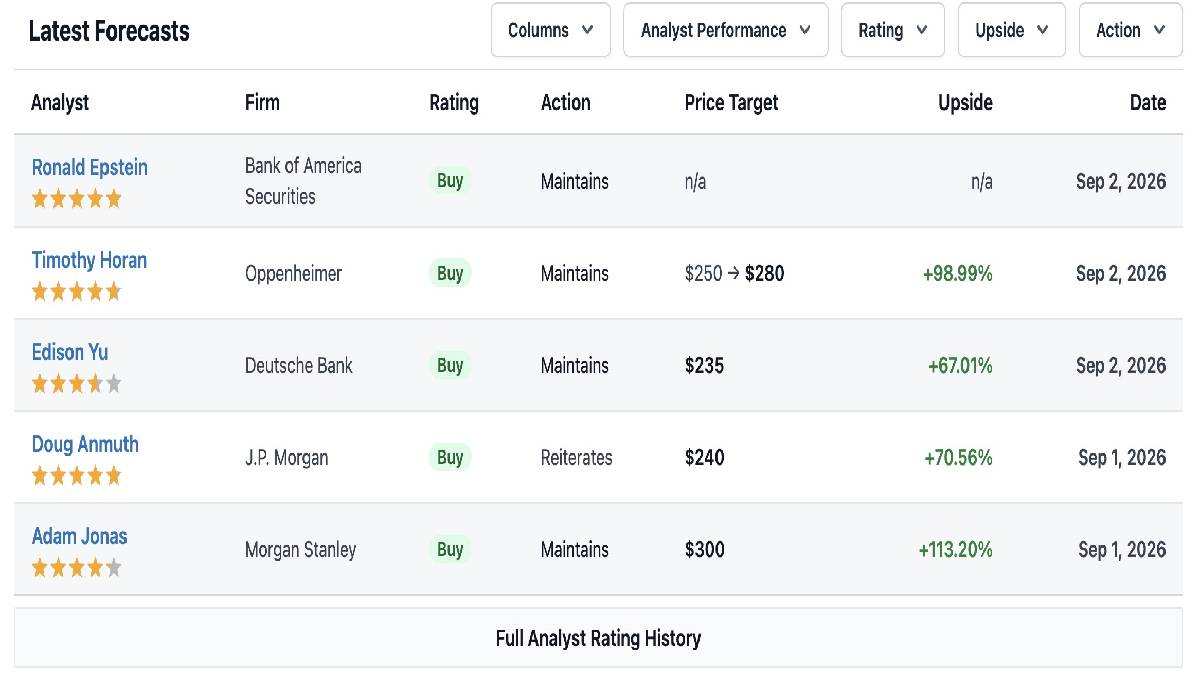
SpaceX is growing amid growing investor optimism on the basis of the company’s position in a number of high-growth areas (e.g. satellite communications, space launches, Starlink and future space technologies and artificial intelligence), as well as the technology that would enable them to keep growing rapidly. Investors are more interested in the possibility of SpaceX eventually becoming one of the most valuable private technology and aerospace companies in the world.
Several Wall Street firms have voiced confidence in SpaceX’s prospects for the long haul. Oppenheimer, for example, maintains an Outperform rating and has raised its price target to $280 from $250. The move reflects growing expectations of SpaceX’s growth opportunities (albeit one that is only increasing as it continues to expand into the commercial space and satellite markets and more and more companies are beginning to grow so fast).
Other analysts have also been bullish. UBS has a Buy rating and Bernstein has an Outperform rating. Morgan Stanley has an Overweight rating, another indication that the firm expects SpaceX to perform better than the broader market or relevant benchmark.
But these ratings should not be interpreted as a sign of the fact that every analyst is equally optimistic.
One of the best-known examples is DZ Bank, which is currently holding a Sell rating with a price target around $100 and has the most severe divergence on SpaceX’s valuation. And while some analysts believe there’s a lot of upside to SpaceX’s valuation, more pessimistic analysts are worried that expectations already imply there could be some big future growth.
The wide range of price targets suggests just how difficult SpaceX is to value. Some analysts have targets in the hundreds; more aggressive forecasts have reached dramatically higher levels. Raymond James, for example, has a particularly bullish target of $800, illustrating the vast gulf between optimistic and conservative scenarios.
This is the case for investors because SpaceX does not fit in the standard framework for valuation of a mature publicly traded company. Its growth opportunities span multiple businesses and some of its most likely to be the best prospects for the future might be dependent on developments that are still years away from the market.
Starlink is still one of SpaceX’s most important pieces in the investment story. The satellite internet business is growing rapidly, which is a potentially very lucrative recurring stream of revenue. SpaceX’s launch business also continues to do well from demand for satellite deployment and other commercial and government missions.
As for future valuation of the company, expectations of artificial intelligence, space infrastructure and other emerging technologies can also affect it. Such a scenario has led some analysts to make much higher valuations, but has also created uncertainty in the valuation.
As investors who are interested in $SPCX, the key takeaway is not just “Wall Street says “Buy.” The more accurate picture is that Wall Street sentiment is overwhelmingly bullish, but analysts differ more sharply on valuation and the degree of upside it is still worth.
A Buy, Outperform or Overweight rating indicates confidence in future performance, but analysts may arrive at those conclusions based on very different assumptions. Revenue growth, Starlink expansion, launch frequency, profitability, capital requirements and future technology progress all can have a profound effect on valuation.
The huge spread between price targets also serves as a warning against treating analyst consensus as a sure thing. A high target is the analyst’s scenario according to specific assumptions, not a promise that the stock will reach that level.
For SpaceX investors, current financial developments, operational milestones and possible changes in the company’s capital structure may be more important than the simple number of Buy ratings.
In short, SpaceX has received strong support from Wall Street, but it is incorrect to say every analyst now rates $SPCX a Buy. The overall sentiment is extremely positive but Sell, Hold-equivalent and more cautious ratings show there is still a lot of debate as to how much SpaceX is worth.
That disagreement will likely continue to play out as investors seek to price the company’s long-term space, satellite connectivity, technology and AI-related opportunities.





Comments
Please to leave a comment on this article.