
Nvidia CEO Jensen Huang just made another big prediction about the future of AI — “AGI has arrived” he says as he congratulates OpenAI on its new AI model Astra.
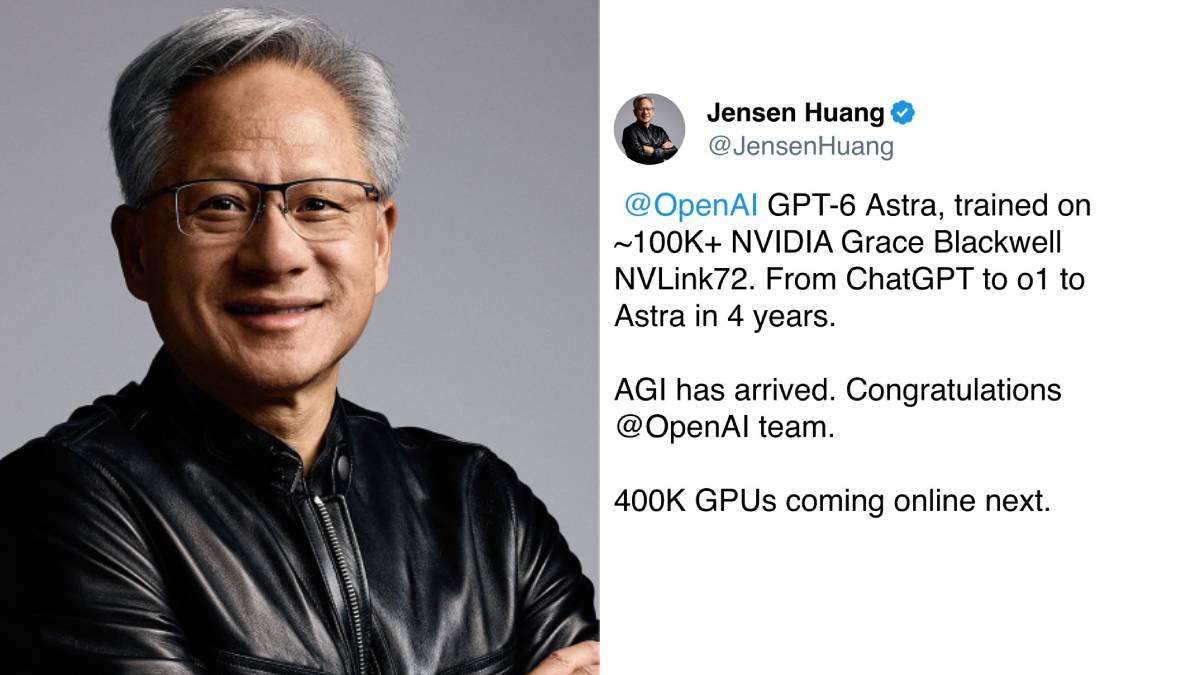
Huang made the statement on X (formerly Twitter) September 6, 2026 after OpenAI released Astra saying “behind Astra is more than 100k Nvidia Grace Blackwell NVLink72 systems used to train Astra”. Huang also noted that another 400k Nvidia GPUs are coming online soon.
The statement is important not only because of AGI but also because Nvidia is at the heart of the AI infrastructure boom — Nvidia supplies many of the advanced GPUs and networking systems used to train and run the world’s most sophisticated AI models.
Huang’s latest claim isn’t the first time he’s said AGI has been achieved. In March 2026 Huang appeared on Lex Fridman Podcast and was asked when we will reach an AGI benchmark — his answer was blunt: “I think it’s now. I think we have AGI.”
The debate continues however about what AGI means. There is no technical definition of artificial general intelligence: some researchers define AGI as a system that can do a wide range of intellectual tasks at or above human levels; others use much more demanding definitions including autonomy reasoning adaptability real world economic productivity.
That’s why Huang’s statement is important but not proof that the AI industry has AGI. Astra was reported to perform well in computer use, software engineering, cybersecurity, science and professional tasks — among other things. But AI researchers and industry figures also disagree about whether current systems meet traditional AGI definition.
For Nvidia investors the more immediate question may be what Huang’s comments mean about future computing demand.
Nvidia’s business has gotten very tied to the extraordinary growth of AI infrastructure. In Nvidia’s most recent report they reported their latest fiscal second quarter revenue (96.2B $89B from data-center business) — how important AI infrastructure is to Nvidia.
That’s an interesting contradiction. Huang is one of the most influential voices out there talking about how fast AI capabilities are advancing and he’s also CEO of the company that supplies a lot of computing hardware to build those systems.
If more powerful AI models need lots of computing power then Nvidia could keep making money from cloud providers, tech companies and AI developers. Huang’s statement that hundreds of thousands more GPUs are coming online only reinforces idea build out of AI infrastructure is not over yet.
Nvidia shares have also gone up a bit from earlier in the year as well. NVDA was trading around $230.36 at the most recent quoted close (52 week range is roughly $164 to $237).
That’s why March was so jarring. Huang was talking about AGI when Nvidia was a fraction of today’s price. His comments then give investors another lens through which to view the AI boom — if AI capability keeps moving fast enough demand for advanced computing infrastructure could be high too.
Investors should not read Huang’s technological vision as an investment promise. AGI is a contested notion and economics of AI (future) could be model efficiency competition capital spending customer returns cost of deploying increasingly powerful systems.
The political side of Nvidia ownership has been discussed as well. Online rumors that Trump and Pelosi own large positions in Nvidia should be taken with a grain of salt — financial disclosures use ranges to report holdings and transactions so current positions may not equal market value today.
Ultimately Huang’s latest “AGI has arrived” declaration is just another chapter in the debate over how close we really are to human level artificial intelligence. For Nvidia the bigger commercial story may be what happens next — will more powerful AI systems keep driving huge demand for chips and networking equipment and data center infrastructure needed to build them?





Comments
Please to leave a comment on this article.