
India’s economy has continued to grow strongly in the first quarter of FY 2026-27, with real Gross Domestic Product (GDP) growing 7.8% year-on-year in the first quarter, according to figures provided by Government of India. Nominal GDP also showed a healthy 10.3% growth in the same period.
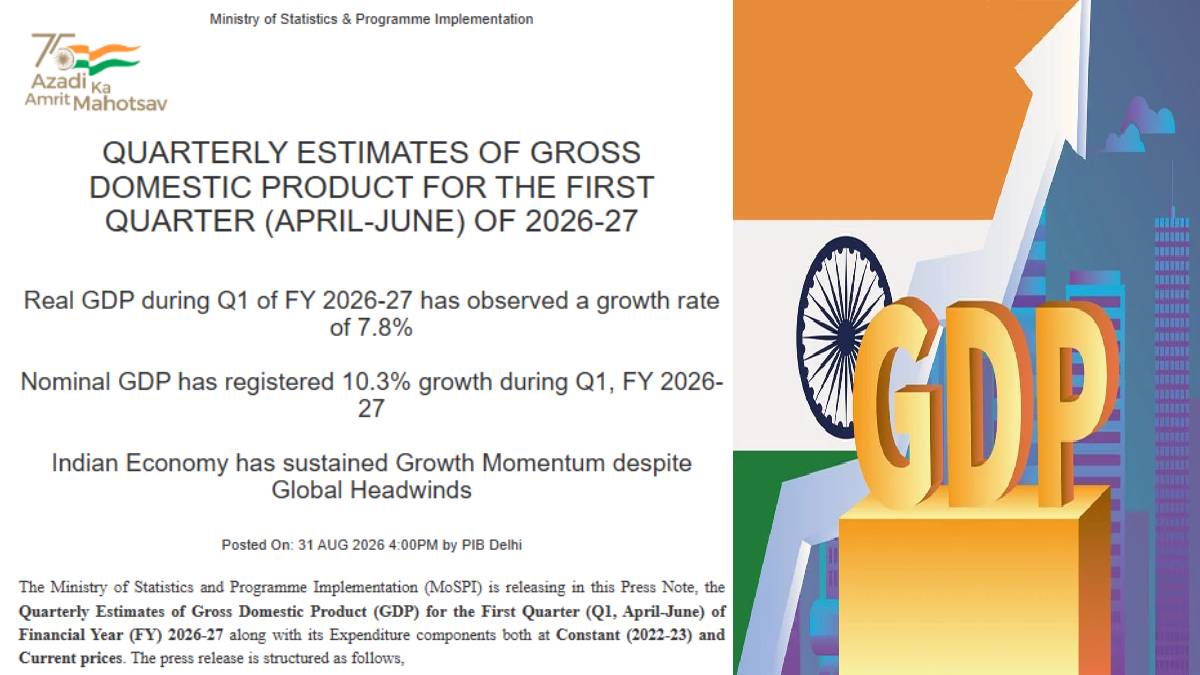
As the world economy is still weak and the Indian economy is still expanding we are grateful for the Indian economy’s resilience.
Real GDP growth is a key indicator as it indicates the expansion of the economy after inflation has been factored in. Thus the 7.8% growth in Q1 indicates that the underlying economic activity in India was expanding robustly during the April-June quarter.
Nominal GDP combines changes in economic output and price movements. Its 10.3% growth is another sign that the size of the Indian economy has increased in the last quarter.
The performance is not just complicated in a macroeconomic context; it is also complicated from a global perspective. There are challenges for economies around the world related to geopolitical tensions, trading conditions in different countries, commodity prices, monetary policy uncertainty and the global market. India's ability to maintain a relatively high growth rate is therefore being closely watched by policymakers, investors and international bodies.
Q1 figures can also offer a very early indication of the direction of the Indian economy in FY 2026-27. Strong growth at the beginning of the financial year can help to shape the next quarter and provide a firm base to build on, but economic performance in the long term will depend on domestic consumption, investment expenditures, exports, government spending and external conditions.
Domestic demand remains an important part of India’s growth story. Consumer consumption, business investment and government expenditure can all shape economic activity together but manufacturing, construction, services and infrastructure have a huge role to play.
India’s large domestic market provides an additional source of resilience compared with economies that are more heavily dependent on external demand. Global changes can affect exports, investment flows and commodity prices, but a good domestic consumption base can help economic activity.
The manufacturing sector is also part of the government's overall economic plan. Investments to boost domestic production, attract investment and strengthen supply chains are part of India’s long term growth objectives.
In the services sector, it is still another significant sector of the economy. Information technology, financial services, professional services, telecommunications, transport and so on are all important to India's economy and employment creation on an industrial level.
The 7.8% real GDP growth rate therefore comes at an important time for policymakers. To maintain growth over the full financial year, continued investment, stable domestic demand and resilience against external shocks are needed.
What is telling is that the government’s portrayal of the figures as evidence of sustained momentum shows the global economic narrative which is that India is still among the world’s fastest growing major economies. And it also signals that India will remain an important destination for investment worldwide.
However, quarterly GDP figures alone do not determine the long-term health of an economy. Analysts will look at the composition of growth, including private consumption, fixed investment, government expenditure, manufacturing output, agricultural performance, and services activity.
Inflation, interest rates and global commodity prices will also be critical factors. Any sharp decrease in global demand or disruption to international trade could affect India's external sector, while domestic inflationary pressures could impact household spending and monetary policy.
The 10.3% nominal GDP growth is especially relevant from a fiscal and business perspective because nominal economic expansion affects government revenue collections, corporate earnings and debt-to-GDP calculations.
For businesses, an expanding economy will help to ensure demand for goods and services and companies will continue to expand capacity and investment. For investors, growth figures can only bolster India's structural economic story, but the performance of stock markets will be dependent on valuations, earnings and global financial conditions.
The first-quarter performance also allows the policymakers to have a solid starting point for this financial year. If India is to achieve its economic goals, momentum will have to continue through the remaining quarters.
All in all, the latest figures give a positive picture of India’s economic performance. Real GDP growth of 7.8% and nominal GDP growth of 10.3% in Q1 FY2026-27 points to the economic activity in the country is still strong even in a turbulent global environment.
We will now question whether this momentum can be sustained through the rest of FY2026-27. In the longer term India’s growth is still dependent on domestic demand, investment, infrastructure development and policy stability.





Comments
Please to leave a comment on this article.