
India’s broad money supply (M3) hit a new all-time high of around ₹322.95 lakh crore — liquidity and deposits are rising across the Indian financial system.
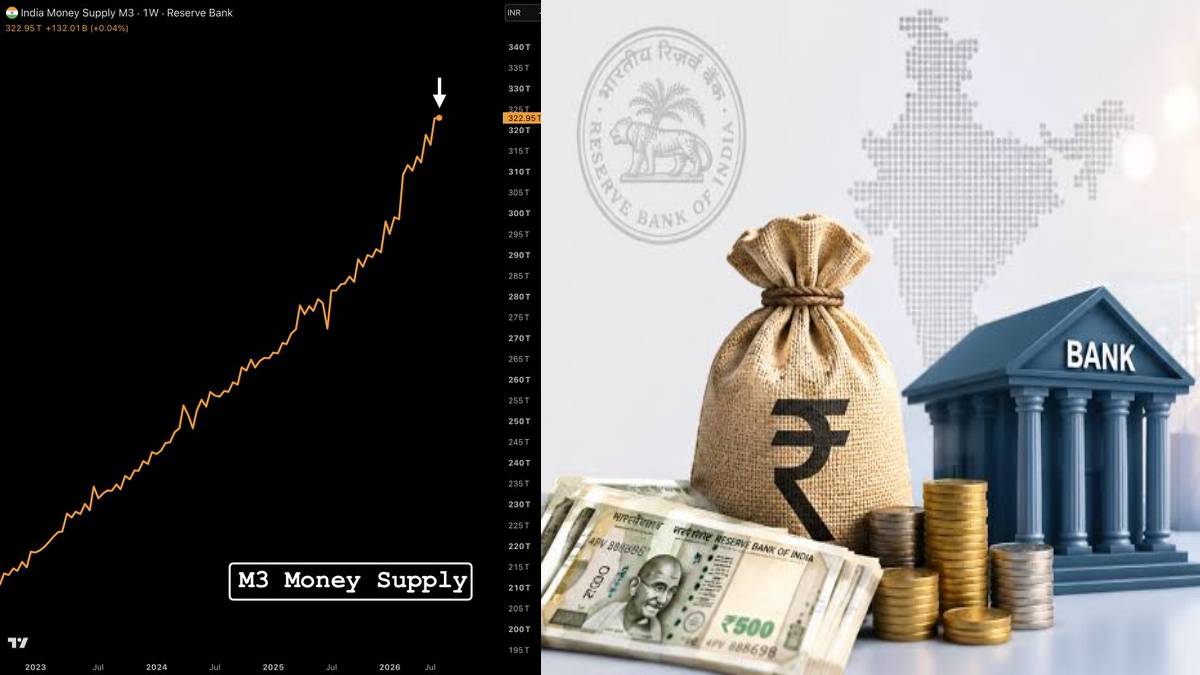
As on 15 August 2026 M3 (M3 = M + N) of India was ₹322,945 bn ($322.95 lakh crore). It grew by 14.2% year on year data published through RBI’s monetary statistics showed.
The new number is higher than the old record. RBI numbers on 31 July put M3 at about ₹322.81 lakh crore so broad money has been around ₹323-lakh-crore even though its composition changes all the time.
M3 (broad money) = currency held by public; demand deposits with banks; time deposits with banks and certain other deposits with RBI. M3 is therefore much broader measure than cash held by public.
One of the largest components of India’s money supply is time deposits with banks. As on July 31, 2026 RBI linked data showed time deposits at ₹243.87 lakh crore; demand deposits ₹35.86 lakh crore and currency in public hands about ₹41.85 lakh crore.
The strong expansion of M3 is happening against a backdrop of major change in India’s banking liquidity: In recent weeks the banking system has had very large surplus liquidity because foreign currency inflows under special deposit arrangements have been very large. Reuters said early September that India’s banking-system liquidity surplus was ₹9.7 lakh crore — highest ever since 2021.
The rise in liquidity has also forced RBI to pull back excess funds from the banking system. On September 7 it withdrew more than ₹6 lakh crore through liquidity operations when surplus was about ₹11.6 lakh crore.
This distinction matters because a record M3 doesn’t mean ₹322.95 lakh crore of physical cash is sitting around the economy — much of that is bank deposits and other broad money components too. Deposits, bank credit, foreign assets and monetary conditions all increase M3 without any comparable increase in physical currency.
Expansion of money supply may be good for activity if it is accompanied by stronger credit growth, investment and consumption; too rapid a rise in liquidity can also be bad news for monetary authorities if inflationary pressures build up or short term interest rates move outside RBI’s desired policy corridor.
The situation now shows that problem. The RBI has been using reverse-repo and other liquidity management operations already (Reuters said central bank withdrew more than ₹6 trillion in early September) but analysts say more may be needed if surplus keeps rising.
For India’s economy then the ₹322.95-lakh-crore M3 milestone is not just a headline number: it tells us how big India’s banking and financial system really is (deposits & credit keep growing); it shows RBI has to ensure abundant liquidity supports growth but not inflation or financial market distortions.





Comments
Please to leave a comment on this article.