
India’s GDP growth over the last 20 years tells the story of one of the world’s most epic economic transitions.
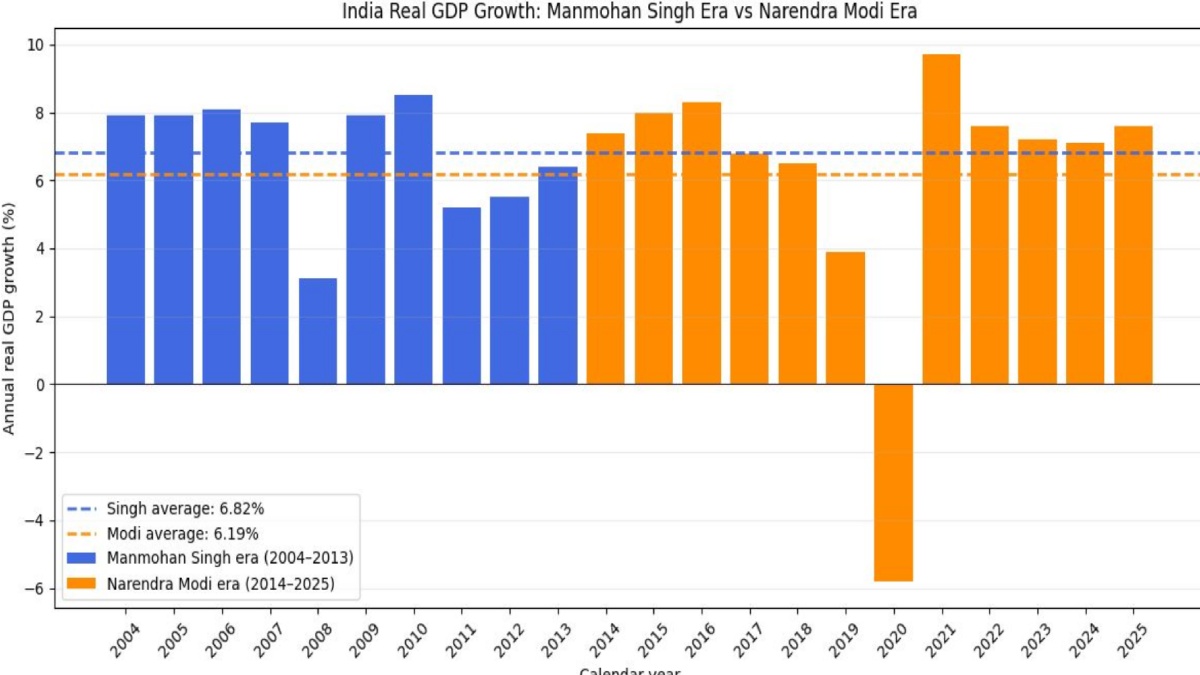
From a fast growing emerging economy in the mid-2000s to an increasingly important global economic power, India has gone through periods of strong growth and crises at home and abroad, structural transformations, pandemic-driven contraction and recovery. Looking at the country’s economic performance over two decades is a good way to view India’s growth trajectory and, at the same time, its challenges.
India was experiencing a period of strong economic growth in the late 2000s. Rising domestic consumption, investment, services, information technology, construction and integration with the world economy supported growth. India's economy grew at a relatively brisk pace during a period of about five years, making it among the emerging countries of the world that are still growing. Investment and productivity were also greatly increased at the same time, as economic reforms and the expansion of the private sector.
The 2008-09 global financial crisis turned out to be an important turning point. India was hurt by the international slowdown but its huge domestic market and strong internal demand helped to buffer India from the worst effects of the crisis. Growth moderated from the previous high growth years but the Indian economy continued to grow. Government spending or policy measures also helped to encourage economic activity during the global downturn.
The early 2010s saw yet another change in growth conditions. India continued to grow but the economy was also facing challenges such as high inflation, low investment and external pressures. Policy reforms and efforts to improve infrastructure and business environment were to be taken up. The growth recovered and with India’s large consumer market, services sector and expanding middle class the government could still hold up.
The GST made India’s taxation system simpler, at least in practice. There were short-term difficulties for some businesses but GST was a fundamental aspect of the process of economic formalisation in India.
India’s growth momentum was interrupted again in the late 2010s when economic activity began to slow down. Various factors— weak consumption and investment— inhibited the pace of growth. Government action was taken to support demand, investment and credit conditions. The slowdown showed that maintaining high growth over a long period of time can be difficult.
The biggest disruption of the past two decades was the COVID-19 pandemic in 2020. India's economy fell sharply as nationwide restrictions hit manufacturing, services, transportation, retail and other sectors. The pandemic was an economic shock that India felt, as well as the economies all over the world. But the contraction was followed by a strong rebound as restrictions were gradually lifted and economic activity resumed.
The post-pandemic period has been characterized by renewed economic expansion. Government infrastructure spending, domestic consumption, manufacturing initiatives, digitalisation and the growth of India’s services sector have bolstered growth. India has also taken steps to strengthen domestic manufacturing and supply chains through Make in India and production-linked incentive programs.
The digital economy is another important growth driver for India which is now on the rise. Digital payments, e-commerce, fintech platforms and digital public infrastructure have been adopted by businesses and consumers with the speed of the process. And India’s huge technology workforce and the expanding startup ecosystem is also contributing to making India a leading country in the global digital economy.
Over the past two decades, the services sector has still dominated the composition of India's economy and manufacturing and infrastructure have come in for more policy attention. Agriculture remains crucial since employment and rural incomes are in demand and employment is still a major factor, but its contribution to overall GDP is much smaller than services.
This trend in GDP growth over the long term also tells us the resilience of India. In terms of the world financial crisis, slow down in domestic investment, tax reforms, geopolitical uncertainty and the unexpected disruption of COVID-19, India had quite a lot to deal with but yet over time has grown to be one of the world’s largest economies.
India’s future growth will be dependent on its ability to sustain investment, improve productivity, create employment opportunities and expand manufacturing while maintaining its services-sector strength. Infrastructure development, education, skill development, technological innovation and greater involvement in global trade will remain the key elements to growth.
🚨 India's GDP growth rate in the last 20 years. pic.twitter.com/wI0T03qEP3
— Indian Tech & Infra (@IndianTechGuide) September 1, 2026
Such is the economic transformation that India has undergone over the last 20 years. Although not in a linear way growth is still a theme, growth has been more of a movement and more globalized. Stable and inclusive growth is essential for India to progress and become better off in the world economy.





Comments
Please to leave a comment on this article.