
India’s crude oil basket has climbed above $100 per barrel and is now at $101.07 per barrel, as high geopolitical tensions in West Asia raise fears for global oil supplies and shipping disruptions. The rise is also putting pressure on India’s energy importing cost and could be a bigger blow to the economy if the high crude prices last longer.
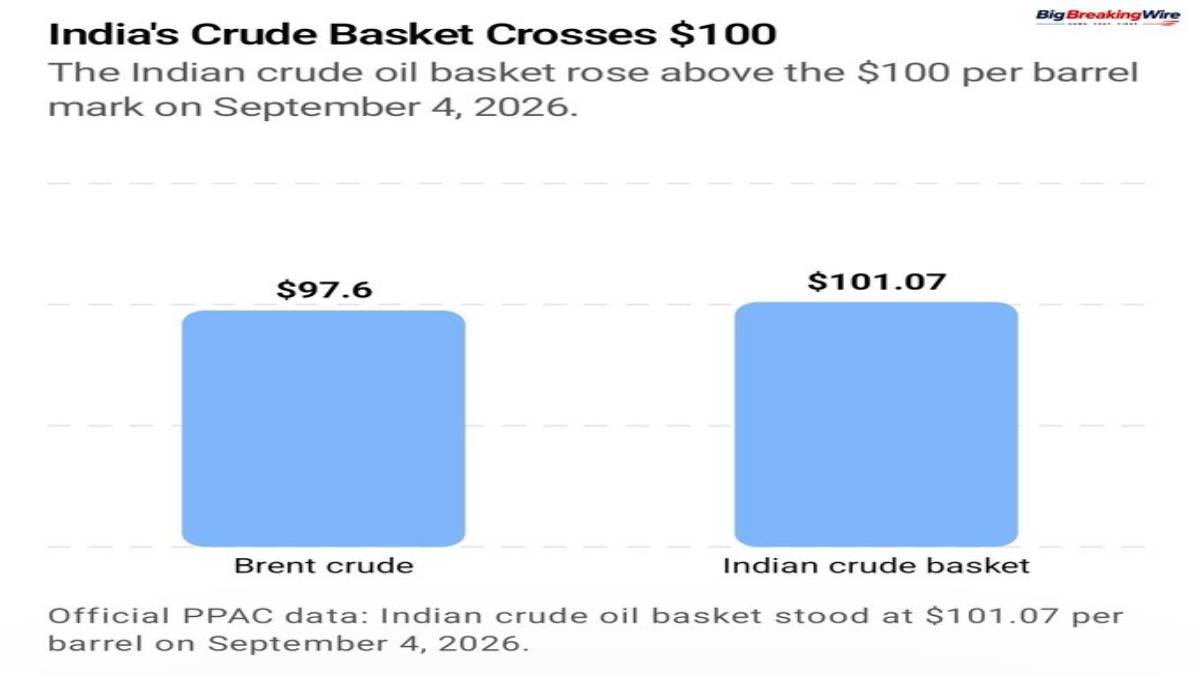
Data from Petroleum Planning and Analysis Cell (PPAC) showed that Indian crude basket reached $101.07 per barrel on Friday, September 4. It was the highest level since July 23 and marked the first time in six weeks that India’s average crude import price crossed the $100 threshold.
The Indian Basket is not a single crude grade. It is a derived average of Dated Brent, a sweet grade benchmark and Oman-Dubai average, which is sour crude imported by Indian refineries. The benchmark thus provides an important indication of the price India is paying for its imported crude.
West Asia conflict drives oil higher
The rise has come amid rising military tension in West Asia, with disrupted oil supplies and shipping routes and uncertainty caused by the crisis. The Strait of Hormuz, one of the world’s key energy corridors, has turned into one of the world’s most important energy chokepoints for world oil markets.
International crude prices have also risen sharply. Brent crude was up $100 a barrel in London on Wednesday as tension continues to linger and physical oil markets are under pressure as well due to supply and logistics.
For India, it is important as India is heavily dependent on imported crude oil to meet its energy needs. If international crude prices continue to rise, the import bill of India will increase and put pressure on the country’s current account.
The September average of the Indian crude basket was $99.38 per barrel, up from $90.19 in August. The increase is even greater when compared with the June and July average of $83 and $82 per barrel respectively.
Pressure on India’s oil companies
Higher crude prices also pose challenges to India’s oil marketing companies (OMCs), particularly when retail petrol and diesel prices do not immediately move in line with international costs.
The Financial Express reported that rising crude prices have put even more pressure on OMC marketing margins with diesel margins under severe pressure. Strong refining margins can provide some cushion, but long-term high crude prices could add to the financial burden on fuel manufacturers.
The effect could be felt beyond oil companies. Aviation, logistics, transportation, tyre manufacturers, chemicals and other energy-intensive industries can face higher operating costs when crude and refined fuel prices remain high.
Impact of inflation on the rupee
A long period of crude prices above $100 could also complicate India’s inflation outlook. Higher fuel and transportation costs can eventually feed into the prices of goods and services across the economy.
The rupee is also a concern. Rising oil prices are increasing demand for dollars as India is spending more on energy. Reuters reported that the rupee weakened to around ₹94.68 per US dollar on September 8, and traders said it would likely intervene in the foreign currency market to support the currency.
The future direction of crude prices will be greatly influenced by developments in West Asia, the security of shipping routes and the extent to which global oil supplies are disrupted.
For India, the climb to $101.07 per barrel is a warning sign. If crude stays at $100 for a long time, the impact would be felt more and more in the country’s import bill, currency, inflation, government finances and corporate profitability.





Comments
Please to leave a comment on this article.