
Bond markets are under renewed pressure as government borrowing costs rise to levels not seen since the 2008 global financial crisis and inflation, government debt and interest rates are in danger.
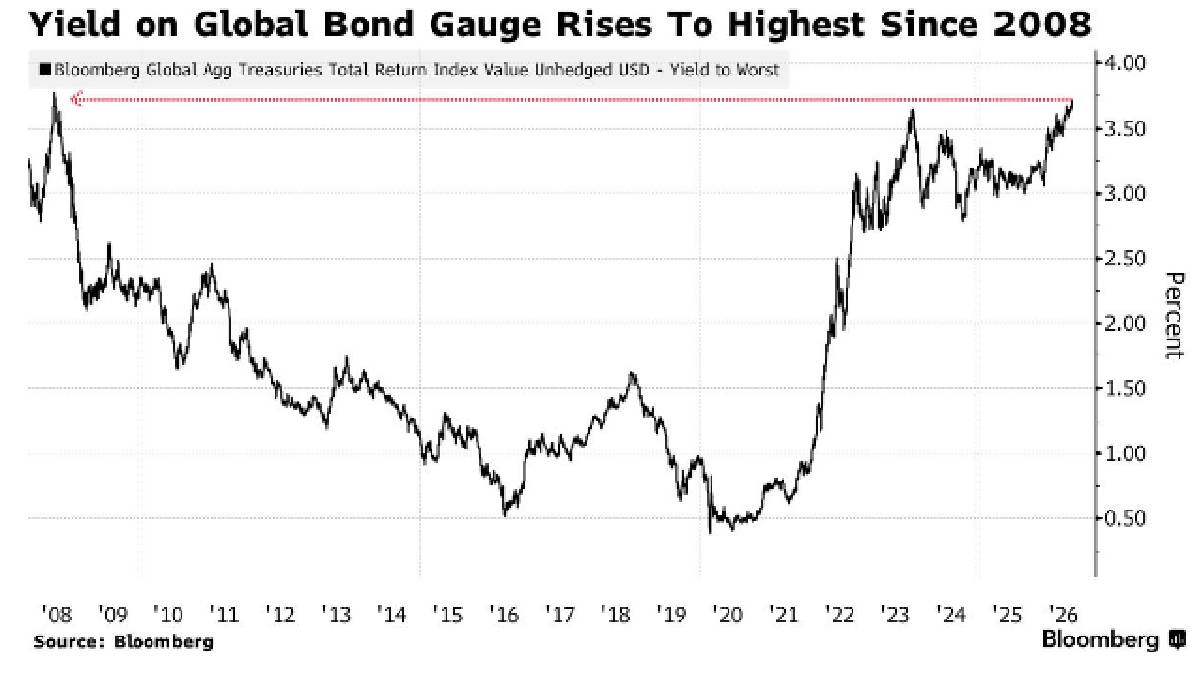
The average yield on the Bloomberg Global Treasury Index of government bonds issued by investment-grade countries rose about 3.68 percent in July, the highest since the global financial crisis. The latest market developments have put pressure on sovereign bonds and yields in the big economies are still rising through the long period of inflation and uncertainty.
The bond market selloff is a drastic change from the ultra-low interest rate environment that flourished for most of the decade after the financial crisis. Investors are looking for more returns to hold longer-term government debt because inflation, fiscal deficits and the sustainability of government borrowing are more pressing than ever.
Bond markets have seen a number of strong market moves in the past. The 30-year Treasury yield in the United States is still below levels last seen in the financial crisis and the 10-year Treasury yield has also risen sharply. Reuters reported in August that the US 30-year yield had climbed above 5 percent for the first time since 2007.
Europe has also felt the pressure. German and French government bond yields have reached multi-year highs as inflation fears mount and government finances come under increasing scrutiny. Germany’s 10-year yield is at its highest since 2011 and France’s long-term borrowing costs have passed levels last seen during the financial crisis.
Japan is also one of investors’ top targets. Japan's 10-year government bond yield rose to 3% on September 1, 2026, the highest since 1996, a sign of how much bond markets have changed globally.
What is the reason why bond yields are up?
One of the biggest drivers is inflation. Higher energy prices have raised fears that inflation will be higher for much longer. Higher oil prices can drive transportation, manufacturing and household prices up and central banks can struggle to lower interest rates.
Geopolitical tensions are adding another layer of uncertainty. New military confrontations have pushed oil prices to a high and fed into the fire and raised fears of another big inflationary shock. Brent crude rose to $90 a barrel on September 1 and bond markets sold off again.
The markets are re-examining expectations for monetary policy. Investors are no longer convinced the central banks will continue to reduce interest rates and are now wondering if rates can keep rising, or even jump again, if inflation were to rise again.
Government debt is also putting pressure on global markets.
Another important factor is the huge amount of government borrowings worldwide. The higher debt levels mean governments need to refinance large amounts of the existing debt at today’s higher interest rates.
Borrowing costs also have wider economic impacts. When government bond yields rise, companies and households also face higher borrowing costs as sovereign yields are key benchmarks for pricing loans and corporate debt.
Higher yields can thus affect mortgages and investment in business as well as government budgets and equity valuations.
The pressure is especially on governments already running large fiscal deficits. As debt service increases, a greater share of public finances can be given to interest payments rather than infrastructure, welfare or other government priorities.
What are some of the big changes in market movements in global capital markets?
The current bond market is in stark contrast with the low-yield era that started after the 2008 financial crisis. Investors were used to historically low borrowing costs as long as the central bank had easy monetary policy and large-scale asset buying.
That environment has now changed.
The rise of yields is not limited to one country. The United States, Germany, France, Japan and the UK have all seen great increases in borrowing costs.
Investor risk and opportunity are mixed in the process. Higher bond yields make fixed-income assets more attractive but the transition can also mean losses for investors who have older bonds with lower coupons. Higher discount rates at the same time can drive down stock market valuations, especially for companies that don’t expect profit for years.
With inflation, government debt, energy prices and geopolitical risks affecting markets at the same time, the bond market is becoming an ever more important tool to indicate financial stress.
So the higher yields are no longer just a market reaction. Investors want something in return for inflation and fiscal risks—and the era of cheap global borrowing is likely to be over.





Comments
Please to leave a comment on this article.