
Broadcom is signalling an extraordinary acceleration in demand for artificial intelligence infrastructure, and CEO Hock Tan said it will ship hundreds of billions of dollars’ worth of AI-specific semiconductors to major technology customers in the next two years.
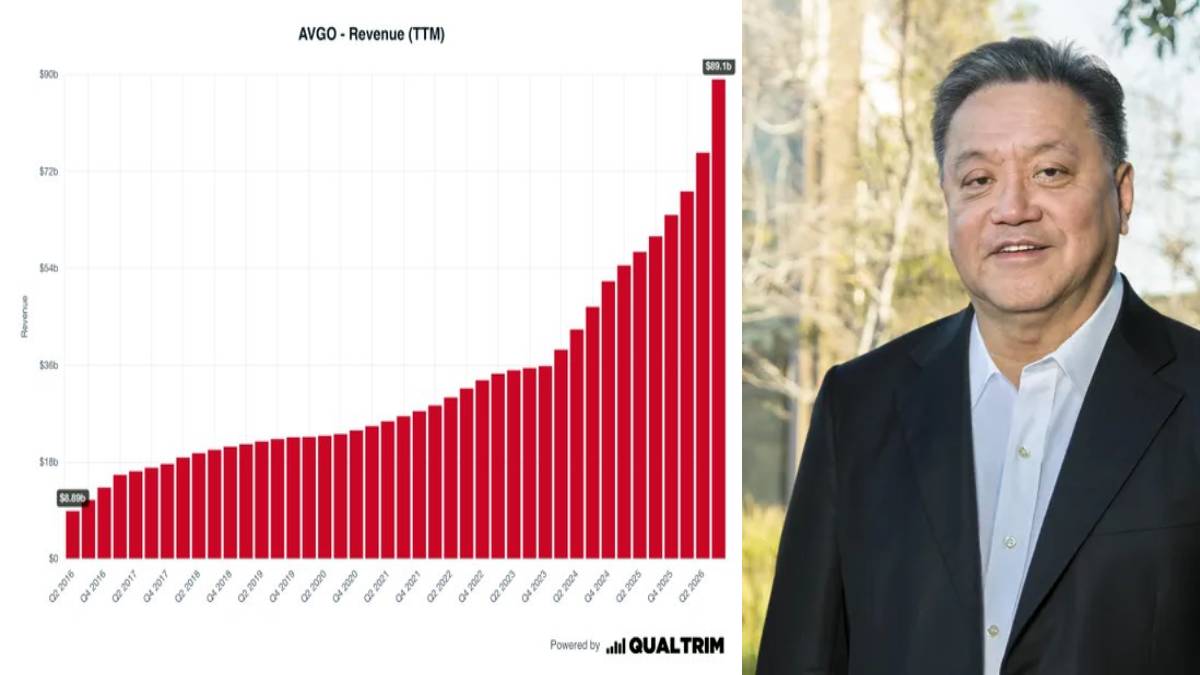
Tan said Broadcom expects to ship about $350 billion of AI semiconductors to its customers in the next two years, highlighting the scale of spending currently flowing into AI infrastructure.
The comments came as Broadcom had another very strong quarter and demand for custom AI accelerators and networking products was strong. Broadcom reported third-quarter sales of nearly $29.59 billion, up 86 percent year-over-year and beating analyst expectations. Adjusted earnings rose to $3.32 per share, beating analyst forecasts.
AI semiconductor sales for Broadcom were $16.7 billion in the third quarter, up 221 percent from a year ago. AI-related products are now part of the firm’s entire business.
Broadcom Raises AI Revenue Outlook.
The company also had an aggressive outlook on future AI semiconductor sales.
Broadcom expects AI semiconductor sales to be approximately $115 billion in fiscal 2027 and double to nearly $230 billion in fiscal 2028. This is a sign of management confidence that the demand for custom AI accelerators and networking infrastructure will continue to grow rapidly.
In fiscal 2026, Broadcom is expecting AI semiconductor revenue to be $21.7 billion, an increase of 236 percent from the previous year. That would be another significant sequential increase from the $16.7 billion in the third quarter.
While social media posts have referred to this trend as Broadcom potentially “3X-ing” its AI revenue, the company's most recent publicly reported forecast is more precise: AI semiconductor revenue is projected to reach $115 billion in FY2027 and $230 billion in FY2028.
Custom AI chips drive growth.
A huge part of Broadcom’s potential has to do with custom AI accelerators. Broadcom doesn’t offer general-purpose processors, but works with big tech companies to create chips for their artificial intelligence requirements.
And the company is developing custom AI infrastructure for huge customers such as Google, Meta, OpenAI, Anthropic and others. The custom chips enable big AI companies to optimize the performance, power consumption and costs of their workloads.
Another key part of the AI infrastructure story is Broadcom’s networking technology. As AI clusters grow larger, high-speed networking is needed to connect thousands of processors and move huge amounts of data between them.
That puts Broadcom in a strategic position in the AI hardware ecosystem alongside Nvidia and other semiconductor manufacturers.
AI spending is rising.
The scale of Broadcom’s projections shows how aggressively major technology companies are investing in AI data centers.
AI developers are building more powerful computing infrastructure to train and run large language models, reasoning systems, and other AI applications. Such systems require huge amounts of specialized computing and networking hardware.
And Broadcom’s recent numbers show demand is not only in Nvidia’s traditional GPU market. Major technology companies are developing or commissioning their own custom accelerators to support their own AI workloads.
That would create a substantial long-term market for Broadcom.
A lot of expectations for Broadcom stock.
Broadcom shares have not been received in an entirely straightforward way by investors with such a strong AI growth outlook.
So far the company did beat expectations in the quarter, but guidance for fourth quarter revenue of $34.8 billion was slightly lower than some of the more aggressive expectations in the investment community. Broadcom shares fell after the results as traders weighed the outlook and valuation and expectations from investors weighed the outlook against the high shares of Broadcom at the company’s high valuation and expectations.
This illustrates an important aspect of today's AI investment cycle: even spectacular growth may not be enough to lift a stock if investors are expecting more out of it.
As such, Broadcom's future prospects for the long run will be very much tied to how AI infrastructure spending increases and whether the company will remain one of the world’s leading producers of custom accelerators and networking components.
For now, Hock Tan’s $350 billion AI semiconductor shipment projection is one of the clearest indications yet of how big Broadcom believes the next phase of the AI hardware boom could become.
Given that AI semiconductor sales are already growing by triple digits and are expected to reach $230 billion by fiscal 2028, Broadcom is positioned as one of the biggest beneficiaries of the shift to customized AI computing infrastructure.





Comments
Please to leave a comment on this article.