The BRICS group has become one of the most influential economic blocs in the world with its expanding membership and a strong presence in global trade, energy, finance and geopolitics.
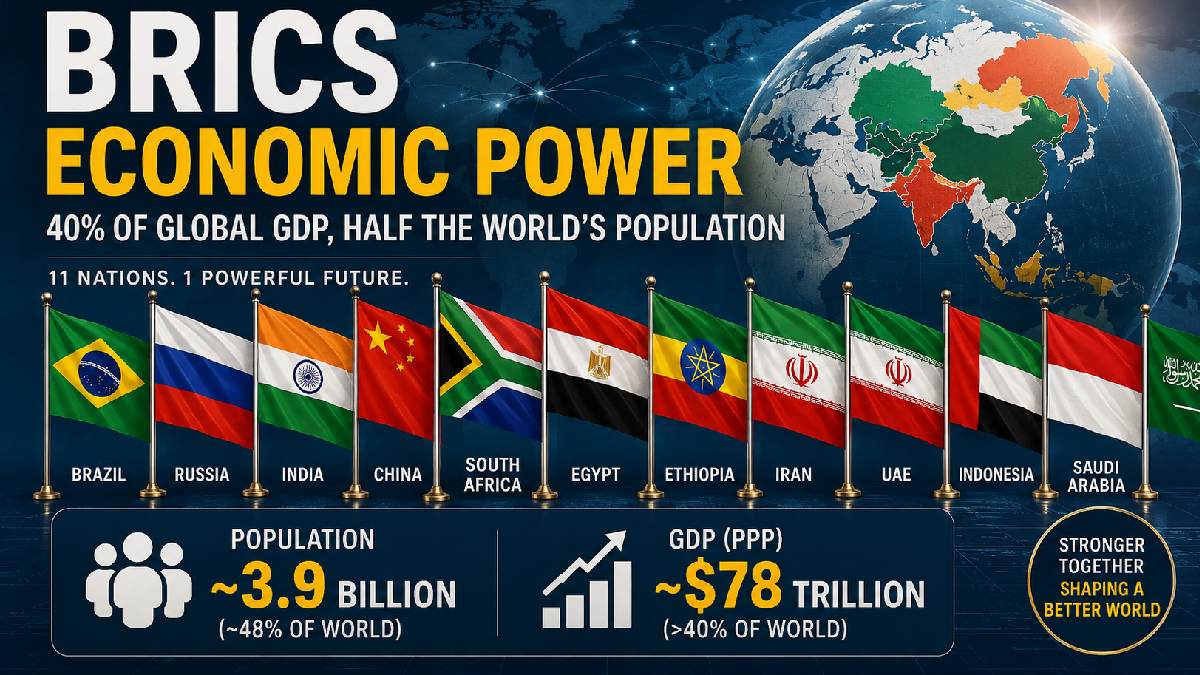
The 11-member group now constitutes nearly half of the world’s population and more than 40% of global economic output when measuring purchasing power parity (PPP).
BRICS comprises Brazil, Russia, India, China, South Africa, Egypt, Ethiopia, Iran, the United Arab Emirates, Indonesia and Saudi Arabia.
All together, they are estimated to have a population of about 3.9 billion and account for about 48% of the world population. PPP-wise their combined GDP is estimated to be around $78 trillion, which is over 40% of global GDP.
From BRIC to a Major Global Economic Bloc
The BRICS story began with Brazil, Russia, India and China. The term “BRIC” was coined in 2001, before the grouping evolved into an intergovernmental forum. South Africa joined later, turning BRIC into BRICS.
The bloc was expanded in 2024 with Egypt, Ethiopia, Iran and the UAE joining. Indonesia became a full member in January 2025.
Saudi Arabia is included in some BRICS assessments but its formal membership status has been described differently by some sources.
Why BRICS Has Growing Economic Influence
The strength of BRICS stems from the diversity of its economies. China is one of the biggest manufacturing players in the world and India is one of the fastest growing major economies.
Brazil is huge in agriculture and commodities and Russia and many Gulf countries are big energy producers.
The combined economic weight of the bloc also helps it to have a stronger voice in discussions around international trade, development finance and global economic governance.
BRICS countries are also looking to use more national currencies in trade and alternative cross-border payment mechanisms. It may help to reduce transaction costs and increase financial cooperation among countries in the group.
BRICS vs G7: A Changing Economic Balance
The growing economic weight of BRICS has intensified comparisons with the Group of Seven (G7). In nominal GDP terms, the G7 remains much larger.
But the PPP data shows a different picture: BRICS make up more than 40% of global GDP while the G7 amounts to a much smaller share.
This is important because PPP adjusts for the differences in the cost of goods and services between countries and thus provides a different measure of the size of domestic economies.
What It Means for the Global Economy
BRICS’ growing share of the world population and economy may strengthen the voice of emerging markets in international institutions.
Its members bring together large consumer markets, energy resources, manufacturing capacity, agricultural production and investment potential.
However, the bloc also has its own challenges. Its members have different political systems, economic priorities and foreign policy interests. So turning its combined economic size into coordinated policy will be a big test.
Even with those challenges, the expansion of BRICS is a sign of global economic change.
With nearly half of humanity and more than 40% of global GDP on a PPP basis, the bloc is becoming increasingly difficult for businesses, investors and policymakers to ignore.





Comments
Please to leave a comment on this article.