
Mahanadi Coalfields Ltd. (MCL), one of Coal India Ltd.’s largest and most profitable divisions, is going to go public with an initial public offering. Coal India is going to sell a 10% stake in its wholly owned subsidiary through an Offer for Sale (OFS).
The proposed issue comprises up to 66.18 crore equity shares. Since the IPO is an OFS, Mahanadi Coalfields will not receive any proceeds from the share sale. The proceeds will go to Coal India, the selling shareholder.
MCL is very well positioned in India’s coal industry and profitable (the Draft Red Herring Prospectus (DRHP) is published).
These 10 red flags investors should look for in the coal major as soon as you bet on the coal giant.
1. Heavy dependence on non-coking coal and thermal power
MCL's business is very highly concentrated in non-coking coal. The DRHP states that 97.41% of product sales in FY26 came from non-coking coal.
The company is also heavily exposed to the thermal power sector. Around 68.62% of product sales were from state, central, and independent power producers.
This poses a structural risk to the company. With India’s continued shift to renewable energy, it may eventually reduce reliance on coal-fired power generation. Any slowdown in demand for thermal power, changes in government policy, or quicker adoption of renewable energy will also affect MCL’s volumes and profitability.
2. Financial, contingent-liability, and cash flow risks
MCL reported contingent liabilities of Rs 8,882.42 crore as of June 30, 2026, which represents 37.37% of its net worth.
Trade receivables also rose to Rs 4,220.20 crore, with receivable days up to 42.9 days from 33 days a year earlier.
Carrying receivables puts pressure on working capital, and contingent liabilities could become an actual financial burden if the underlying claim materializes.
3. Coal reserves do not guarantee mine life
MCL's large reserves may look good at first glance, but investors should not take reported reserves to be a guaranteed mine life.
Reserve estimates depend on geological assessments, coal quality, recovery rates, mining conditions, production costs, coal prices, and regulatory approvals.
The company has also stated that it does not systematically review reserve estimates for producing mines using all subsequent production data. Therefore, headline reserve figures should not be interpreted as an assured 45-year mine life.
4. Dependence on government and Coal India
MCL operates in a highly regulated sector and remains a subsidiary of Coal India in the process of allocation, supply, and pricing, and the Government of India has control over this.
The company also depends on Coal India for certain technical and human resources and on the Central Mine Planning & Design Institute (CMPDI) for mine planning and technical expertise.
Changes in coal policy, pricing, royalties, allocation mechanisms, or environmental regulations could have a direct impact on MCL.
5. Mining operations face disruption risks
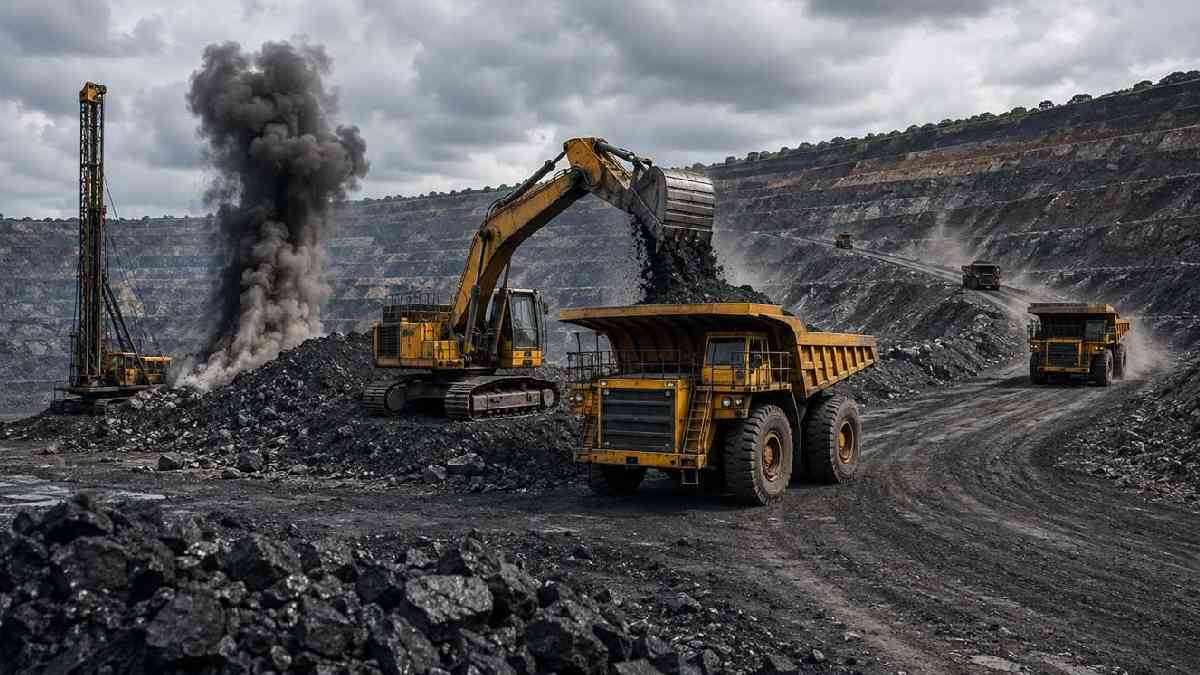
Mining is inherently vulnerable to operational disruptions. Floods, monsoons, extreme weather, equipment failures, power interruptions, diesel shortages, labor problems, and transportation delays can all affect MCL activities.
Land acquisition, village relocation, and delays in environmental or forest approvals could also affect mine expansion plans.
There is an additional geographical concentration risk as all 17 operational mines are located in the Talcher and Ib Valley coalfields in Odisha.
6. Heavy dependence on contractors and infrastructure
MCL relies greatly on third-party contractors for overburden removal, extraction, loading, and transportation.
In FY26, its top 10 contractors accounted for 60.02% of contractual expenses and rose to 70.97% during the second quarter of June 2026.
The company also depends on suppliers for explosives, machinery, oil, lubricants, and spare parts. Coal evacuation, meanwhile, depends heavily on Indian Railways and other transport infrastructure.
For production and deliveries, any disruption in contractors, suppliers, or rail networks would have an impact.
7. Customer concentration and payment risks
MCL also has significant exposure to a relatively concentrated customer base. Its top 10 customers accounted for 55.94% of FY26 revenue from operations.
Government-owned and government-controlled power companies and utilities contributed 40.39% of revenue from operations in the June 2026 quarter.
The DRHP also highlights the delayed payments from Andhra Pradesh Power Generation Company and Andhra Pradesh Power Development Company. As of June 30, 2026, the outstanding balance is Rs 2,519.52 crore and Rs 561.33 crore, respectively.
Such concentration can bring payment and cash-flow risks.
8. Employee costs, labor issues, and safety risks
Employee costs are another big expense. Employee benefits were Rs 4,719.17 crore in FY26, which is about 15.45% of revenue from operations.
Future wage revisions, employee benefits, and changes in labor laws could increase costs. Strikes and labor disputes could also disrupt mining operations.
In addition to safety, mining carries inherent occupational hazards. MCL reported 13 fatal accident cases between April 1, 2023, and June 30, 2026, according to the DRHP.
9. Environmental, climate, and mine-closure risks
Coal mining is under increasing environmental and regulatory scrutiny. Higher emissions standards, restrictions on new mining projects, environmental litigation, carbon-related policies, and stricter reclamation requirements could increase operating costs or restrict production.
MCL had a provision of Rs 1,369.53 crore for site restoration and mine closure as of June 30, 2026. However, actual closure and restoration costs could differ from current estimates.
The company's expansion into renewable energy, coal gasification, and other minerals also entails execution and capital-allocation risks.
10. Corporate governance and shareholder-alignment risks
The DRHP also identifies corporate governance issues. MCL currently has no independent directors and is seeking an exemption on the basis that its directors are government-appointed.
The filing also highlights historical record gaps, legal and regulatory proceedings, observations by the Comptroller and Auditor General (CAG), auditor emphasis-of-matter items, and related-party transactions.
Related-party transactions were at Rs 8,386.14 crore in FY26
Another important consideration is shareholder alignment. Coal India and the Government of India will continue to have massive control over the company, and their priorities may not always be entirely aligned with those of minority shareholders.
Finally, since the proposed IPO is entirely an Offer for Sale, Mahanadi Coalfields will not receive fresh capital from the issue.
Should investors be concerned?
Mahanadi Coalfields has several strengths: its place within Coal India’s group and importance in India’s coal supply chain. However, the IPO’s investment case can only be assessed with the company’s profit and market position.
The DRHP itself highlights risks related to coal dependence, thermal power exposure, government policy, operational disruptions, customer concentration, contingent liabilities, labor and safety issues, environmental regulations, and corporate governance.
As the company’s strengths and valuation are going to help them make sense of these risks, the key question will be: why are they so attractive?
As with any IPO, investors should read the full DRHP, evaluate the issue valuation, and understand the company's long-term business outlook before making an investment decision.





Comments
Please to leave a comment on this article.