
India’s Parliamentary Finance Committee will discuss cryptocurrency and VDA’s at a meeting with the Finance Ministry on September 16. The move puts India’s evolving digital-asset framework back under parliamentary scrutiny.
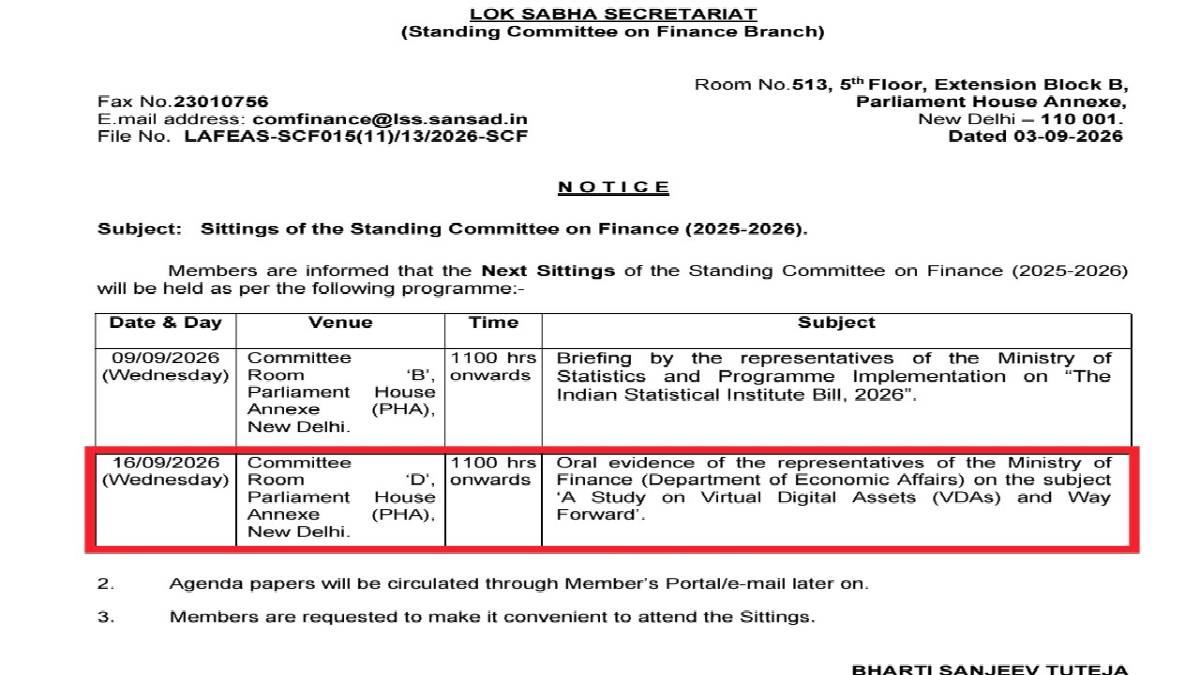
The interaction is important as cryptocurrencies and other virtual digital assets have become an increasingly hot topic for policymakers, investors, financial institutions and technology companies. The committee’s meeting with Finance Ministry may help them get a clearer picture on how the government sees the future of digital assets in India and whether further policy measures can be contemplated.
September 16 discussion will address issues around cryptocurrencies and VDAs as well as the broader regulatory and policy environment. India has not recognised private cryptocurrencies as legal tender but digital-asset activities have come under the country’s taxation and AML framework.
In 2022 India introduced taxation provisions for Virtual Digital Assets (VDA): a tax of 30% on income from transfer of certain VDAs and a TDS of 1% on specified VDA transactions. Thus the sector was put under a separate taxation regime.
The government has also given a lot of attention to monitoring digital-asset transactions from a financial crime and money laundering perspective. Crypto companies operating within the applicable framework have had to comply with more rules (know your customer procedures, reporting obligations etc.)
Against this background, the Parliamentary Finance Committee’s planned meeting with the Finance Ministry could be watched by domestic crypto industry players. Market participants have been asking for more regulatory certainty (taxation, compliance requirements and long-term treatment of digital-asset businesses) so far.
The timing is also interesting because cryptocurrency markets are increasingly integrated into the global financial system. Bitcoin, Ethereum and other digital assets have attracted investors from around the world; governments are still debating how to regulate them without creating financial instability or illicit activity.
For India the policy challenge is how to balance innovation with consumer protection and financial stability. Blockchain technology and digital assets have applications in payments, finance, tokenisation etc but policymakers have also flagged volatility, fraud, money laundering and investor protection issues too.
The Finance Ministry’s response to questions from the parliamentary panel could therefore be important for understanding where the government is at in its current position. Any indication of proposed changes to taxation, regulation, compliance or broader legal framework would get a lot of attention from crypto ecosystem players.
But the September 16 meeting itself shouldn’t be read as confirmation that a new cryptocurrency law or regulatory framework will be announced on September 16 — the committee’s questioning is primarily an opportunity for lawmakers to look at how the government is going about things and ask questions from the relevant ministry.
The move underscores how important Virtual Digital Assets are becoming in India’s economic and financial policy debate. As digital-asset markets keep evolving rapidly, parliamentary scrutiny could influence the direction of future regulation.
All eyes are on September 16 now when Parliamentary Finance Committee will quiz the Finance Ministry on cryptocurrency and Virtual Digital Assets. What comes out of the discussion and what observations are made could give important signals about how India approaches next phase of its approach to rapidly changing digital-asset sector.





Comments
Please to leave a comment on this article.