
IBM suffered one of its biggest setbacks in its long corporate history as its stock tanked 25 per cent on Tuesday after it reported disappointing preliminary second-quarter results. It was the company's worst single-day stock market fall in nearly 58 years, wiping out an estimated $67 billion to $70 billion in market value, according to Bloomberg.
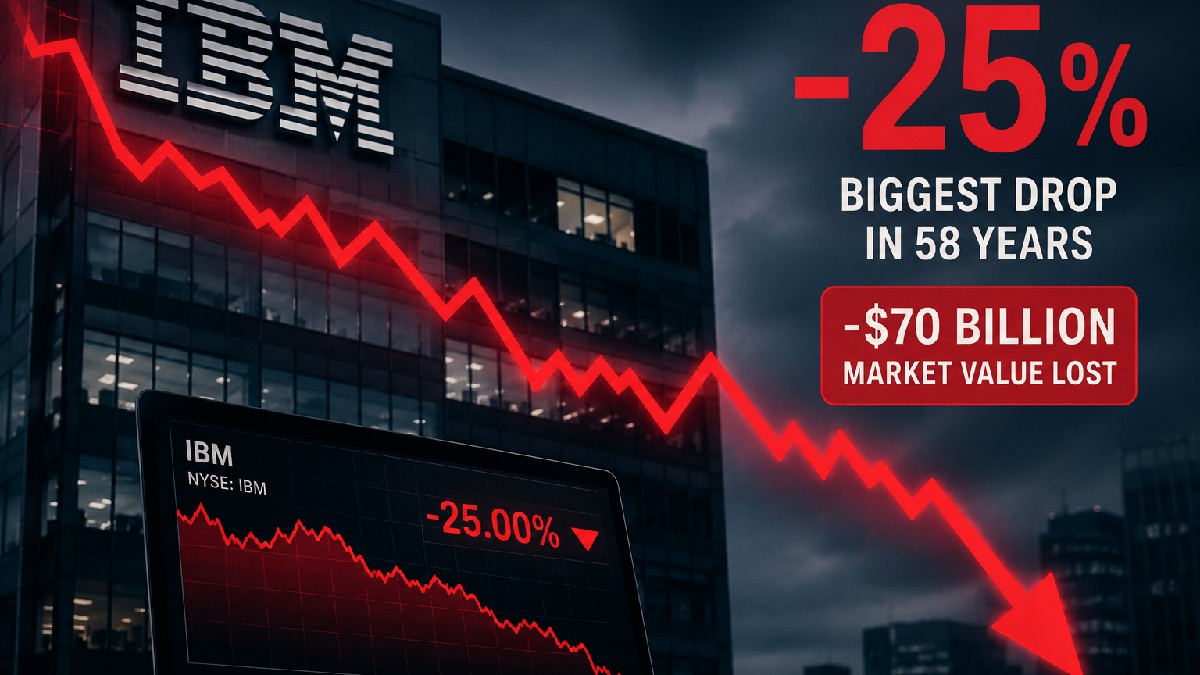
The historic sell-off has been a reflection of growing investor concern around IBM’s failing to stay up with a rapidly evolving artificial intelligence (AI) market where competitors are profiting from huge demand for AI infrastructure and IBM’s traditional businesses are struggling to keep up.
Investor sentiment in the stock market is strong and the share market is down.
In the second quarter ending in June, IBM reported revenue of $17.2 billion -- which was only 1 percent higher than the previous quarter. The company maintained its profitability, but the result was lower than Wall Street's expectations and investors sold on the stock.
IBM’s infrastructure division, which includes its flagship mainframe computers used by banks, government agencies and big businesses, saw revenue decline by seven per cent. Software sales grew by five per cent, but it also failed to meet analysts’ expectations.
The disappointing results showed IBM CEO Arvind Krishna said that IBM CEO Arvind Krishna had failed to adapt quickly enough to market changes and the company’s market conditions.
Krishna wrote, “We faltered... and did not adapt and move quickly enough."
AI Boom Changes Customer Preferences
The AI boom has dramatically changed the way businesses allocate technology budgets, IBM said.
As companies race to build AI capabilities, demand for servers, storage systems and memory chips has swelled around the world. Supply shortages and rising prices led many enterprise customers to rush to buy AI-based hardware before costs went up further.
Krishna explained that in the final weeks of June, many large clients shifted their capital expenditures towards servers, storage equipment and memory infrastructure rather than IBM’s more profitable mainframe systems.
The company did admit they anticipated some supply chain disruptions but underestimated the magnitude of changing spending priorities of customers.
This change had a huge impact on IBM’s most profitable hardware business in the quarter.
Cybersecurity Spending Also Hurt IBM
Another factor that weighed on IBM’s performance was how cybersecurity is becoming more important.
IBM said many corporate customers diverted technology budgets toward strengthening cyber defences as AI-powered cyber threats became increasingly sophisticated.
Industry concerns were reinforced by Anthropic’s Mythos AI model, which was said to have been able to identify possible vulnerabilities in computer networks. As a result, many organizations put cybersecurity investments ahead of infrastructure upgrades.
The trend was good for cybersecurity firms instead of enterprise software providers. CrowdStrike shares rose around 12 percent and Okta and Netskope gained about 11 percent during the trading session.
Fresh Questions Over Traditional Software Companies
IBM’s disappointing performance has also reignited debate on the future of Software-as-a-Service (SaaS) companies in the AI era.
Analysts had predicted earlier this year that generative AI would reduce demand for a number of traditional software products by allowing businesses to use advanced AI models to perform complex tasks instead of specialized applications.
Following IBM’s warning, shares of several software companies, including Salesforce, Adobe and Intuit, also fell as investors weighed in on growth prospects for the software industry’s long-term prospects with a more pessimistic view on future growth.
Bright Spots Remain
Despite the disappointing quarter, IBM reported a few business segments that had a good quarter.
The Red Hat division, which makes open-source enterprise software, saw 11 per cent revenue growth, highlighting strong demand for cloud and hybrid infrastructure solutions.
Meanwhile, IBM's server and storage business outside its mainframe portfolio grew 37 per cent as the demand for AI infrastructure equipment from customers increased.
The company also announced Lightwell, a new $5 billion effort to improve the security of open-source software. The project has received backing from several large banks, including Bank of America, JPMorgan Chase and Goldman Sachs.
Outlook
In the meantime, even as IBM continues spending heavily on artificial intelligence, cloud computing and cybersecurity, the latest earnings show the challenges facing one of the world’s oldest technology corporations in the midst of one of the biggest technological changes in decades.
Investors will now anxiously watch IBM’s upcoming quarterly results to see if its AI strategy and new businesses can offset the slowdown in its traditional mainframe business. How IBM responds to the rapidly changing AI economy will ultimately determine whether Tuesday’s historic stock market bust will be a temporary blip or a long-term headwind.






Comments
Please to leave a comment on this article.