
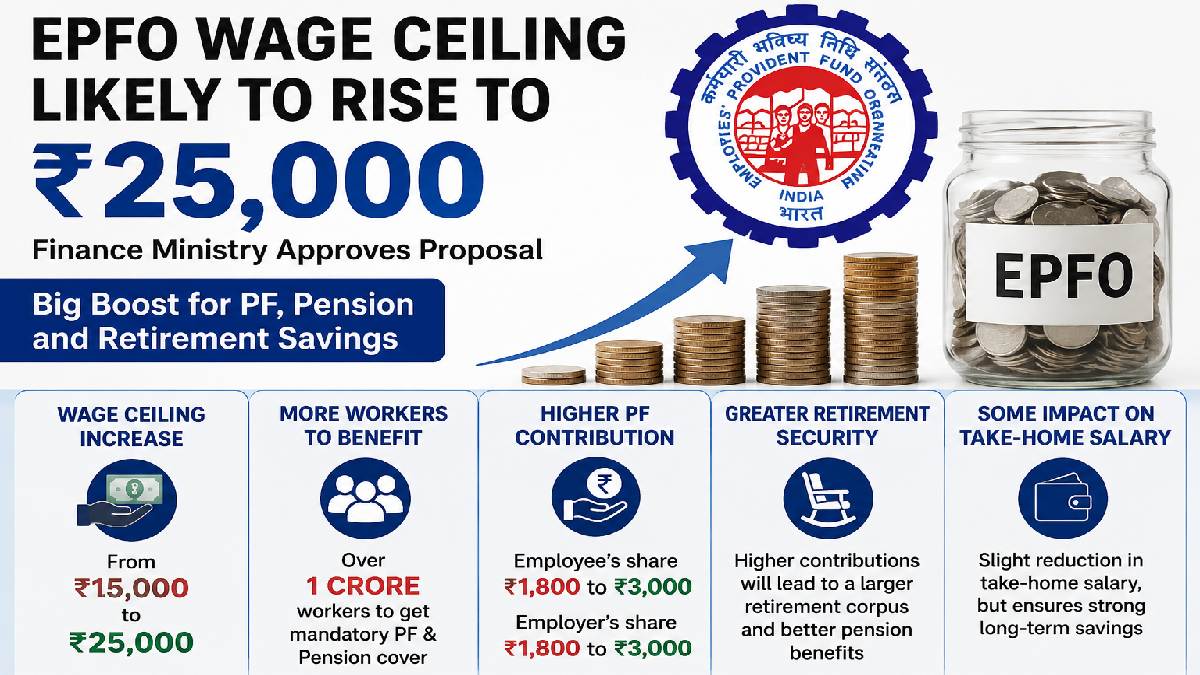
In another gamechanger for Indian organized labor, the Ministry of Finance has proposed to raise the EPFO wage ceiling from ₹15,000 to ₹25,000 per month. If implemented, it would be the first significant change in the EPFO wage limit since 2014 and would help to make mandatory social security coverage available to millions of additional employees across the country.
The rise is widely seen as a long-anticipated change that is in line with changing salary structures, inflation, and rising living costs. In September 2014, the current wage ceiling of ₹15,000 was introduced - raised from ₹6,500. Since then, industry groups, employee unions, and labor experts have repeatedly advocated for a change in the wage structure to match the economic reality of the organized sector.
One of the most significant benefits of the proposed revision is the extension of mandatory EPF and Employees' Pension Scheme (EPS) coverage. More than one crore employees in the private and organized sectors could fall under compulsory provident fund and pension coverage once the new wage ceiling is implemented. This would enhance social security benefits for a large portion of the workforce and give long-term financial stability to workers.
Under existing EPFO regulations, employers must enroll employees whose basic wages fall within the prescribed wage ceiling. While many companies voluntarily provide EPF benefits to employees earning over ₹15,000 per month, their mandatory contribution obligations are usually based on the current ceiling. Hence, many workers don’t get the full benefit of higher contributions, even if they earn much more than the existing threshold.

If the wage ceiling is raised to ₹25,000, employee and employer contributions to the provident fund will increase. The mandatory contribution is about 12 percent of ₹15,000, so the monthly contribution is ₹1,800 each for employee and employer. With the ceiling raised to ₹25,000, the mandatory contribution could increase to ₹3,000 per month for both sides. This would translate to much more money in the EPF accounts of employees every month.
The increase in contributions is expected to greatly improve retirement savings. The people in the workforce who earn between ₹15,000 and ₹25,000 in basic wages would accumulate a larger retirement corpus for their careers. Financial experts say the compounding effect of higher monthly contributions might have an impact on significantly higher savings in retirement and lead to greater financial security in the post-retirement years.
Another important benefit would be the impact on the EPS. Since the employer’s contribution goes to EPS, higher contributions in the future might also increase pension benefits. The retirees covered by the scheme would receive higher monthly pension payments after retirement, and the whole social security system might be better managed.
But the proposed change could also slightly affect employees' take-home salaries. Since the employee's mandatory contribution would go from ₹1,800 to ₹3,000 per month, workers above the current threshold would see a modest reduction in their monthly disposable income. But financial planners say this reduction will result in higher long-term savings rather than a cost.
As a result, employers, especially private companies, will also face increased payroll costs if they need to pay 12 percent of their payroll to meet the new wage ceiling. And if businesses pay more for employment-related expenses for their labor-related costs, labor experts say that the benefits of better retirement security and social protection outweigh the additional costs.
The proposed change is an important step towards modernizing India’s social security system. If PF and pension coverage is enlarged and retirement savings opportunities are increased, millions of workers can experience financial benefits and the country’s organized labor system will be strengthened.










Comments
Please to leave a comment on this article.