
As more Indian households switch from gold and real estate assets to financial products including mutual funds and equities, investing is more accessible than ever. This growing trend, often referred to as the ‘financialisation of savings’, has driven up the number of SIPs with monthly SIP contributions hitting over ₹30,000 crore in recent months.
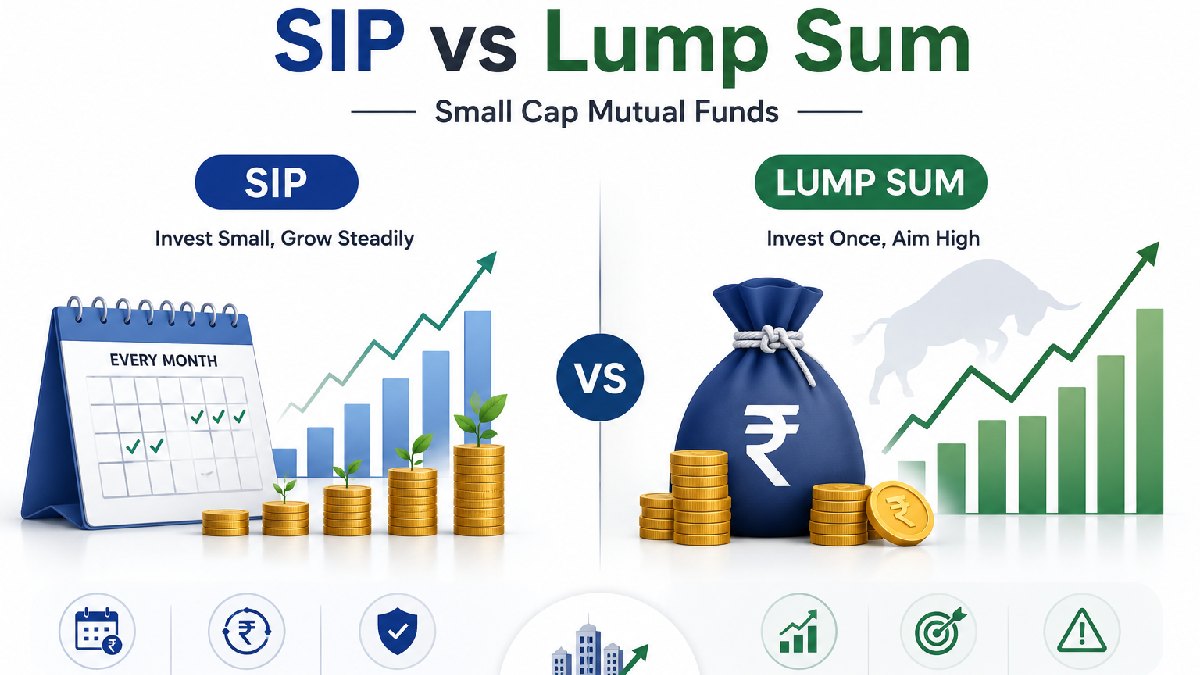
Small cap mutual funds are now a very attractive option for investors looking to reap in India’s long run of growth. However, one common question is whether to invest in a systematic investment plan (SIP) or lump sum investment?
The answer depends on your financial goals, cash availability and risk tolerance.
What is a SIP?
A systematic investment plan (SIP) allows investors to invest a fixed amount at regular intervals—usually monthly or quarterly—in a mutual fund.
Instead of investing a large amount at once, SIP spreads investments over time. Since mutual fund units are bought at different net asset values (NAVs), investors benefit from rupee cost averaging to reduce market volatility.
If you invest ₹10,000 every month for five months, your investment will buy more units when prices are low and fewer units when prices are high. Over time, that is going to minimize your average purchase cost and not require you to forecast market movements.
What is a Lump Sum Investment?
A lump sum investment is investing in a mutual fund as a whole in a single transaction.
For example, investing ₹50,000 at one time means all units are purchased at the prevailing NAV on that day.
While this strategy can yield good returns when the markets rise after investment, it also comes with big timing risk. If the markets fall off after investing, the portfolio will suffer immediately.
Benefits of SIP in Small Cap Funds
Small cap stocks are known for their high growth potential but also experience significant price fluctuations.
Some advantages of SIPs:
- Reduces dependence on market timing.
- Encourages disciplined investing.
- Benefits from rupee cost averaging.
- Makes investing affordable through smaller monthly contributions.
- Helps investors stay invested through different market cycles.
Benefits of Lump Sum Investing
Lump sum investing may be suitable when:
- You have a lot of money available for investment.
- The markets are trading at relatively attractive valuations.
- You have a long investment horizon.
- You can tolerate short-term market swings.
If the investment is made ahead of a sustained market rally, lump sum investment may lead to better returns than staggered investment.
Which Strategy Should You Choose?
There is no universal answer to this.
A SIP may be more suitable if:
- You have a regular monthly salary.
- You like to invest slowly.
- You want to minimize market timing risk.
- You are a first-time investor.
A lump sum investment is suitable if:
- You have received a bonus, inheritance or other surplus funds.
- You think market valuations are attractive.
- You have a higher risk appetite.
- You are investing for the long term.
Can You Combine Both?
Many financial planners recommend a hybrid strategy.
Under this approach:
- Continue a monthly SIP for long-term wealth creation.
- Invest additional lump sum amounts whenever surplus funds become available or market opportunities arise.
This strategy combines disciplined investing with the flexibility to take advantage of attractive market conditions.
Final Thoughts
Both SIP and lump sum investments ultimately invest in the same small cap mutual fund—the difference lies in how and when your money enters the market.
SIPs help to mitigate volatility by spreading out investments in multiple market cycles, while lump sum investments can yield higher returns when done properly but also have higher short-term risk.
Investors should not try to predict market movements; instead, they should focus on their financial goals, investment horizon and risk tolerance before choosing an investment strategy.
Disclaimer:
This article is intended solely for educational purposes and should not be considered investment advice or a recommendation. Mutual fund investments are subject to market risks. Please read all scheme-related documents carefully before investing.






Comments
Please to leave a comment on this article.