
Alternative Investment Funds (AIFs) are one of the fastest-growing investment options for high-net-worth individuals (HNIs), institutional investors and advanced investors looking at diversification of their portfolios from stock, bond or mutual funds. Under SEBI’s regulations (Alternative Investment Funds) (2012), AIFs are subject to a lot of risk, especially in terms of the investment opportunities for long term at the time of launching and maintaining the investment in the investment portfolio.
Unlike mutual funds for retail investors, AIFs are private investment vehicles that have huge capital commitments. They can be formed as trusts, companies, Limited Liability Partnerships (LLPs) or any other legally permitted entity.
What is an AIF?
An alternative investment fund is an investment vehicle that is a private mutual fund which receives money from a select group of investors and invests it according to an investment strategy. A subset of these funds typically invests in startups, private companies, infrastructure projects, hedge funds, debt or other non-traditional assets.
AIFs are mainly aimed at investors who are looking for higher returns, portfolio diversification and exposure to alternative asset classes.
Types of Alternative Investment Funds
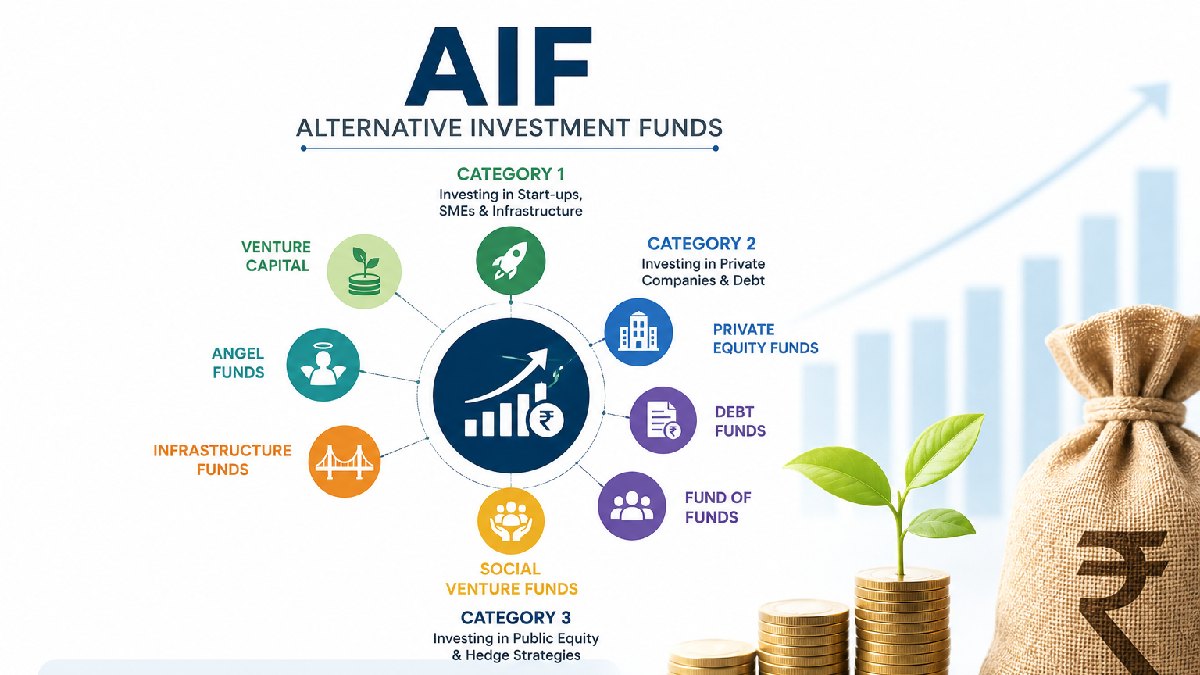
SEBI has classified AIFs into three broad categories based on their investment objectives.
Category I AIFs
These funds invest in sectors considered socially or economically desirable and often receive regulatory incentives too.
Venture Capital Funds (VCFs): These funds provide capital for startups and early-stage businesses with high growth potential. They are suitable for investors willing to take on greater risks in exchange for potentially huge returns.
Angel Funds: Angel funds invest in promising startups in their early stages when there is an absence of traditional funding. The minimum investment of each angel investor is Rs 25 lakh.
Infrastructure funds invest in infrastructure projects like roads, railways, airports, ports and power generation. Many investors who consider India's long-term infrastructure growth to be very compelling will use these funds.
Social Venture Funds: These funds invest in businesses that aim to create social impact and also deliver reasonable financial returns.
Category II AIFs
Category II funds generally invest in companies without the need for any leverage except for operational requirements.
Private equity funds invest in unlisted private companies that grow and retain the money investors invest into it, in turn giving them a stable and long-term return on the investment. There are lock-in periods of four to seven years.
Debt Funds: These funds buy unlisted companies’ debt. Although they may generate attractive returns, they carry much more credit risk than traditional debt.
Fund of Funds (FoF): Instead of investing directly in companies, these funds invest in other Alternative Investment Funds, offering investors a higher level of diversification.
Category III AIFs
These funds are complicated to invest in and leverage is the approach that may be used to obtain more returns.
Private Investment in Public Equity (PIPE): PIPE funds invest in shares of publicly listed companies at a large discount to provide quick capital to businesses.
Hedge Funds: Hedge funds have aggressive investment strategies in domestic and international equity and debt markets. Management fees of about 2% as well as performance fees of 20% can be charged.
Who can Invest in AIFs?
Alternative Investment Funds are open to:
- Resident Indians
- Non-Resident Indians (NRIs)
- Foreign nationals
- Institutional investors
The minimum investment requirement is generally Rs 1 crore per investor. For directors, employees and fund managers associated with the AIF, the minimum investment is Rs 25 lakh.
AIFs tend to have a minimum lock-in period of three years, and as such they are more suitable for long-term investors.
Investing in AIFs. High Return Potential
AIFs invest in both alternative asset classes and high-growth businesses so they might generate much higher returns than traditional investment options.
Portfolio Diversification
AIFs give investors exposure to assets that are not strongly linked to stock market movements, helping to diversify their portfolio and reduce concentration risk.
Professional Fund Management
Experienced fund managers actively manage investments using sophisticated strategies and in-depth market research.
Lower Market Correlation
Many AIF strategies are designed to work independently of traditional markets and, thus, might provide more stability during periods of market volatility.
Things to Consider Before Investing
While AIFs present some promising opportunities, they also pose certain risks. Investors should carefully assess:
Investment horizon
Liquidity constraints due to lock-in periods
Risk profile
Fund manager's experience and track record
Fee structure
Investment objectives
Since AIFs usually involve significant capital commitments, they are best suited for investors with a high risk appetite and long-term wealth creation goals.
Final Thoughts
Alternative Investment Funds have become an increasingly popular investment avenue for sophisticated investors seeking diversification beyond conventional financial products. AIFs can offer opportunities that retail investors don't have access to - venture capital, private equity, infrastructure, debt or hedge funds - and so on.
However, these investment options also come with unique risks which require thorough due diligence before investing. Understanding the different types of AIFs, eligibility criteria and investment strategies can aid investors in making informed financial decisions that are in line with their long-term goals.
As an investor, the reader should consult a financial adviser.






Comments
Please to leave a comment on this article.