
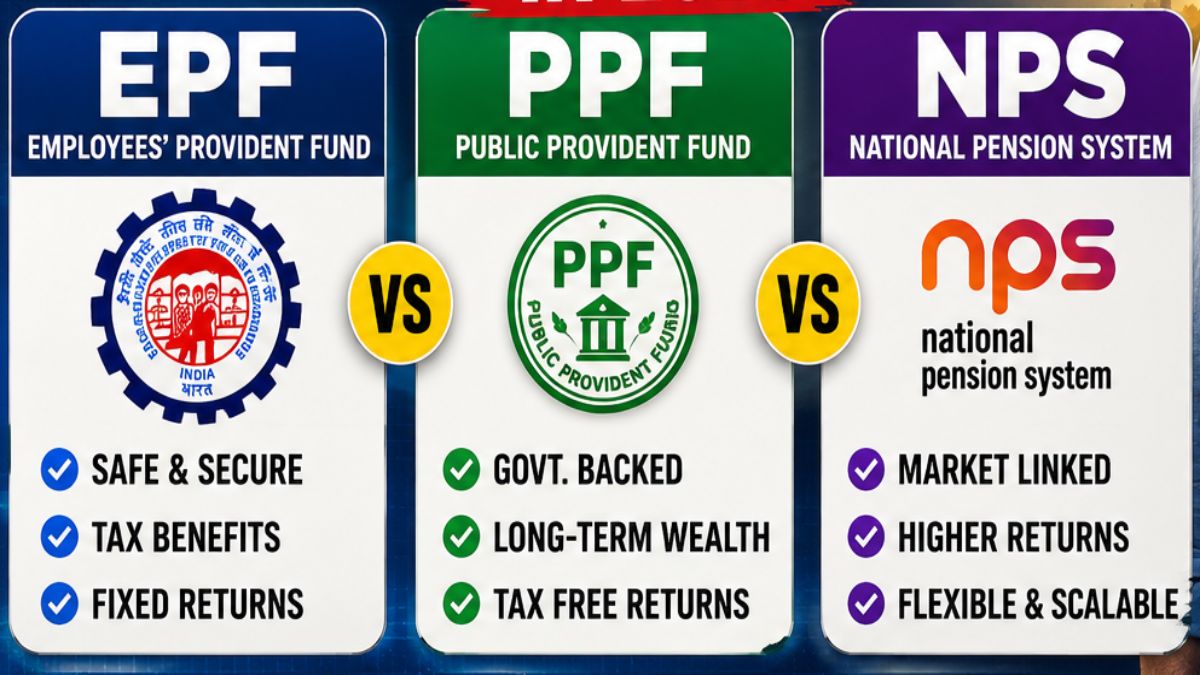
EPF
Eligibility: Mandatory for salaried employees in organizations that are listed on EPFO.
Returns: Interest rate fixed annually (8.25% for FY2025‑26).
Tax Benefits: Contributions are tax-free under Section 80C, and maturity is tax-free (EEE status).
Best For: Salaried individuals seeking stable, government‑backed retirement savings.
PPF
Eligibility: Open to all Indian citizens, including self-employed.
Returns: In quarterly update (currently ~7.1%).
Lock-in: 15 years, and extendable in 5-year blocks.
Tax Benefits: Section 80C deduction; interest and maturity tax-free.
Best For: Conservative investors looking for safe, long‑term wealth creation.
NPS
Eligibility: Open to all citizens aged 18-70.
Returns: Market-linked; average 9-12% depending on equity exposure.
Withdrawals: 60% lump sum at retirement (tax‑free), 40% mandatory annuity purchase (taxable).
Tax Benefits: Section 80C (₹1.5 lakh) + Section 80CCD(1B) (₹50,000 extra).
Best For: Investors comfortable with market risk, seeking higher returns and pension income.
Returns Fixed around 8.25% Fixed around 7.1% Market-linked 9–12%
Risk Very low Very low Moderate to high
Tax Status EEE EEE Partial (annuity taxable)
Lock-in Till retirement 15 years Till age 60
Best For Salaried employees Self-employed, conservative investors
EPF is ideal for salaried employees who want guaranteed returns and tax‑free maturity.
PPF is suited to self-employed or risk-averse individuals who are looking for safe, long-term savings.
NPS has a higher growth potential but comes with market risk and partial taxation.
In 2026, the best retirement strategy is diversification combining EPF/PPF for stability with NPS for growth to provide a stable and secure retirement corpus.






Comments
Please to leave a comment on this article.