
From making UPI payments by hand and scanning restaurant menus to getting Wi-Fi access and downloading event tickets, Quick Response (QR) codes are now part and parcel of life for millions of people around the world.
The square-shaped patterns of black and white modules have been born in almost every city and have changed the way we interact with digital information in our daily life. With only a smartphone camera, we can easily access digital information in our lives with a lot of digital content instantly, so QR codes are one of the most important tools in today’s digital world.
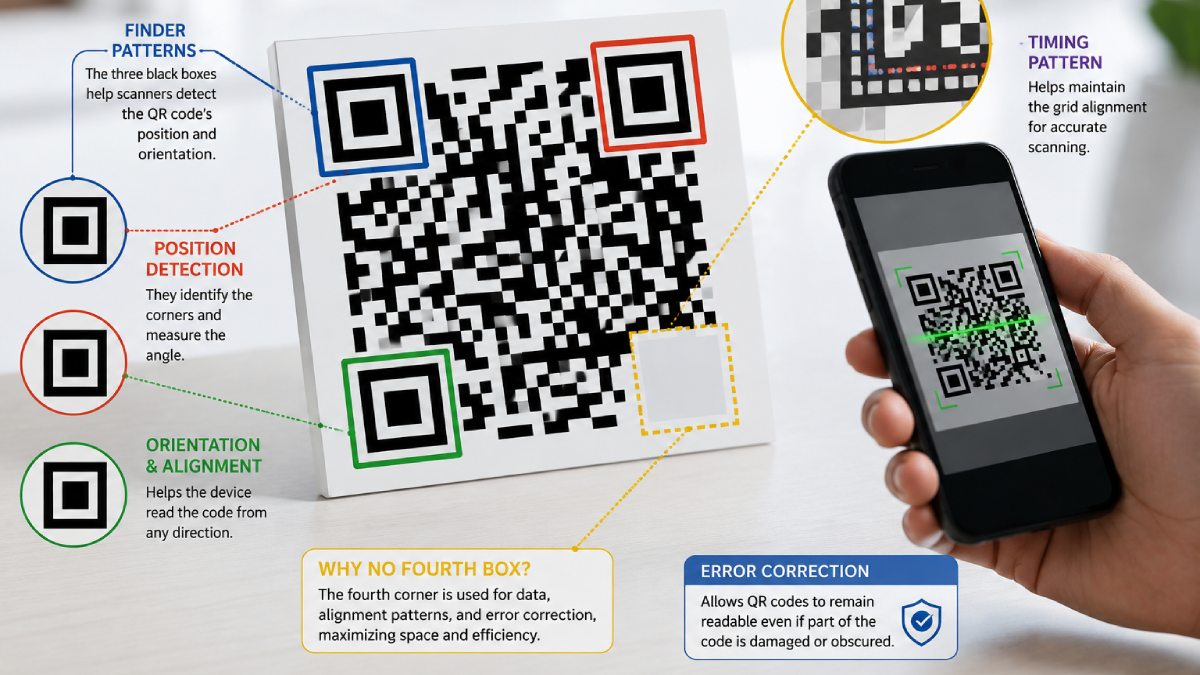
While billions of people scan QR codes every day, very few of them notice the three large black squares on the top three corners of the code, and only the top corner of the QR code has an empty space. It’s not just a logo in the QR code, but a design that allows the code to be scanned accurately and quickly from almost any angle, and thus makes it very convenient.
The Purpose of the Three Black Boxes
These bright black squares are referred to as Finder Patterns. They are all the reference points for a smartphone/scanner to find a QR code almost instantly in view of the camera. Once the scanning software is turned on, the software continuously analyzes the image for a black and white pattern.
The patterns in the finder squares are set to be 1:1:3:1:1 and this makes the image-processing algorithm much easier. The exact ratio also means that QR codes can be found in a complicated or crowded space where other patterns would be missed.
As soon as these three finder patterns are detected, the scanner confirms instantly that it is indeed seeing a valid QR code and not random shapes, text, or other visual clutter. Quick recognition is key for efficiency and user experience as it facilitates easy-to-use interaction with the digital world.
How QR Codes Can Be Scanned From Any Angle
The most amazing property of QR codes is that they can be scanned even if they are turned upside down or viewed from an angle. This is possible because the three finder patterns are enough to guide the scanner to determine important factors:
- The orientation of the QR code
- Its rotation angle
- The viewing perspective
- The size and scale of the image
Using these three fixed points, the decoding software can manually adjust the image to minimize distortion and read the encoded information. It happens in just milliseconds for users to scan QR codes and not have to be in line with their phones or the code fit to the frame.
Why Isn't There a Fourth Black Box?
Some people might think that adding a fourth finder pattern would improve the scanning accuracy. Surprisingly, engineers have left the fourth corner free for practical reasons. From a mathematical point of view, only three non-collinear points are enough to form a two-dimensional plane. As the scanner already has the three finder patterns, it has all the information it needs to locate the QR code, orientation, and scale.
To add an extra finder pattern would take up valuable space on the code without improving performance. Instead, we use the fourth corner and the area around it for more important functions, such as:
- Timing patterns that keep the scanning process synchronized
- Alignment patterns that can help correct any distortions that might occur when scanning
- Version information that indicates the version of the QR code standard that is used
- Data storage that keeps the actual information in the QR code
- Format information that tells the scanner how to read the data
This extremely efficient use of space allows QR codes to carry much more information while being small in size.
The Alignment Patterns
Besides the large finder patterns, a lot of QR codes, even larger ones, display small square markings, also known as alignment patterns. These smaller patterns help scanners to get rid of image distortion that can be the result of curved surfaces, printing imperfections, or the angle at which the camera is held.
A QR code is written on a bottle, a poster, a package, or a billboard and alignment patterns increase reading accuracy and make it possible to read the digital content without having to deal with the scanner's error.
Error Correction Makes QR Codes Very Reliable
One of the most advanced features of QR code technology is its robust Error Correction feature. QR codes have the Reed-Solomon error correction algorithm with which they can recover and repair damaged data. That is, a QR code is still readable even if it is:
- Torn
- Scratched
- Dirty
- Partially covered
- Printed imperfectly
Considering how much error correction is done to the code, QR codes can recover information if up to 30% of the code is damaged or obscured. This resilience is of particular value to businesses as they can still put their logos on the center of QR codes and still use them to ensure that the codes don’t lose their functionality or readability in the system.
Why QR Codes Have Become Popular
Originally created by Denso Wave in 1994 to track automotive components, QR codes have been used as one of the most popular data-sharing technologies in the world, and have become one of the world’s most popular in recent years, due to the proliferation of contactless services.
QR codes not only have the capability to store data as opposed to barcodes, but also to store large amounts of information, such as:
- Website URLs
- Contact information
- Payment information
- Wi-Fi passwords
- Product information.
- Digital tickets
- App download links
- Authentication data
With a large storage capacity, fast scanning speed, and error correction capability, QR codes are now indispensable in banking, healthcare, education, retail, logistics, transportation, and government services.
A Perfect Blend of Mathematics and Engineering
A simple QR code may seem simple at first sight, but it is designed as an engineering process. Each square of the QR code is structured to guide the scanner to fix any image distortion in the image, so as to protect the data from further damage.
The three black boxes on the corners of the QR code are not only visual markers for the reader, but they provide the basis for QR codes to be found from all angles. This combined with the high-level error correction algorithms and data organization of the QR code are what make it the most reliable and intelligent technology in digital communication today.
As contactless services become more prevalent across the world, QR codes will serve as the bridge between the physical and digital world. Small design choices such as not having a fourth black box can make a big technological impact and show the balance between functionality and efficiency in QR codes.






Comments
Please to leave a comment on this article.