
New Delhi: Tata Consultancy Services (TCS), the Tata Group's largest profit-generating company, paid a much smaller dividend to its parent group, Tata Sons, in FY26 than in FY25. The dividend dropped 12%, the largest year-on-year cut since the Covid-19 pandemic and indicative of the global IT industry’s issues.
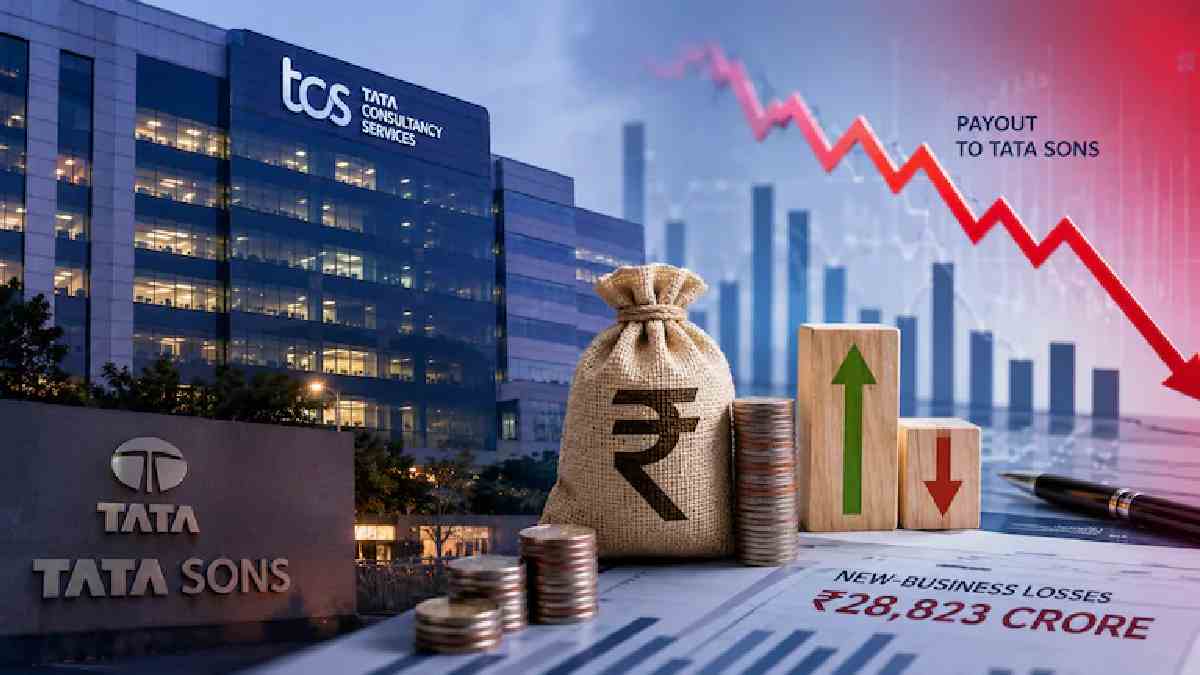
According to the Tata Sons FY26 Annual Report, the holding company received Rs 28,291 crore in dividends from TCS during the financial year, down from a record Rs 32,184 crore received in FY25. TCS did not announce any share buyback in either financial year, and dividends are the main source of cash returns to Tata Sons.
The biggest decline since the Pandemic
The fall in dividends is the sharpest year-on-year reduction in TCS payouts since FY21, when dividends fell by 22% due to the disruption caused by the Covid-19 pandemic.
After that period, dividend payouts had also recovered and were still between Rs 28,000 crore and Rs 32,000 crore in the period from FY23 to FY25. From FY20 to FY26, Tata Sons received a cumulative Rs 1.81 lakh crore from TCS through dividends and share buybacks.
Despite the massive returns, the dividend growth has been modest - a compound annual growth rate (CAGR) of about 3.5% is in place, and payouts have declined in three of the past six financial years.
IT Industry Under Global Demand Change
The reduced dividend is representative of changes in the global information technology industry.
Businesses worldwide are becoming more cautious about traditional IT outsourcing expenditure, while increasingly investing in AI, automation, and digital transformation. Demand for technology services has moderated compared to previous years.
For FY26, TCS reported:
- Revenue: Rs 2.67 lakh crore (up 4.58% YoY).
- Net Profit: Rs 49,454 crore (up 1.34% YoY)
The relatively slower profit growth also influenced the company's shareholder payouts.
Tata Group’s growth businesses’ losses are increasing
While dividend income was down, Tata Sons had to provide more financial support to a number of its rapidly growing businesses.
Combined losses at Air India, Tata Digital, and Tata Electronics nearly doubled to Rs 28,823 crore in FY26, compared to Rs 15,539 crore in the previous financial year.
Air India remained the biggest loss-making business with a net loss of Rs 22,238 crore, which is significantly higher than Rs 10,859 crore in FY25. The airline is now heavily investing in fleet expansion, operational integration, and service transformation following its acquisition.
Tata Digital reported a loss of Rs 4,974 crore against Rs 4,610 crore a year ago as it continued investing in platforms like Tata Neu, BigBasket, and 1mg, which would help to build its digital commerce ecosystem.
Tata Electronics also had a higher loss of Rs 1,611 crore, up sharply from Rs 70 crore in FY25. However, the increase in loss is mainly due to aggressive investments in semiconductor manufacturing and electronics production. But the business achieved operating break-even for the first time as it almost doubled its revenue to Rs 1.31 lakh crore.
Tata Sons’ financial position is good
Tata Sons is still financially strong even as it has a growing investment requirement in several businesses.
Its standalone profit rose 22% to Rs 31,961 crore in FY26. The company was debt-free and ended the year with cash and cash equivalents of Rs 21,841 crore. The one-time investment gain of Rs 6,531 crore also contributed to the profit improvement.
However, due to the lower contribution from TCS, Tata Sons' total dividend income declined by around 10%, falling to Rs 32,528 crore from Rs 36,149 crore in FY25.
Despite this, TCS contributed nearly 87% of Tata Sons' total dividend income in FY26, highlighting its continued importance to the group's funding strategy.
Long-Term Outlook
Tata Sons is in a very good position financially for all of its ambitions in aviation, semiconductors, and digital technology, industry experts say. However, as these businesses are going to require substantial capital over the long run, future cash generation from TCS will remain a critical pillar of the Tata Group’s long-term growth strategy.






Comments
Please to leave a comment on this article.