
South Korea’s most important stock index, KOSPI, is off 11% so far and sending a chill through financial markets around Asia and raising questions about the health of one of the world’s most export-dependent economies. The selloff has wiped out billions of dollars in market value and triggered a wave of risk aversion among domestic and international investors.
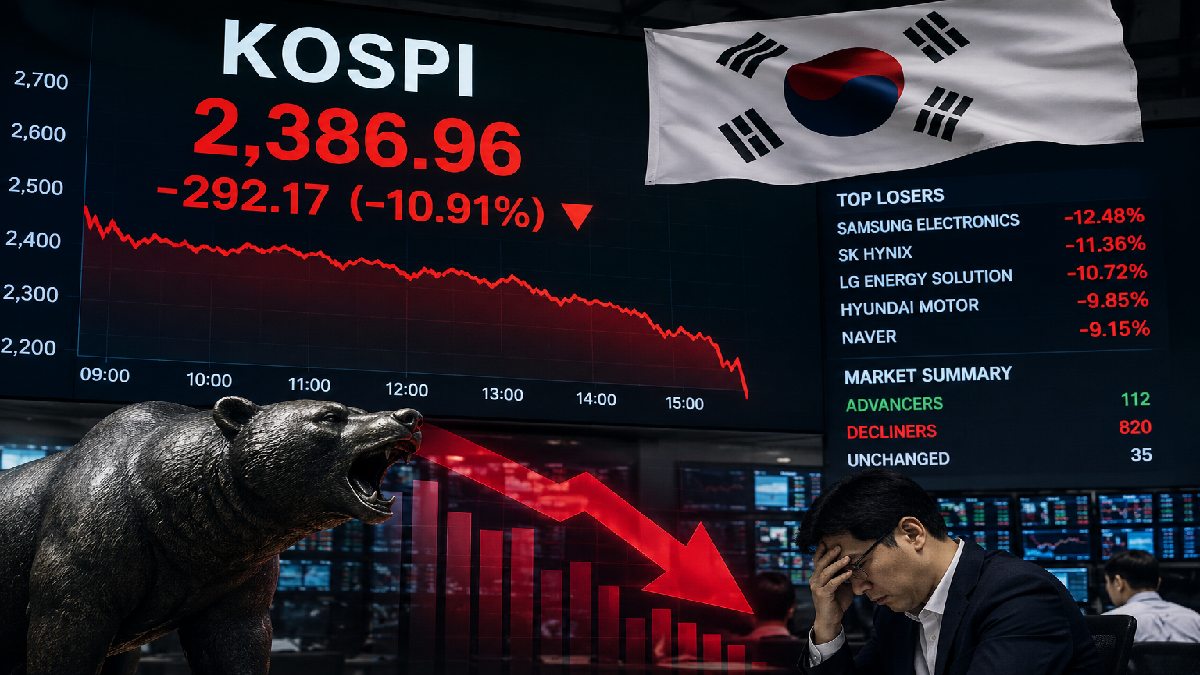
The decline is caused by a combination of global and domestic headwinds that have severely eroded investor confidence. South Korea has long been considered one of Asia’s top developed economies and one of the world’s technology leaders, but the economy is starting to show some vulnerability, which investors are starting to worry about.
One of the major reasons for the sharp drop in the KOSPI is the weakness in the technology sector. South Korea is home to some of the world's biggest technology companies, including Samsung Electronics and SK Hynix. Demand for semiconductors and electronic products is increasingly volatile. Investors fear that slower growth in large markets like the US, Europe, and China may depress demand for chips, smartphones, and consumer electronics in general. South Korea is dependent on exports, and if such a slowdown in global trade affects exports, it could have a severe impact on corporate earnings and even economic growth.
A second big concern is uncertainty around international trade. South Korea is not only heavily integrated into global supply chains semiconductors, automobiles, batteries, and consumer electronics but is also in the global supply chain of companies in these sectors. Increasing geopolitical tension, trade wars, potential tariff issues, and restrictions on technology exports have increased concerns that South Korean businesses might not be able to maintain growth momentum.
China’s economic slowdown has also been a key factor in the market decline. China is still one of South Korea’s largest trading partners; weaker Chinese demand will also be a blow to South Korean exports. Investors are getting more and more concerned as signs of slower industrial activity and worse consumer spending emerge in the Chinese economy.
Currency fluctuations have intensified market pressure. A stronger US dollar and investors nervous that money outflows from emerging markets will soon be pulled back to safer assets have driven Asian stocks to a much closer close. Foreign investors who are holding huge stakes in Korean companies are being less invested in Korean stocks in this time of global turbulence.
The domestic economic problems have also added to the negative sentiments. South Korea is still struggling with slower consumer spending, a cooling housing market, demographic pressures, and concerns about long-term growth prospects. Even if the government has taken measures to shore up the economy, investors are cautious about the pace of recovery.
The sharp correction has been particularly severe for growth-oriented industries. Technology, semiconductor, battery, and automotive stocks have had a severe selloff as investors assess the prospect of future earnings. Companies that were once growth drivers are now under the microscope regarding profits and future demand.
Market analysts also point to the broad global risk-off sentiment as a major factor driving the selloff. Investors have grown more cautious in the face of inflation, interest rates, geopolitical tensions, and cooling global economic growth. Stock markets that are heavily dependent on global trade and technology exports tend to fall more than more globally diversified ones.
Some analysts still see the sharp drop as a good thing for long-term investors and might even see an opportunity in the future. South Korea is still the leader in advanced manufacturing, semiconductor production, battery technology, and innovation. Many of its leading companies have strong balance sheets, global market positions, and technological advantages.
But at least in the short term, volatility will still be high. Investors are going to monitor economic data, corporate earnings reports, trade developments, and central bank decisions for signs of stabilisation. If global demand, semiconductor pricing, or export activity improve, then the South Korean stock market could be revived.
For now, the 11% fall in the KOSPI is a reminder of how interconnected the world's markets are. Uncertainty in the global economy, weak technology, geopolitical risks, and trade activity have all combined to create a challenging environment for one of Asia’s most important stock markets. How and when this selloff may come to an end will be largely determined by how these factors evolve in the coming months.






Comments
Please to leave a comment on this article.