
India’s biggest banks are changing the way they deploy employees as customers increasingly move routine banking activity to digital channels. State Bank of India (SBI), HDFC Bank and Axis Bank have different strategies, but the general trend is the same: banks want employees to spend time on sales, customer engagement and new business.
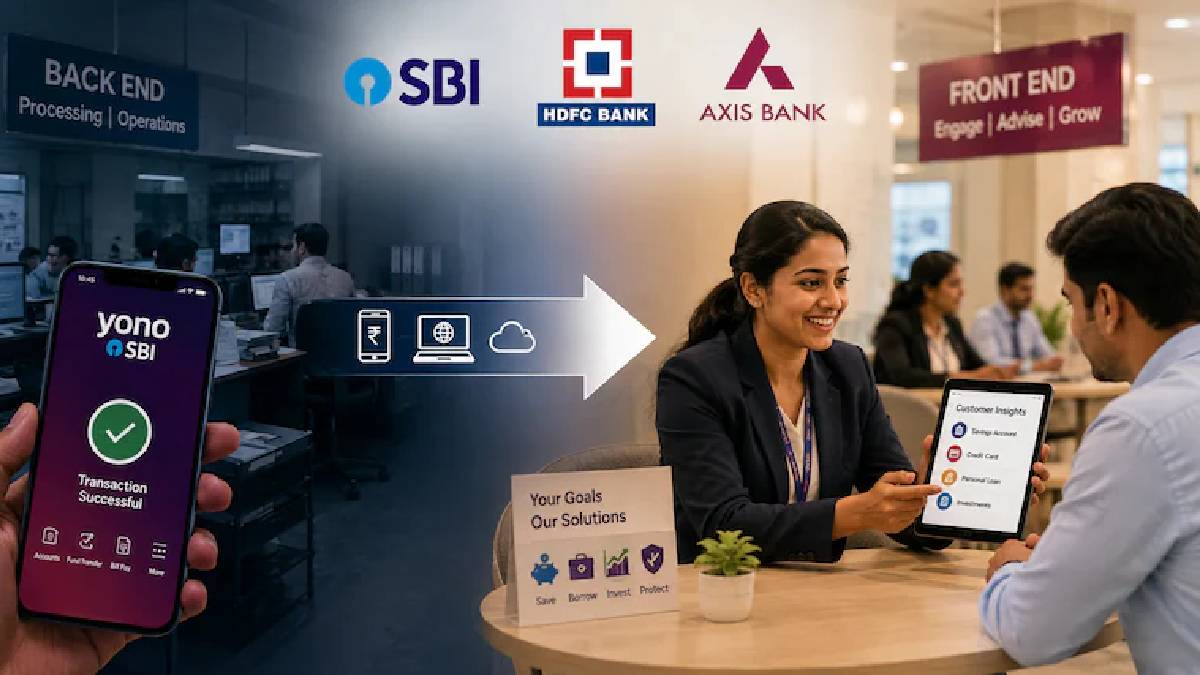
SBI is redeploying employees on branch sales and upselling, while HDFC Bank is looking to shift capacity from back-office operations to customer-facing roles. Axis Bank, on the other hand, has employed technology to give its employees real-time customer information and personalised recommendations to find cross-selling opportunities.
The change illustrates the fact that digital banking is not just reducing the need for physical banking activity. It’s also changing the way bank employees work and the skills that lenders are increasingly demanding from their workforce in the process have also changed.
SBI Turns Branch Staff Towards Sales
SBI has made a point of the shift in its Q4 FY26 earnings call that transactions that are routine are rapidly migrating to other channels.
SBI chairman Challa Sreenivasulu Setty said the bank was redeploying some of its workforce into sales and training branch employees in upselling.
It comes as SBI’s digital platform Yono continues to gain traction. 66% of new savings accounts originated through Yono in FY26, the bank said.
The latest version of Yono also crossed four crore registrations in three months since it launched, taking the total user base to around 10 crore.
With customers turning to digital channels for regular activities such as account opening and transactions, SBI sees an opportunity to use branch employees for higher-value customer interactions.
Instead of just making the process of transactions, employees can spend more time identifying customers’ needs and suggesting products like loans, insurance, deposits, credit cards and investments.
HDFC Bank To Move Capacity From Back End To Front End
HDFC Bank is taking a somewhat different approach to the same structural change.
The private sector lender has stated that technology and customer service improvements would reduce turnaround times and the amount of capacity required for back-end activities.
The bank intends to put some of that capacity towards customer-facing functions.
HDFC Bank management said capacity in the back end would be moved to the front end, allowing employees to engage more closely with customers and generate business momentum.
The strategy is part of a wider change in banking functions. As automation and digital processes take over repetitive duties, banks may be able to shift employees back to activities where human interaction is still required.
These include customer acquisition, relationship management, product sales, and more complex financial decisions.
Axis Bank Uses Technology To Improve Cross-Selling
Axis Bank is creating a customer intelligence-based employee fit and technology-driven customer insights.
Its Siddhi platform has more than 90,000 employees getting real-time insights and personalized recommendations. The platform now supports more than 30 cross-sell journeys covering deposits, credit cards, loans, investments and remittances.
According to the bank, it has observed an approximately 30% improvement in key metrics (including term-deposit bookings, mutual fund transactions and credit-card sales).
Axis Bank has also developed digital journeys covering a broad range of products including savings accounts, salary accounts, current accounts, term deposits, personal loans, business loans, auto loans, gold loans and home loans.
The bank is also using digital tools for credit-card onboarding, cross-selling and upselling.
The objective is to make employees more effective by putting relevant customer information and product recommendations in front of them at the point of interaction.
Digital Banking is Changing Employee Roles
The scale of India's digital banking transition can be seen in customer transaction data.
Punjab National Bank has said that 95% of customer transactions are now digital. The bank has also said that every second loan is now sanctioned through its digital channel, compared with every third loan in the last quarter of the previous year.
Such changes reduce the time employees need to spend processing routine transactions.
But it doesn’t mean banks need proportionately fewer employees at every level. Instead, lenders are increasingly looking at how existing workforce capacity can be redeployed to work that creates revenue or increases the customer experience.
The result is a gradual shift in the definition of a bank employee’s role.
From Transaction Processing to Business Generation
The strategies taken by SBI, HDFC Bank and Axis Bank illustrate three different versions of the same transition.
SBI is explicitly moving some branch employees towards sales and upselling. HDFC Bank is attempting to move capacity away from the back-end and move to customer-facing activities. Axis Bank is using technology to help employees identify customer needs and make personalised recommendations.
The common thread is that digitalisation is freeing employees from some routine banking activities while increasing the importance of sales, relationship management and customer engagement.
In the context of digital adoption, banks’ ability to redeploy this capacity could become even more important.
For employees, the transition could mean that traditional transaction-processing skills become less central, while customer relationship, sales, financial advisory and technology-related capabilities become more valuable.
So India’s banking sector is moving beyond the simple question of whether customers prefer branches or apps. The bigger change is what banks expect their employees to do once technology takes care of more of the basic banking work.






Comments
Please to leave a comment on this article.