
The foreign investors may still be selling Indian stocks in large numbers, but Jefferies’ influential strategist Christopher Wood is still bullish for India.
Hence, foreign portfolio investors have pulled $25.4 billion from Indian stocks so far this year, putting pressure on market sentiment. But domestic liquidity and robust economic activity have helped the broader market absorb much of the selling.
While other global strategists are somewhat cautious, Wood still sees India as his biggest overweight position in Asia Pacific ex-Japan. His latest Greed & Fear strategy note highlights a lot of things that are going to make Indian markets more optimistic in his view.
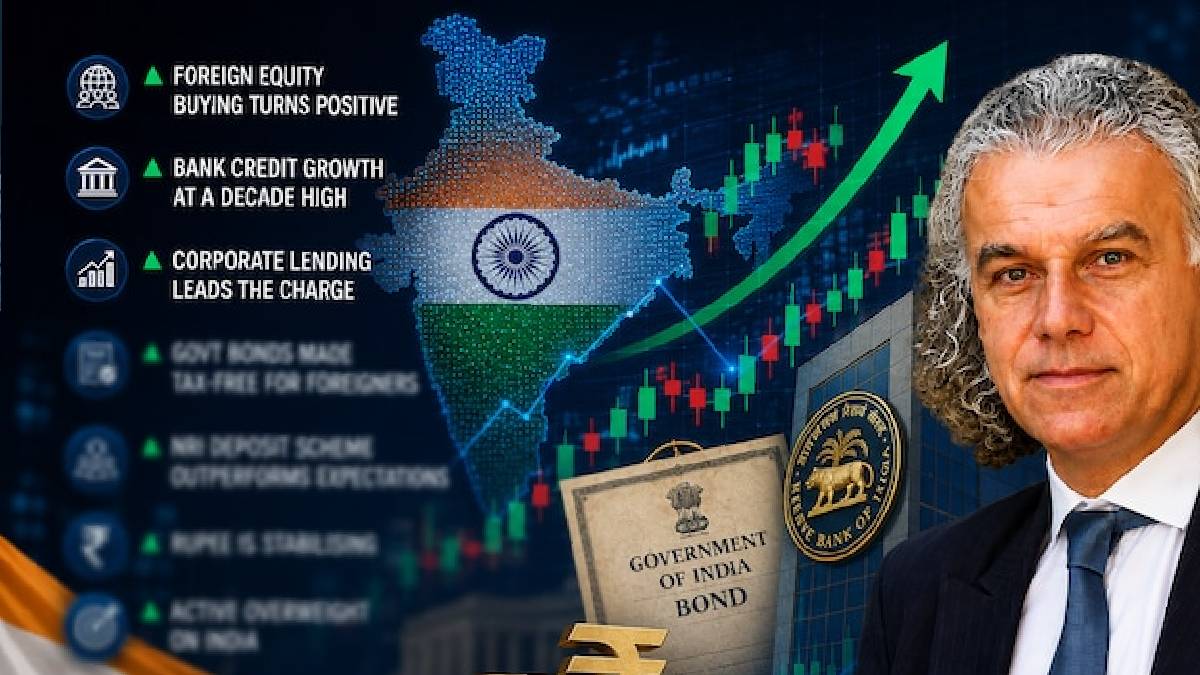
Here are the seven reasons behind his India conviction.
1. Foreign Equity Buying Is Turning Positive
Finally, in July, foreign investors returned to investing in Indian stocks after months of heavy selling.
In July, India had net foreign equity inflows of around $2.45 billion. Wood calls this a good result of the “memory trade event” that unwound.
Even though the monthly inflow is small relative to the year-on-year FPI outflow, Wood sees the change in direction as an important signal. A sustained recovery in foreign buying could provide an additional tailwind for Indian equities if global risk appetite improves.
2. Bank Credit Growth Has Reached a Decade High
One of the biggest pillars of Wood’s India thesis is the acceleration in bank lending.
Bank credit growth across the system is 17-18% year-on-year, the strongest expansion in more than a decade.
For Wood, this is significant because credit growth can be seen as an indication of domestic economic activity. With Indian households and businesses borrowing more, the acceleration signals that growth in the economy is being supported by domestic demand rather than foreign capital.
And corporate lending is leading the credit cycle
The credit expansion is also led by corporate lending.
Corporate loans are projected to grow at around 20% annually, and agriculture credit is estimated to grow at 17% and retail loans at 16%.
In addition, Jefferies’ India research head Mahesh Nandurkar said that there was healthy demand in the automobile and property sectors as well.
Corporate borrowing is a key indicator of investment and capital expenditure. If companies continue to draw more and more money to expand in India and to invest in the future, it will only strengthen India’s domestic growth and would be beneficial to banks and other financial companies.
3. Foreign Investors Are Becoming More Interested in Government Bonds
Another important development is the treatment of Indian government bonds.
Government bond ownership was made tax-free for foreign investors in early June. Since then, India has attracted about $8.7 billion of net inflows into government securities.
The development is important because stronger foreign participation in India's bond market can increase demand for rupee-denominated assets and simultaneously support the currency.
For Wood, the bond inflows are part of a broader improvement in India’s external funding picture.
4. RBI's NRI Deposit Scheme Is Attracting Foreign Currency
India has also been using foreign-currency deposits from non-resident Indians to strengthen its external liquidity position.
According to Wood's note, the RBI-backed scheme has already attracted around $41 billion, with the amount expected to double by September.
Wood emphasizes the unusually attractive returns for participating NRIs, with investors using a great deal of leverage to achieve dollar returns in the double-digit range.
It’s not the first time that India has employed such a mechanism to support its currency. In 1993 and 2014, similar measures were introduced and the government has shown its willingness to use such tools when external pressures are on the rise.
5. The Rupee Is Showing Signs of Stabilisation
Currency stability is another major point in Wood's argument.
The Indian rupee fell to 96.96 against the US dollar in May before recovering to around 95.17.
If the currency doesn’t move with global dollar movements and capital flows, Wood believes that the combination of government bond inflows, NRI deposits and other external funding measures increases the chances of further stabilisation.
A more stable rupee could also reduce pressure on imported inflation and improve investor confidence in Indian assets.
6. India Is an Active Overweight for Christopher Wood
The most direct indication of Wood’s conviction is his portfolio positioning.
India currently represents about 12% of his Asia Pacific ex-Japan portfolio, compared with a benchmark weighting of around 11.4%.
That makes India an active overweight rather than just a market held in line with its benchmark.
Wood also still holds Indian government bonds in his global sovereign debt portfolio.
His position stands out in contrast to Indonesia, which he had completely exited in October 2025 and has not since.
Why Wood Is Willing to Look Past FPI Selling
The key message of Wood’s thesis is that foreign equity selling alone does not capture the full picture of India’s capital flows.
While equity investors have pulled billions of dollars out, other channels—government bonds and NRI deposits—have been drawing big foreign capital. At the same time, domestic credit growth is accelerating, and sectors like automobiles and property are in good demand.
For Wood, such factors show how India’s investment story is being supported by domestic economic momentum, more credit creation and better external liquidity.
However, that does not eliminate all risks. India is still at relatively high valuations; global interest rates, oil prices, currency volatility and renewed foreign selling are also important factors for investors to monitor.
But Wood's continued overweight reflects his conviction that India’s structural growth story is still intact.
The bullish India call from Christopher Wood rests on more than optimism for GDP growth. His argument is based on seven developments: tentative return of foreign equity buying, decade-high bank credit growth, strong corporate lending, rising foreign participation in government bonds, huge NRI deposits, rupee stabilisation and an active portfolio overweight.
While foreign investors are still net sellers for the year, Wood's position is a contrarian view. His argument is essentially that India's domestic financial and economic momentum is going to be strong enough to offset some of the pressure from global capital outflows.
Whether foreign equity flows continue to recover will be crucial. But for now, Wood is willing to bet that India's domestic growth engine will continue to make it one of Asia's most attractive markets.






Comments
Please to leave a comment on this article.