
Central Board of Direct Taxes (CBDT) has declared the cost inflation index (CII) for fiscal year 2026-27 at 384, up from 376 for FY2025-26. From 1 April 2026, the revised index will be used to calculate long-term capital gains (LTCG) tax for non-indexed taxpayers who can still claim the benefit of indexation.
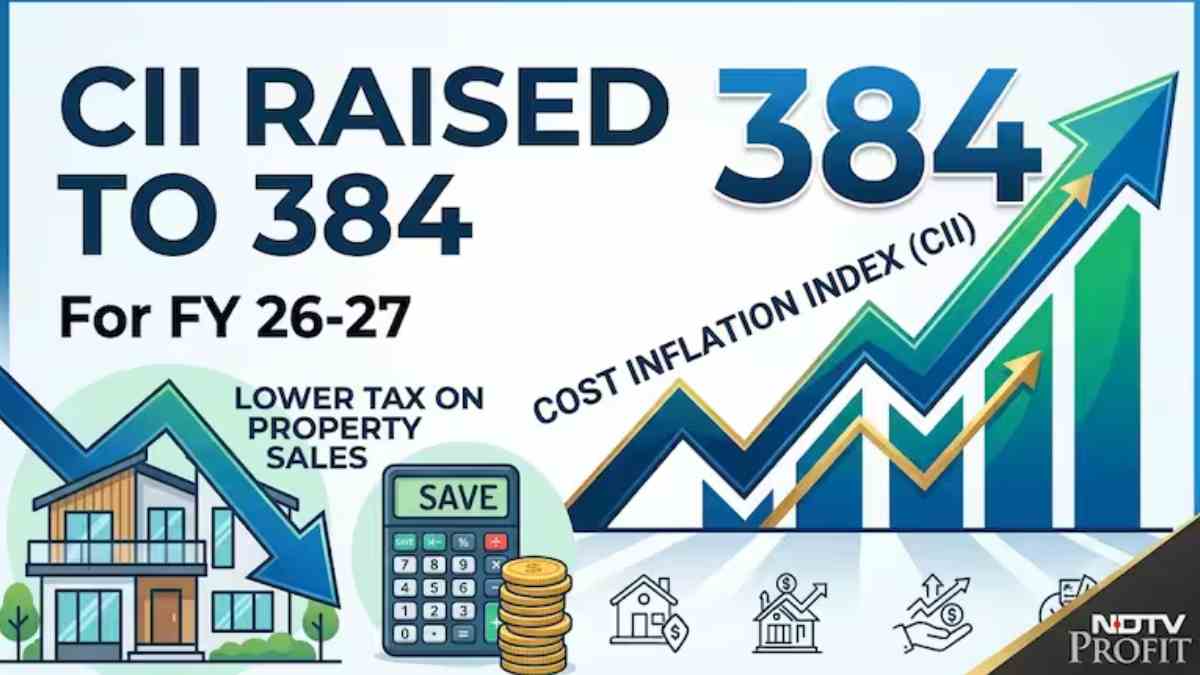
Although indexation benefits for most capital assets were ceased beginning July 23, 2024, some taxpayers still could utilize the older tax regime. For them, raising the Cost Inflation Index could translate into a lower tax liability when selling eligible properties.
What is the cost inflation index (CII)?
The Cost Inflation Index (CII) is a figure given annually by the CBDT to account for inflation when determining the purchase cost of some long-term assets.
Instead of using the original purchase price, taxpayers can increase the acquisition cost based on inflation. This reduces the taxable capital gains and, therefore, the tax payable.
With the CII increasing from 376 to 384, eligible taxpayers will receive a higher indexed purchase cost, which will also reduce taxable gains.
Who Can Still Claim Indexation?
Based on the changes made in the Union Budget 2024, most assets purchased or sold after July 23, 2024, no longer qualify for indexation.
As for property capital gains, they are not indexed, as long-term capital gains are generally taxed at a flat 12.5%.
However, resident individuals and Hindu Undivided Families (HUFs) selling land or buildings acquired before July 23, 2024, might still choose between:
- 12.5% LTCG tax without indexation,
- or 20% LTCG tax with indexation (if eligible),
whichever results in a lower tax outgo.
This flexibility allows eligible taxpayers to compare both methods and choose the more beneficial option.
How Indexation Reduces Tax: An Example
Consider the following example:
- Purchase Year: FY2014-15
- Purchase Price: ₹50 lakh
- Sale Year: FY2026-27
- Sale Price: ₹1 crore
- CII (FY2014-15): 240
- CII (FY2026-27): 384
Step 1: Calculate Indexed Cost
Formula:
Indexed Cost = Purchase Price × (CII of Sale Year ÷ CII of Purchase Year)
= ₹50,00,000 × (384 ÷ 240)
= ₹50,00,000 × 1.6
= ₹80,00,000
Step 2: Compare Taxable Gains
Without Indexation: Purchase Cost: ₹50 lakh
With Indexation: Indexed Cost: ₹80 lakh
- Sale Price: ₹1 crore
- Taxable Gain: ₹50 lakh
- Taxable Gain: ₹20 lakh
Step 3: Compare Tax Liability
- New Regime: 12.5% of ₹50 lakh = ₹6.25 lakh
- Old Regime with Indexation: 20% of ₹20 lakh = ₹4 lakh
Tax Saving: ₹2.25 lakh
This example illustrates how indexation can reduce taxable gains and lower the final tax bill for eligible taxpayers.
Why the Higher CII Matters
While the increase in the Cost Inflation Index is modest at 2.12%, it still provides some relief by increasing the inflation-adjusted acquisition cost of eligible assets.
If taxpayers want to sell long-held real estate or other qualifying assets, the revised CII could make the old tax regime with indexation more attractive than the new flat-rate system.
Key Takeaways
- FY2026-27 Cost Inflation Index: 384
- Previous FY2025-26 CII: 376
- Effective From: April 1, 2026
Indexation is still available only for eligible taxpayers and qualifying assets
Eligible sellers can choose between:
- 12.5% LTCG tax without indexation, or
- 20% LTCG tax with indexation, whichever results in lower tax.
Before finalizing a property sale, taxpayers should carefully calculate their liability under both methods or consult a qualified tax professional. Choosing the appropriate tax regime could result in significant savings, especially for properties held over a long period.





Comments
Please to leave a comment on this article.