
Healthcare expenses are still one of the biggest financial burdens for millions of Indian families. Most of these costs are spent on medicines, especially for people with chronic diseases requiring long-term coverage.
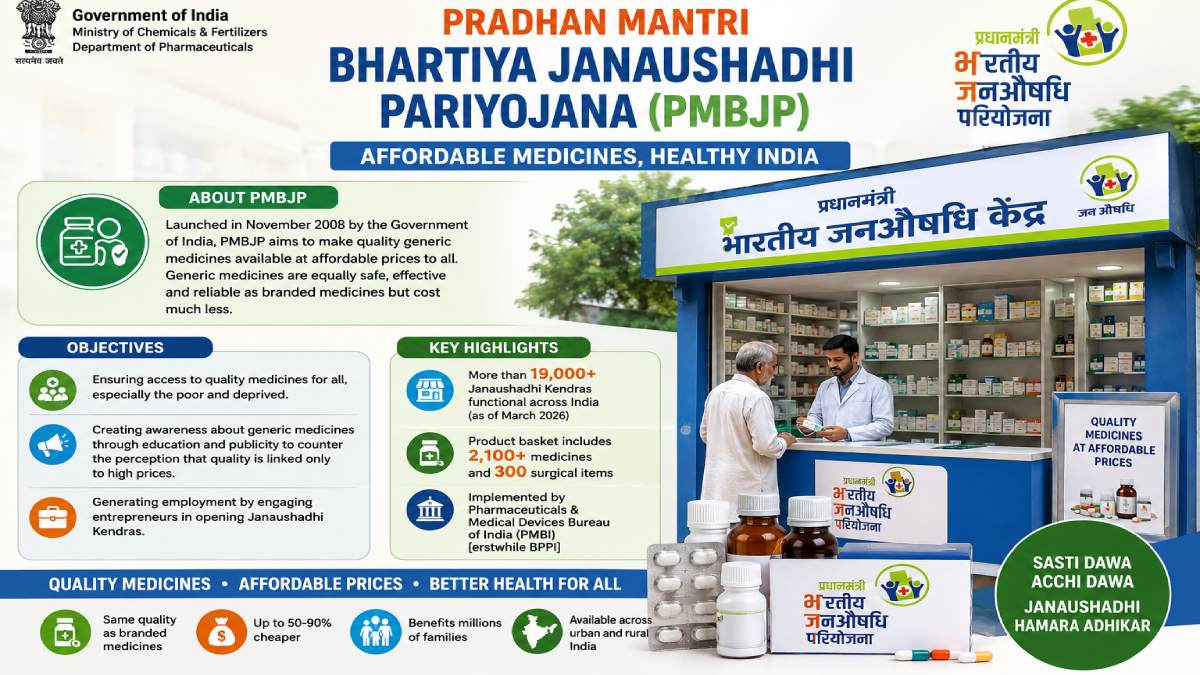
To tackle this problem and make healthcare affordable for all citizens, the Government of India launched the Pradhan Mantri Bhartiya Janaushadhi Pariyojana (PMBJP) in November 2008.
The programme is being initiated by the Department of Pharmaceuticals under the Ministry of Chemicals & Fertilizers and is designed to provide affordable generic medicines at affordable prices through a nationwide network of dedicated retail outlets known as Janaushadhi Kendras. It is one of India’s most successful health programs where medicine treatment has been made so much easier for millions of people to access and the government has not only reduced prices for medicines, but also provided access to essential drugs.
What is PMBJP?
The Pradhan Mantri Bhartiya Janaushadhi Pariyojana (PMBJP) is a flagship government initiative to make quality generic medicines available to the public at prices much lower than branded medicines.
Generic medicines have the same active pharmaceutical ingredients, dosage, strength, safety, quality, and therapeutic effectiveness as branded medicines. However, generic medicines are not heavily marketed or advertised, so they are available at substantially lower prices which makes treatment affordable for people of all income groups.
The scheme is implemented by the Pharmaceuticals & Medical Devices Bureau of India (PMBI), formerly known as the Bureau of Pharma PSUs of India (BPPI), which is registered under the Societies Registration Act.
Why was PMBJP created?
India has a large number of people depending on affordable healthcare services. And branded medicines often cost many times as much as their generic equivalents despite being of the same medical benefits. High costs of medicines force many families to shorten treatment, delay medical care, or stop taking medications entirely.
PMBJP was launched to remove this financial hurdle so that every citizen is able to access affordable medicines without compromising their health due to affordability.
Key Objectives of PMBJP
The scheme has various objectives:
- Provide affordable generic medicines to every citizen at affordable prices
- Access to essential medicines for poor and economically weaker segments of society and provide easy access to it
- Show people that generic medicines are just as safe, effective, and reliable as branded ones
- Stop thinking that expensive drugs are better than cheap ones
- Lower healthcare costs for all families across India
- Promote entrepreneurship as individuals and organizations want to establish Janaushadhi Kendras
- Strengthen India's public healthcare system for affordable pharmaceutical access.
- Expand Janaushadhi Kendras
PMBJP’s rapid expansion in the country has been one of the major achievements of PMBJP
More than 19,000 Janaushadhi Kendras are in operation in India as of March 2026. These stores are located in cities, towns, semi-urban areas, and rural areas to ensure medicines are available even in remote locations. The Kendras are operated by entrepreneurs, pharmacists, charitable organizations, hospitals, NGOs, and self-help groups under PMBI's guidance.
Deep and Wide range of Affordable Medicines
PMBJP has gradually expanded its product portfolio to meet the healthcare needs of the population.
Currently, the scheme offers:
More than 2,100 medicines
Over 300 surgical and medical consumables
The medicines are of multiple therapeutic categories:
Diabetes, Hypertension, Heart diseases, Cancer, Respiratory disorders, Gastrointestinal diseases, Antibiotics, Pain management, Women's healthcare, Child healthcare, Vitamins and nutritional supplements, Mental health medicines, Skin disorders.
Surgical products include syringes, gloves, bandages, cotton, dressings, adult diapers, and other essential healthcare items.
Quality Assurance
A common misconception about generic medicines is that they are inferior to branded medicines. But medicines provided under PMBJP undergo rigorous quality testing before reaching Janaushadhi Kendras.
PMBI buys medicines only from certified manufacturers that comply with Good Manufacturing Practices (GMP). All medicines are tested at laboratories accredited by the National Accreditation Board for Testing and Calibration Laboratories (NABL) to ensure safety, efficacy, and quality.
Such a high-quality control system for medicines makes sure patients receive medicines that are in line with the national standards.
Benefits of PMBJP
The scheme is of great benefit to both patients and the healthcare system.
Some major advantages include:
- Affordable medicines that will greatly reduce treatment costs
- Quality generic medicines with the same therapeutic efficacy as branded drugs
- Greater access to healthcare in rural and underprivileged regions
- Improved awareness about generic drugs. Lower out-of-pocket healthcare costs
- With the establishment of Janaushadhi Kendras, employment for long-term treatment of chronic diseases
- Promote self-employment among pharmacists and entrepreneurs
- Employment opportunities
- PMBJP is not only a healthcare initiative but also an employment-generation programme
Entrepreneurs, registered pharmacists, hospitals, charitable trusts, NGOs, and self-help groups can open Janaushadhi Kendras under the scheme. Financial incentives and support from PMBI encourage more people to participate, creating jobs while expanding affordable healthcare access.
What impact will this have on India’s healthcare system?
PMBJP has changed the way millions of Indians buy medicines since it was launched. Lowering the costs of medicines and making it easier to access has helped improve treatment adherence for patients suffering from chronic diseases.
The initiative complements healthcare programmes like Ayushman Bharat and is in line with the government’s vision of universal healthcare.
As the awareness of generic medicines grows, PMBJP will be able to work much more effectively to reduce healthcare inequality and guarantee that quality treatment is available to every citizen regardless of income.
With thousands of Janaushadhi Kendras operating throughout India and a wide range of products available, PMBJP is one of India's most impactful public health measures and it is improving people’s lives with affordable but accessible healthcare.
Frequently Asked Questions (FAQs). 1. What is PMBJP?
PMBJP (Pradhan Mantri Bhartiya Janaushadhi Pariyojana) is a Government of India scheme that provides quality generic medicines at affordable prices through Janaushadhi Kendras.
When was PMBJP launched?
The scheme was launched in November 2008 by the Department of Pharmaceuticals, Ministry of Chemicals & Fertilizers.
Who implements PMBJP?
The scheme is implemented by the Pharmaceuticals & Medical Devices Bureau of India (PMBI).
What are Janaushadhi Kendras?
Janaushadhi Kendras are retail outlets selling affordable, quality generic medicines and surgical products.
How many Janaushadhi Kendras are operating in India?
By March 2026, there are more than 19,000 Janaushadhi Kendras operational in the country.
How many medicines are available under PMBJP?
The scheme offers more than 2,100 medicines and 300 surgical and healthcare products.
Are generic medicines as good as branded medicines?
Yes. Generic drugs have the same active ingredients and offer the same therapeutic benefits as branded medicines and are much more affordable.
Who can open a Janaushadhi Kendra?
Entrepreneurs, pharmacists, NGOs, hospitals, charitable trusts, self-help groups, and other entities can apply to open a Janaushadhi Kendra under PMBI guidelines.
Why are PMBJP medicines cheaper?
They are sold with very low marketing and branding costs that make them very affordable and still high quality and effective.
What is the prime objective of PMBJP?
The main aim is to guarantee affordable access to quality medicines for all citizens, especially the poor and deprived, and to increase the awareness and employment of generic medicines.






Comments
Please to leave a comment on this article.