
India has taken another step towards becoming a global electronics manufacturing powerhouse with the approval of the Mobile Phone Manufacturing Scheme (MPMS), a new incentive programme worth ₹62,500 crore. The scheme will run for five years from FY 2026-27 to FY 2030-31 and will help to strengthen domestic smartphone manufacturing, raise local value addition, create employment and help Indian companies to create globally competitive smartphone brands.
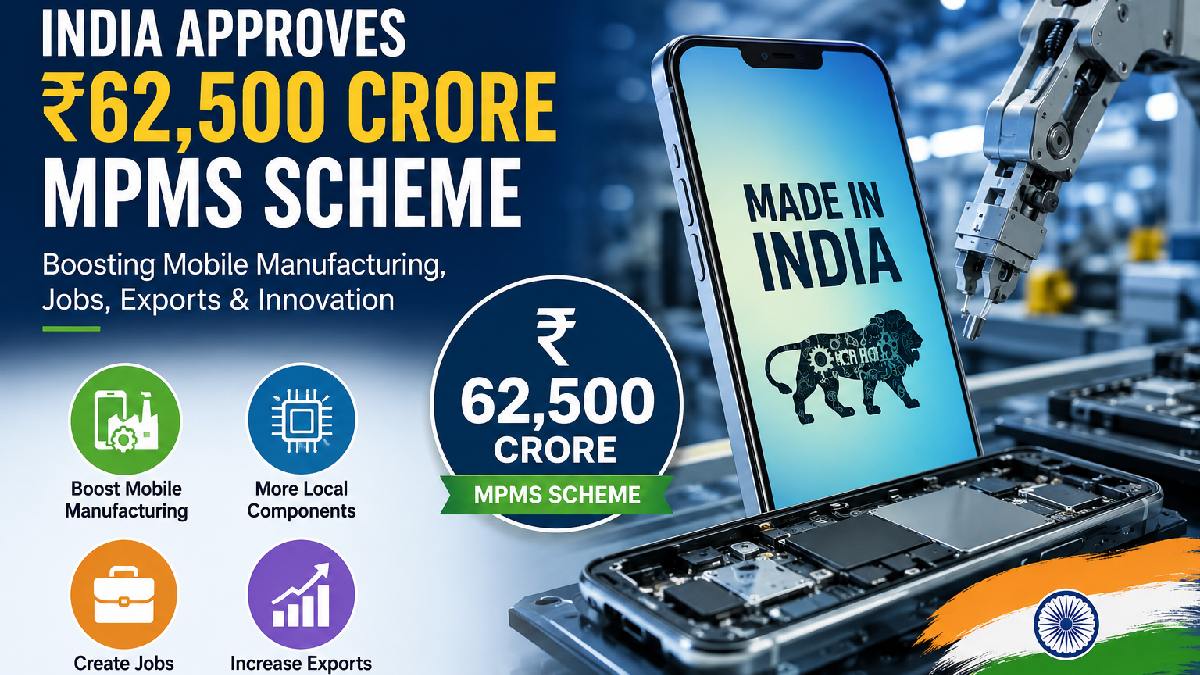
The MPMS replaces the Production Linked Incentive (PLI) Scheme for Large Scale Electronics Manufacturing, which ended on 31 March 2026. While the PLI scheme helped India become one of the world's leading smartphone manufacturing hubs, the new initiative aims to move beyond assembly to component manufacturing, research, innovation and indigenous technology development.
Incentives Based on Domestic Value Addition
As for the new scheme, companies manufacturing mobile phones in India will get incentives ranging from 2.25 per cent to 5 per cent on eligible sales, depending on their category and performance.
To enhance localisation, manufacturers that source more of the key components from India will be eligible for an additional incentive of up to 1.5 per cent. This will lower reliance on imported components and contribute to India's electronics supply chain.
The government has also introduced a special incentive for innovation. Companies investing in product design, research and development (R&D) would receive an additional 3 per cent incentive on eligible sales. This will spur Indian companies to develop proprietary technologies, create intellectual property portfolios and file more patents.
Massive Production and Export Targets
The scheme is expected to achieve a cumulative mobile phone production of nearly ₹39 lakh crore during its five-year term, the Centre said. Mobile phone exports are also expected to grow significantly as India becomes a major manufacturing site of choice as India becomes a global manufacturing destination for the world.
The government estimates that the MPMS will create approximately 60,000 direct jobs, while also supporting thousands of indirect employment opportunities across component manufacturing, logistics, research, design and supply chain management.
And officials hope the scheme will be an important step to support India’s position on the global stage for electronics manufacturing as a leading electronics production hub under the Make in India initiative.
Electronics manufacturing is expected to be very strong in the future
This is at a time when India’s electronics manufacturing sector is booming. Electronics manufacturing has increased seven-fold since FY 2014-15, according to government data, while exports have grown nearly eleven times over the same period.
India has also become one of the world’s largest smartphone manufacturing centres with many global companies expanding production facilities in India.
Industry experts are happy to see that
Industry experts have generally welcomed the government’s decision, many of them seeing it as a timely measure that is a timely approach to tackle global supply chain disruption by the government as it is in the midst of global supply chain problems.
Faisal Ali Kawoosa, Chief Analyst at TechArc, said the scheme comes at a much more crucial time when countries are increasingly focusing on supply chain resilience.
"The announcement of MPMS is very timely. For the past seven months we have witnessed why control over supply chains is important. MPMS will help India further command control of the supply chain," he said.
Kawoosa particularly praised the government’s emphasis on domestic value addition and local smartphone brands.
"The additional 3 per cent incentive for creating local brands is a game changer. India needs strong domestic brands as it works towards becoming a developed nation. We should now move beyond simply assembling global brands and start creating globally recognised Indian smartphone companies," he added.
Focus Shifts Beyond Assembly
Tarun Pathak, Research Director at Counterpoint Research, believes that the new scheme is a fundamental change to the electronics policy in India.
"The ₹62,500 crore MPMS shifts the focus from simple assembly to deep local value addition. The scheme fits well with India’s overall semiconductor ambitions and encourages indigenous R&D and intellectual property creation," he said.
He added that the scheme comes at a challenging time for the world smartphone market. DRAM memory prices are expected to remain high until at least 2027.
A New phase in India’s smartphone industry
The Mobile Phone Manufacturing Scheme is a transformational shift in India’s manufacturing approach. Now instead of assembling devices from scratch, the government is encouraging companies in India to manufacture critical parts locally, invest in research, develop original technology and build Indian smartphone brands that will be able to compete in the world.
If implemented successfully, the MPMS could significantly strengthen India’s electronics ecosystem, reduce import dependence, boost exports, create thousands of skilled jobs and position the country as one of the world’s leading centres for smartphone innovation and manufacturing.





Comments
Please to leave a comment on this article.