
Nifty stocks accounted for just 33% of retail investors’ equity portfolios in June 2026, the lowest level on record and highlighting a significant shift in the way individual investors are allocating money across the Indian stock market.
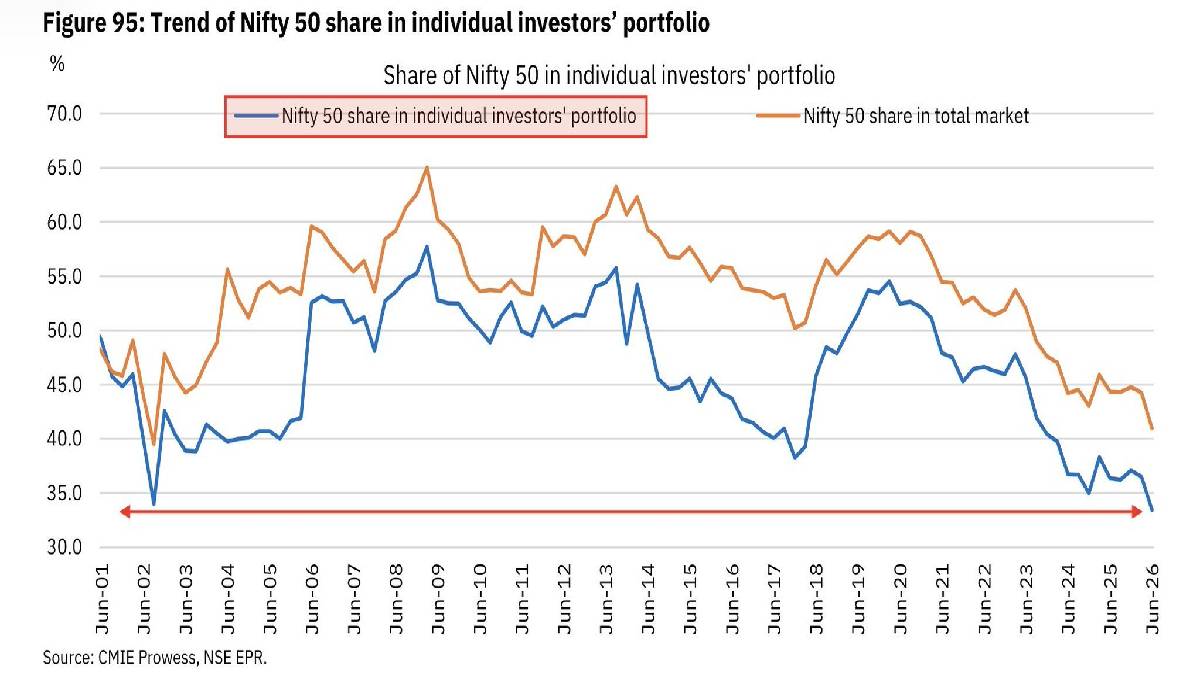
The decline shows that retail investors are not just looking beyond the mainstream large-cap universe as represented by the Nifty, but are now also looking at mid-cap, small-cap and all other listed companies. This is a time when retail investment in Indian equities is continuing to grow and thus, for the most part, it is done through digital trading platforms - a new means of accessing a larger range of stocks and investment opportunities.
The Nifty 50 is the benchmark index for the Indian stock market. It is composed of 50 of the largest and most liquid companies of the National Stock Exchange and has formed a large share of retail portfolios for both the market presence in India such as this one and the businesses which are well established and have a high level of liquidity.
But the latest figure shows that the dominance of Nifty constituents among retail holdings has been steadily weakening. By a factor of four, their share is now down to just one-third of retail portfolios and almost two-thirds of equity exposure is now outside of the Nifty 50 universe.
This shift can have several reasons. A major factor is the growing popularity of mid-cap and small-cap stocks among individual investors. These companies may also offer faster earnings and revenue growth as compared to mature large-cap firms, but also more volatility and risk.
Retail investors have also gained access to unprecedented amounts of market information. Mobile trading applications, financial news platforms, social media, stock-screening tools and online investment communities have made it easier for individuals to research and trade companies outside the major benchmark indices.
Investment with systematic investment and direct equity participation has also changed the investment landscape. Investors who once relied on large established companies and big business players are starting to build their portfolios based on individual themes, sectors and growth prospects.
The low share of Nifty stocks in retail portfolios also reflects the growing coverage of India’s equity market. The Indian stock market is increasingly exposed to the likes of manufacturing, defence, infrastructure, renewable energy, financial technology, electronics, healthcare, consumer businesses and emerging technology companies.
But diversification outside the Nifty is not always linked to lower risk for retail investors. Mid-cap and small-cap companies can move much more rapidly when the market is depressed. Liquidity is also lower, so it is harder for investors to move out fast without causing price drops.
And so the record number is an opportunity and a warning. On one hand, broad participation can allow retail investors to benefit from growth in different parts of the economy. On the other hand, too much exposure to speculative or highly volatile stocks can increase portfolio risk.
Another important factor is changing retail participation in India. Individual investors are becoming an increasingly important force in domestic equity markets and thus less dependent on foreign institutional flows. Good domestic participation can provide stability in periods when overseas investors reduce exposure to Indian equities.
The shift away from Nifty stocks could also influence the general market's behavior. Retail investors may allocate more money to smaller companies and the mid-cap and small-cap segments could still be elevated. But as long as selling or sentiment holds firm, these segments could see further corrections.
The development also demonstrates the need for understanding portfolio construction. Investors may have dozens of stocks but still run the risk of concentration if they are heavily invested in the same sector or investment theme. Similarly, diversification of company size is not enough to protect a portfolio if your holdings are subject to the same economic or market conditions.
The drop in Nifty representation to 33% is therefore an important indicator of changing retail behaviour and not just the index ownership numbers. It means Indian individual investors are more active and increasingly inclined to look beyond the country’s largest listed businesses.
This could have long-term implications for the Indian stock market. More retail participation in mid-cap and small-cap companies can improve liquidity and market depth: those with potential to attract more capital can enter the market.
At the same time, investors will need to be cognizant of valuation risks. A company not being in the Nifty does not automatically make it an attractive investment, and quick price appreciation can sometimes outstrip earnings growth.
The June 2026 figure is, however, a significant achievement. With Nifty stocks accounting for just 33% of retail equity portfolios - the lowest level yet - Indian retail investors are clearly spreading their exposure far beyond the traditional large-cap benchmark.
The trend will be watched in the coming quarters. If this diversification continues or reverses during the next market cycles, it can be useful in understanding and determining the behaviour, risk appetite and investment preference of India’s rapidly growing retail investor base.






Comments
Please to leave a comment on this article.