
XPeng’s robotics business has raised $900 million in fresh funding at a valuation above $6.3 billion, a significant achievement for the Chinese company in humanoid robotics and embodied artificial intelligence. That is one of the biggest private funding rounds in China’s rapidly developing embodied AI sector and shows investors are interested in robots that can interact with and work in the physical world.
The latest funding round was led by IDG Capital and strategic partners were Tencent and Alibaba, two major Chinese technology companies. The involvement of these players shows the increasing importance of Physical AI as technology companies look beyond purely digital artificial intelligence applications to bring intelligent systems into factories, offices, retail environments and other real-world settings.
XPeng will use the newly raised capital to accelerate some of its robotics projects. Such funding will support development and scaling of robot hardware, Physical AI models and manufacturing capabilities, with the company preparing for the next major phase of its humanoid robot programme.
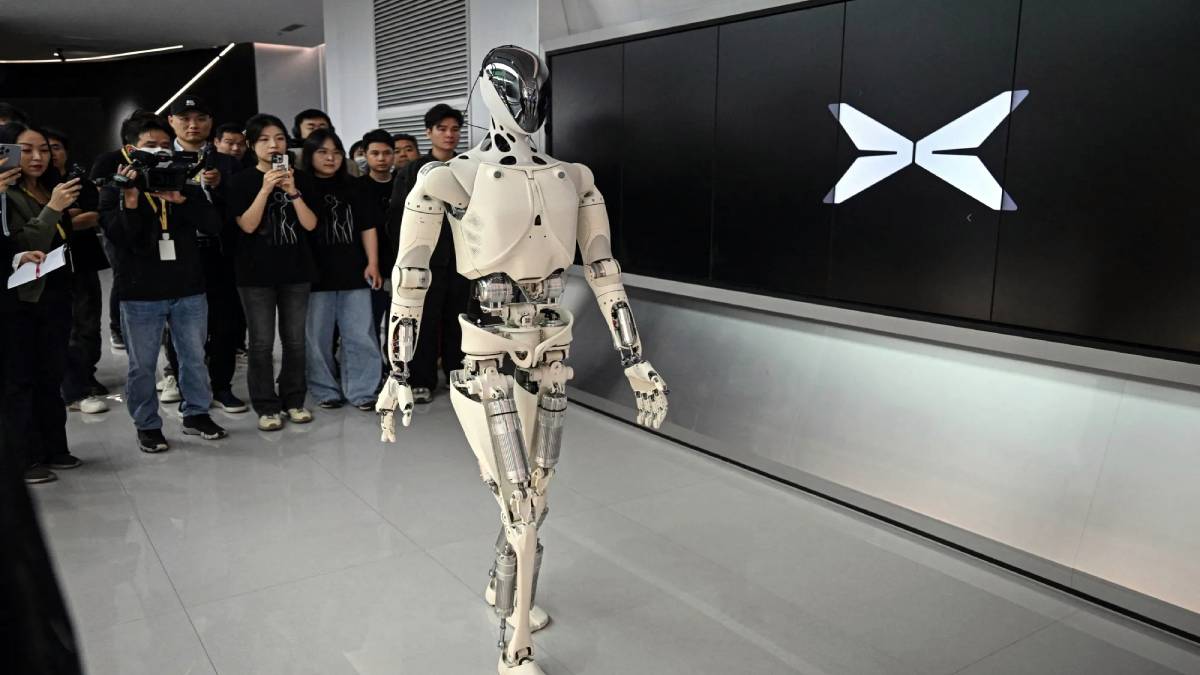
At the heart of XPeng’s robotics ambitions is its IRON humanoid robot that the company plans to mass produce by the end of this year. Commercial deliveries are expected to start in 2027, and XPeng will be among those companies with the potential to turn humanoid robots into commercial products at scale.
It is a big change because humanoid robotics has developed rapidly from a kind of experimental research field into one of the most closely watched areas of the world's technology industry. Companies in China, the United States and other countries are investing in robots to do things that humans typically struggle with.
Humanoid robots are not rooted in industrial robots; in fact, they are built for people and are designed around the environments humans would like to be in. Their human-like shape also allows them to move through existing buildings, use tools, manipulate objects and do things that they would not be able to do otherwise without the need for workplaces to be redesigned completely.
XPeng is also in the field as an electric vehicle manufacturer or autonomous driving specialist, as well as an AI-based sensor developer. The company has been working on sensors, computing platforms, intelligent control systems and autonomous decision-making for years. That capability might be the basis for building advanced robotic systems.
The new funds will provide XPeng with more resources to develop them and get closer to large-scale manufacturing.
The concept of Physical AI is also very important to the company's strategy. Traditional AI systems are mostly digital systems and they are used to process text, images, audio or other digital information. Physical AI is a vision of AI systems so that “intelligent machines” can see things, sense the world and make decisions in real life.
Hence, humanoid robots must recognize objects and instructions, coordinate movement and respond to changes in the environment.
Developing these capabilities requires significant investment. Companies need advanced sensors, processors, motors, actuators, batteries, robotic hands and sophisticated software models. They also require huge amounts of real-world training data to improve the ability of robots to perform safely and reliably.
XPeng’s $900 million fundraising could prove key in helping the company to develop the physical infrastructure and artificial intelligence capabilities required to realize its ambitions.
The company's focus on mass production is significant. Making humanoid robots on a large scale is far more difficult than creating prototypes. When thousands of robots are being manufactured, the manufacturing costs, component reliability, software integration, battery performance and quality control are all key.
XPeng will also need to demonstrate that its robots can perform useful tasks consistently before customers are willing to adopt them commercially.
The planned commercial deliveries in 2027 could be an important test for the company’s strategy. Initial deployments would help XPeng to gain real-life operating data, identify weaknesses and make progress with subsequent generations of the robot.
Investor interest in the sector suggests expectations are already high. IDG Capital, Tencent and Alibaba will provide XPeng’s robotics operation with both capital and possibly valuable strategic support.
For XPeng, the opportunity is far bigger than humanoids. It is an attempt to build a larger entity in the Physical AI ecosystem which involves artificial intelligence, robotics, autonomous systems and advanced manufacturing.
The robotics business has a $6.3 billion+ valuation, which shows the magnitude of expectations for the sector. Investors are betting that humanoid robots will become a major technology platform over the next decade.
But there are still huge challenges. Humanoid robotics is a relatively young field and commercial success is far from guaranteed. Companies need to overcome technical limitations, reduce manufacturing costs and show that robots are worth buying or leasing.
As robots become increasingly capable of working alongside humans, safety will also continue to be an issue.
For XPeng, the next big thing to do is to turn all of its new funding into tangible progress. The company now has more resources to scale hardware development, improve Physical AI models and prepare manufacturing operations for its IRON humanoid robot.
If XPeng reaches mass production by the end of 2026 and starts commercial deliveries in 2027 as planned in China, it can become a significant force in the increasingly competitive humanoid robotics market that is on the rise in China.
The $900 million round at a valuation of more than $6.3 billion shows investors are willing to make big bets on the future of embodied AI. With IDG Capital leading the round, and Tencent and Alibaba funding the project, XPeng’s robotics ambitions are in a new and potentially transformative phase.






Comments
Please to leave a comment on this article.