
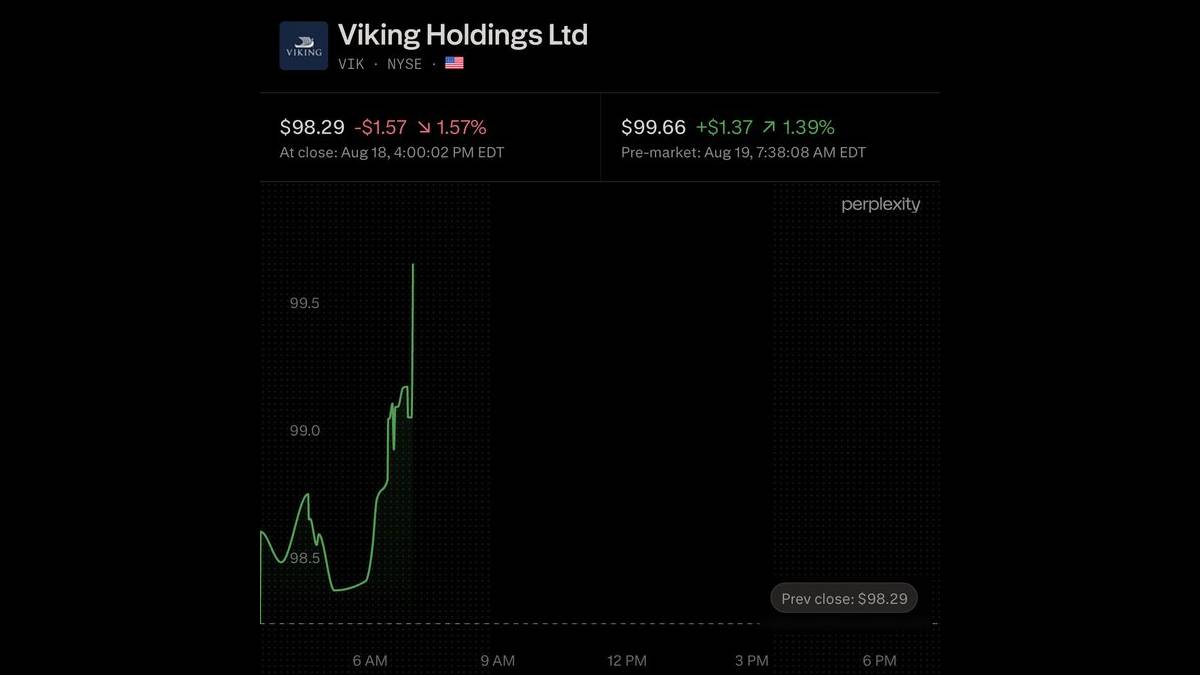
Viking Holdings Ltd. (NYSE: VIK) had a pretty good second quarter performance (revenue, earnings and adjusted EBITDA), and also got excellent advance bookings for both the 2026 and 2027 seasons. This shows demand for Viking’s river, ocean and expedition cruises as it expands in the world.
Viking Holdings reported Q2 2026 revenue of $2.2 billion, up 16.5% from the previous year (an estimated $2.14 billion). The strong top line performance was accompanied by strong profitability with $1.31 per share in adjusted earnings (up from $1.26). Adjusted earnings grew by 32% year on year.
Adjusted EBITDA came in at $748.4 million, beating the estimate of $723 million and up 18.2 percent. Net income came in at $587.7 million, up more than 34 percent from the same period last year and above the expected $562 million.
And Viking's premium cruise offerings remain in demand, it said. A key metric assessing the company's performance was net yield of $645, up 6.2% year-over-year. For cruise operators, net yield is critical because it shows revenue generated in terms of available capacity.
Viking also reported 94.4% occupancy in the quarter, well within the company’s growing fleet. As it adds new vessels in its ocean and river cruise businesses, the company will continue to grow capacity.
Probably the most encouraging signal for investors was the strength of advance bookings. Viking had around $6.4 billion in advance bookings for the 2026 season, up 13 percent year-over-year.
Demand remains very strong for the 2027 season. The advance bookings are at $4.7 billion, a 21% year-over-year increase.
Booking numbers give the company a clear picture of future revenue. Strong advance sales also enable Viking to plan capacity, pricing and operations well ahead of the sailing season.
Management said approximately 96% of its 2026 capacity for Core Products has already been sold and the company is well-positioned for the rest of the year.
And the company said it is already 53% booked for its 2027 capacity and expects capacity to increase by about 15% year-on-year.
Viking’s growing fleet is a crucial part of its long-term strategy. Viking Mira was delivered in the quarter and Viking has now acquired another ocean vessel.
Viking also exercised options for two more ocean ships to be delivered in 2032. Viking is still planning for long-term capacity growth as it already has a high demand for its existing fleet.
Viking’s business model is a combination of river cruises, ocean cruises and expedition trips so it sees a variety of premium travel segments. The company is positioning itself more as a destination-oriented travel company than as a mass-market cruising firm.
This strategy is resonating with customers, the earnings show.
The advance booking performance is particularly important in cruise operations because cruise companies often have bookings months or even years in advance. More advance sales can give operators more revenue visibility and better pricing control.
Viking’s balance sheet is also strong— at the end of the quarter Viking had $4.0 billion of cash and cash equivalents. That liquidity enables the company to invest in new vessels and expand its operations.
The news comes at the same time that global travel demand is growing. Premium and luxury tourism have been relatively resilient with consumers still looking for experiences and international travel.
The combination of double-digit revenue growth, healthy profitability, rising yields and robust advance bookings represents a number of positive signals for VIK stock investors. But cruise operators are still subject to fuel costs, geopolitical risks, currency movements, economic slowdowns and changing consumer travel habits.
Viking needs to make massive capital investments to continue expanding its fleet, so it will have to balance ambitious growth with healthy returns.
So far, the numbers indicate that demand is keeping pace with the company’s capacity expansion. The fact that the company sold 96% of its 2026 Core Product capacity gives us good visibility for the year.
The 2027 booking numbers are just as significant. A 21% increase in advance bookings and planned capacity growth means customers are committing to Viking cruises well before departure.
That makes the quarter of Viking Holdings a good one. Revenue was up 32%, EBITDA grew more than 18% and net income was up 34%.
At the same time, the company is expanding its fleet, increasing capacity and building a huge pipeline of future bookings.
Viking’s performance also shows that premium travel is still very strong for cruise lines and that’s good for cruise companies. The question for shareholders will be whether the growth of the business can be sustained as it expands its fleet and becomes more settled into long-term sailing seasons.
With $6.4 billion in 2026 advance bookings and $4.7 billion already booked for 2027, Viking enters the rest of the year with strong visibility and a strong demand environment.






Comments
Please to leave a comment on this article.