
Gold’s rally into August is getting stretched, with the SPDR Gold Shares ETF (GLD) at its highest overbought level since the precious metal’s record-setting rise in January.
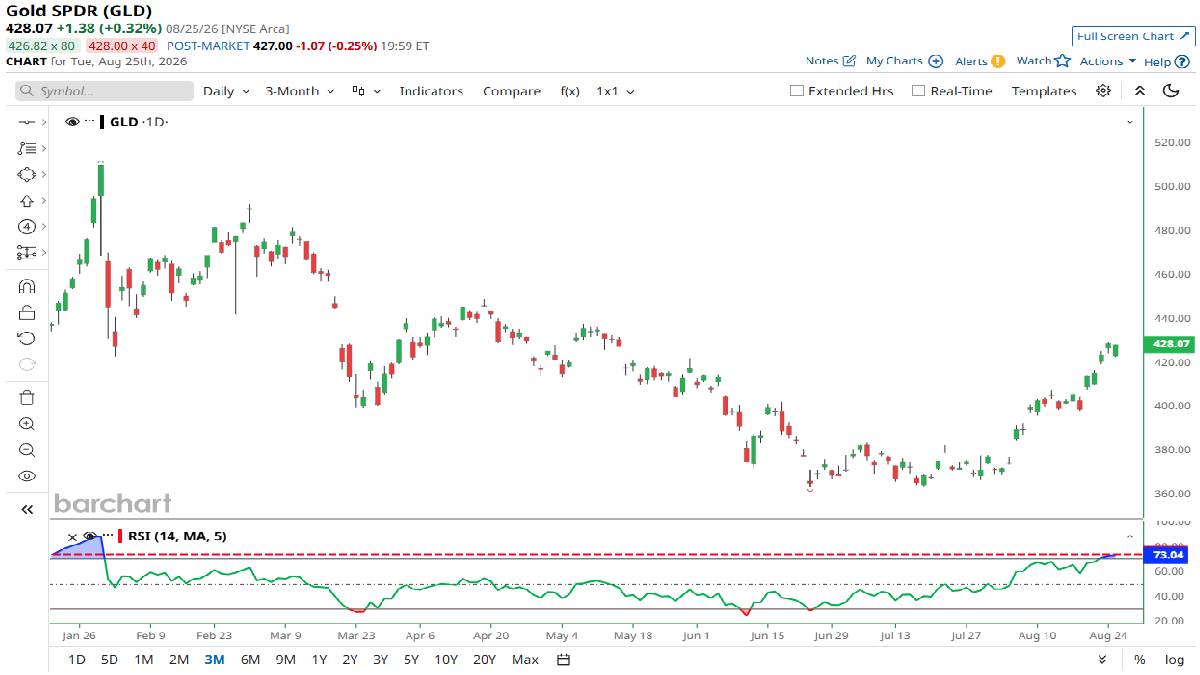
The move follows a strong recovery in gold prices in August. Spot gold rose to about $4,700 per troy ounce on Tuesday and is at its highest level since May. Spot gold slipped back slightly on Wednesday, August 26, and was at $4,643 an ounce.
The recent surge has dramatically changed gold’s short-term technical picture. Gold had spent the middle stages of 2023 below the January peak, but now is recovering massively. Trading Economics data through August 26 showed gold up more than 13 percent over the previous month and still far below its January all-time high.
The overbought price reading does not mean gold’s rally is coming to an end. It signals that prices are going to go up fast and if buying momentum starts to weaken the market may go into consolidation or even a short-term pullback.
Gold’s January rally was particularly strong, with prices almost hitting an all-time high above $5,600 an ounce in the month. The subsequent correction took the metal much lower than when the latest recovery started.
The new rally was a result of many factors. Investors were looking at the U.S. dollar, Treasury yields, inflation expectations and how we think about the country’s fiscal situation. And gold has been supported in part by the continued demand for risk-based assets based on those assets to hedge against economic and geopolitical uncertainty.
The U.S. Treasury’s moves around longer-dated government bonds have also influenced markets. With falling Treasury yields, non-yielding gold is more attractive to investors and a weak dollar can boost the market as gold is priced overseas in dollars.
Another source of support is uncertainty in the world. Gold is more likely to be in demand when there is a war going on in the Middle East, political instability or financial market instability.
The rally has been helped by a positive image of investors and investment in gold-backed products. In August, the World Gold Council said gold had broken above a technical trend that kept prices low since January and that ETF inflows and more futures positioning had kept the move up.
The more overbought conditions for traders are a big technical warning. When an asset goes up quickly over a short period of time, investors who bought earlier can lock in profit. And that can create selling pressure even when the trend is good.
Gold’s recent move toward the $4,700 area is therefore being closely watched. Analysts have identified this zone as an important near-term resistance level, so a sustained break higher could reinforce bullish momentum and if things fail again and again, then profit-taking could be the next thing that would occur.
But the current market is very different from a pure speculative rally. Structural factors like central bank appetite for gold, diversified investors and concerns about currencies and government debt have largely supported this. State Street Global Advisors, for example, warned in its 2023 outlook that gold could technically be overbought and might be small in terms of global investment portfolios.
Gold will be more attractive to investors now if there is no serious cooling-off period. An overbought reading can accelerate a correction but it can also persist during a very strong bull market.
So the GLD holders and gold traders’ signal is more of a warning sign than an automatic sell signal at a time when the metal is on track. We will know if the metal consolidates or continues to slide on toward its January record in the coming weeks.
Gold is still at a low early-2023 price but has rallied much of the past two weeks and investors are now caught between strong bullish momentum and increasingly stretched technical conditions.





Comments
Please to leave a comment on this article.