
Germany’s benchmark 10-year government bond yield has climbed to around 3.26%, its highest level since 2011 as financial markets increasingly price in a more hawkish European Central Bank (ECB). German borrowing costs are up sharply amid growing fears about inflation, strong energy prices and the economic impact from the current conflict involving Iran.
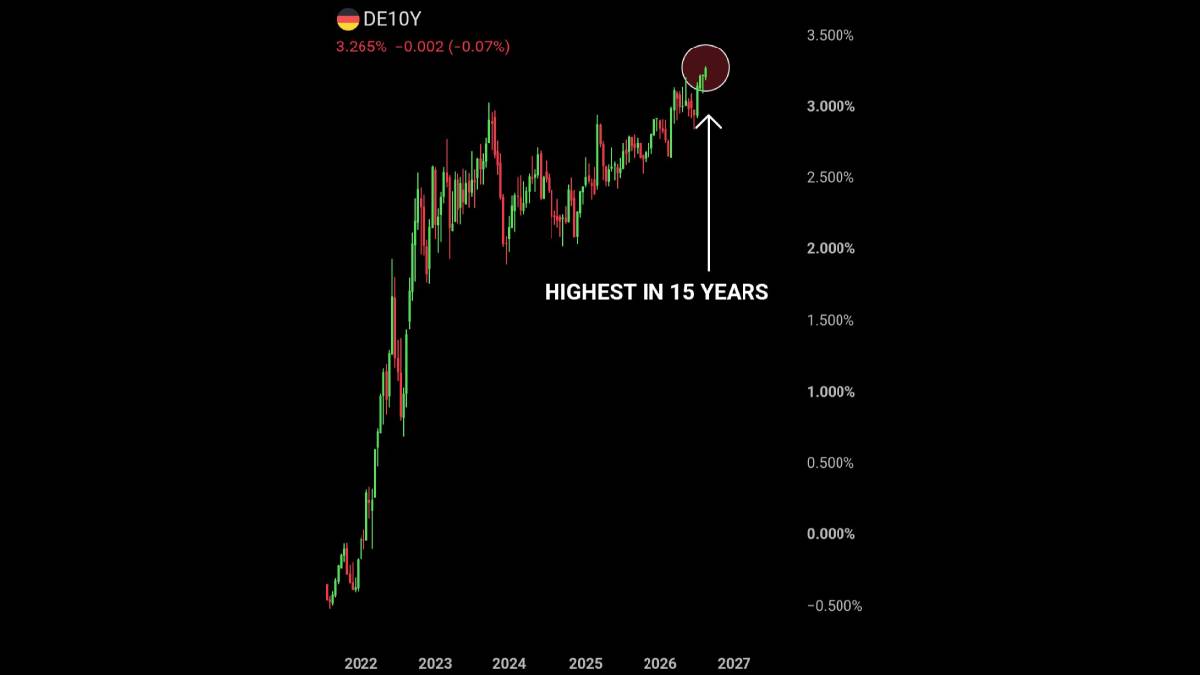
Market data showed Germany’s 10-year Bund yield rising to about 3.26% on August 28, 2026. Trading Economics reported the yield at 3.26%, while other market data put it around 3.25-3.28% in the 3.28% range.
The rise in Bund yields is significant because German government bonds are the benchmark of eurozone fixed-income markets. And when yields rise rapidly, it means investors are demanding higher returns to hold longer-term government debt, often because of higher interest rates, higher inflation or higher government borrowing.
One of the biggest influences on European markets is the revived pressure on energy prices from Iran and uncertainty about the Strait of Hormuz. Higher oil prices can directly drive up transportation and fuel costs and indirectly increase the cost of producing and distributing goods. That is difficult for central banks to manage inflation when economic growth is weak at present.
Recent market developments have intensified expectations that the ECB could raise interest rates again in September. Minutes from the ECB’s July meeting showed that a September 2026 rate increase was already almost fully priced into markets, with expectations for another hike by February 2027.
The ECB will increase its key interest rate from 2.25% to 2.50% in September, a decision of which will depend on inflationary pressures generated by the conflict and higher energy costs. The ECB's decision will depend on data on August inflation and ECB policy-setting decisions and will be made in the coming months.
The ECB has already moved away from the easier monetary-policy environment that characterized much of the previous cycle. The central bank raised rates in June for the first time in nearly three years and kept them unchanged at its July meeting. But policymakers have suggested that the pause is not the end of monetary tightening.
Bond investors are most interested in the prospect of rate increases. Bond prices and yields generally move in the opposite direction. When investors expect higher policy rates, existing bonds are less attractive than new ones, and they will fall in price and yield.
Germany’s yield move is now being closely watched across European financial markets. Higher German yields can affect the borrowing costs of governments, businesses and households in the eurozone. Countries with weaker fiscal positions can feel it even more because their borrowing costs are usually higher than Germany’s benchmark rates.
The rise in yields also reflects wider concern about persistent inflation. Recent market analysis has also flagged rising energy costs, fiscal pressure and geopolitical uncertainty as the reasons for European bond yields under pressure. Reuters reported that traders are preparing for a more hawkish ECB, and markets are likely to keep tightening monetary policy as long as inflation remains stubbornly high.
Investors are also stuck in a very difficult position. An aggressive monetary tightening could help to control inflation but at the same time, it could also hurt economic activity by raising borrowing costs. Businesses might delay investment, households may be forced to pay higher rates for credit and governments might see a larger amount of their budgets go towards debt payments.
The situation is particularly sensitive for Germany, Europe’s largest economy. A rise in long-term yields could further increase finance costs when European governments already have to deal with high levels of defence, energy and infrastructure spending as well as other pressing issues.
For global investors, Germany’s 10-year Bund yield reaching levels last seen in 2011 is more than just a bond market statistic. It reflects a huge change in expectations for European inflation, monetary policy and geopolitical risk.
As the ECB’s September meeting draws closer, markets will be highly sensitive to oil prices and inflation data and the Iran conflict. If energy prices remain elevated, pressure to keep the central bank as hawkish as possible will grow.
As the German yields rose today, investors are preparing for a potentially higher-for-longer interest rate environment in Europe. In the coming weeks we will see if the rise in bond yields is just the result of geopolitical and energy market shocks and the beginning of a more sustained repricing of European monetary policy.






Comments
Please to leave a comment on this article.