Shein’s long-awaited Hong Kong IPO has taken a weird financial turn: the fast-fashion giant is paying up to $3.5 billion to investors and only $1.77 billion in the IPO. The details are disclosed in Shein’s Hong Kong listing prospectus and show the dramatic drop in the firm’s valuation since the peak of the private market.
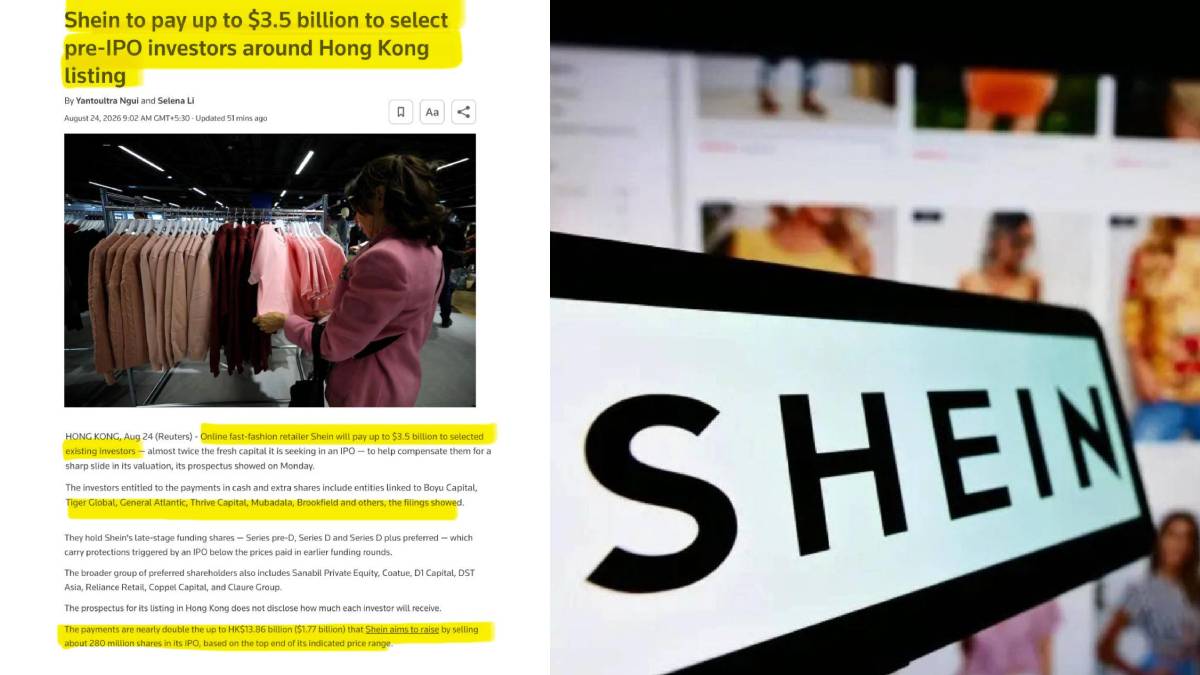
Shein will sell about 280 million shares in Hong Kong with an indicative price range of HK$47.60 to HK$49.50 per share. At the high end of that range, the IPO could raise about HK$13.86 billion (about $1.77 billion) for the company and give it a value of close to $27 billion.
That is a radical change from Shein’s previous private fundraising rounds. In 2022, Shein was valued at about $98.2 billion so its proposed IPO valuation is roughly 70 percent smaller than that peak. Shein was valued at $64 billion in 2023 and again in April 2024 so the highest valuation for investors who bought shares at those levels is now much larger.
The potential $3.5 billion payout is the result of certain protections that were made to certain investors prior to the funding rounds. Investors holding shares of the Series pre-D, Series D and Series D Plus rounds have a contractual downside protection if Shein goes public below certain levels of valuation.
Because the Hong Kong IPO is being conducted at a much lower valuation, these provisions have been triggered.
According to the prospectus, Shein could pay $2.2 billion in cash and issue around 19.6 million shares to non-accredited investors at no charge. More than $1.33 billion in structured payments will be made in installments. It is not clear how much individual investors will get.
The investors who benefit from these agreements include companies associated with major investment firms like Boyu Capital, Tiger Global, General Atlantic, Thrive Capital, Mubadala, and Brookfield, among others. Other preferred shareholders are Sanabil Private Equity, Coatue, D1 Capital, DST Asia and Reliance Retail.
The contrast is clear. Shein is going to public investors for $1.77 billion in new capital, and the price it pays to selected existing investors could be far more than twice that.
But we shouldn’t just take the payments as Shein losing $3.5 billion on the day of its IPO. Some of the obligations are structured payments and other shares, and the total financial impact is spread across different mechanisms and possibly different periods.
The bigger story is the valuation reset.
Shein was one of the world’s most profitable private companies as online shopping and ultra-low-cost fashion flourished. Its data-driven supply chain and fast adoption of new products put it in a global customer base. But that growth has slowed with competition and higher costs (trade restrictions and regulatory scrutiny).
The company is also facing challenges in a number of key markets in the United States and Europe - and in the United States, where low-value import rules are costing businesses that had enjoyed duty-free treatment of small shipments. Shein is also competing with other e-commerce and fast-fashion companies.
The lower IPO valuation reflects a different market environment from 2022, when investors were willing to assign extremely high valuations to rapidly growing technology and consumer companies.
Shein's Hong Kong listing will start trading on September 1, 2026, and the final IPO price should be announced on August 31.
Shein is going to be on the radar of many investors now that it is a very big transition from a privately valued growth company to a public company.
The IPO will ultimately test whether public-market investors believe that the company’s lower valuation already represents its problems—or if more pressure will come once trading starts.
For early investors, the downside protections offered are testament to fundamental contractual protections in private-market investments. The provisions might soften the impact of Shein’s valuation decline for eligible shareholders, but it also adds to the company’s financial burden as it returns to the public markets.
The numbers also make the upcoming listing all the more significant: a company that was once valued at $98.2 billion is now seeking a public valuation of around $27 billion, and could pay up to $3.5 billion to select investors under previously agreed protection clauses as it raises around $1.77 billion via the IPO.



Comments
Please to leave a comment on this article.